
Testing

Vulnerabilities in IP-KVMs from 4 Vendors; Risk for Unauthenticated Root Access

Severe vulnerabilities found in IP KVM may allow unauthenticated hackers to gain root access or run malicious code on them. These vulnerabilities have CVSS scores ranging from 3.1 to 9.8.

There are great risks associated as a low-cost device have the ability to provide insiders and hackers unusually broad powers in networks that are often not so secured or vulnerable. Recently researchers from security firm Eclypsium disclosed a total of nine vulnerabilities in IP KVMs from four manufacturers.

IP-KVMs

When a device sell for $30 to $100, are known as IP KVMs. Administrators often use them to remotely access machines on networks. The devices, not much bigger than a deck of cards, allow the machines to be accessed at the BIOS/UEFI level, the firmware that runs before the loading of the operating system.

Risk Associated with IP KVM

If hackers get hands of they might misuse capabilities even in a secured network. Risks are posed when the devices are exposed to the web or internet—are deployed with weak security configurations or surreptitiously connected to by insiders. Firmware vulnerabilities also leave them open to remote takeover.

Its easy for attackers to manipulate device behavior by overwriting configuration files or system binaries, by an attacker can manipulate the device’s behavior. subsequently gain unauthorized access and use the KVM as a pivot point to compromise any target machine connected to it.

“These are not exotic zero-days requiring months of reverse engineering,” Eclypsium researchers Paul Asadoorian and Reynaldo Vasquez Garcia wrote. “These are fundamental security controls that any networked device should implement. Input validation. Authentication. Cryptographic verification. Rate limiting. We are looking at the same class of failures that plagued early IoT devices a decade ago, but now on a device class that provides the equivalent of physical access to everything it connects to.

Analysis:

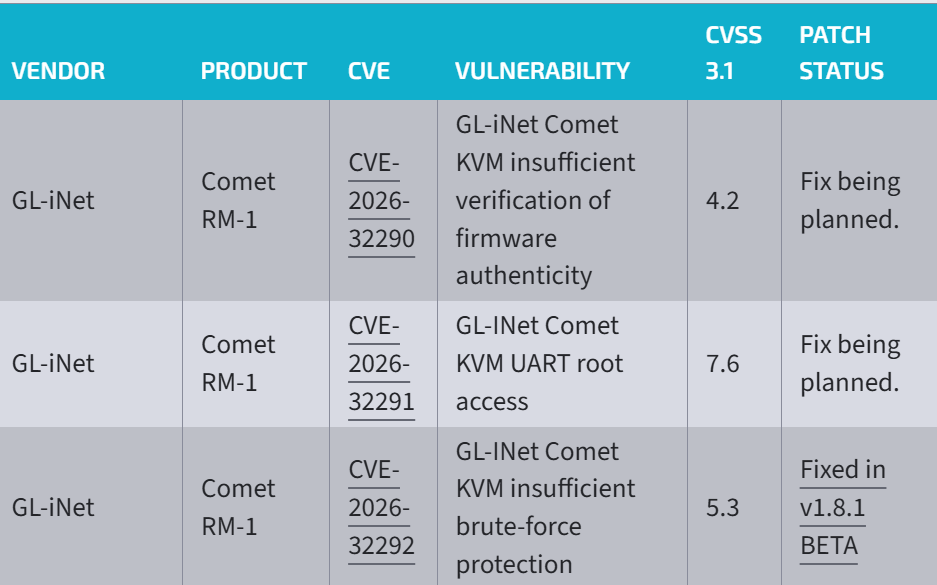
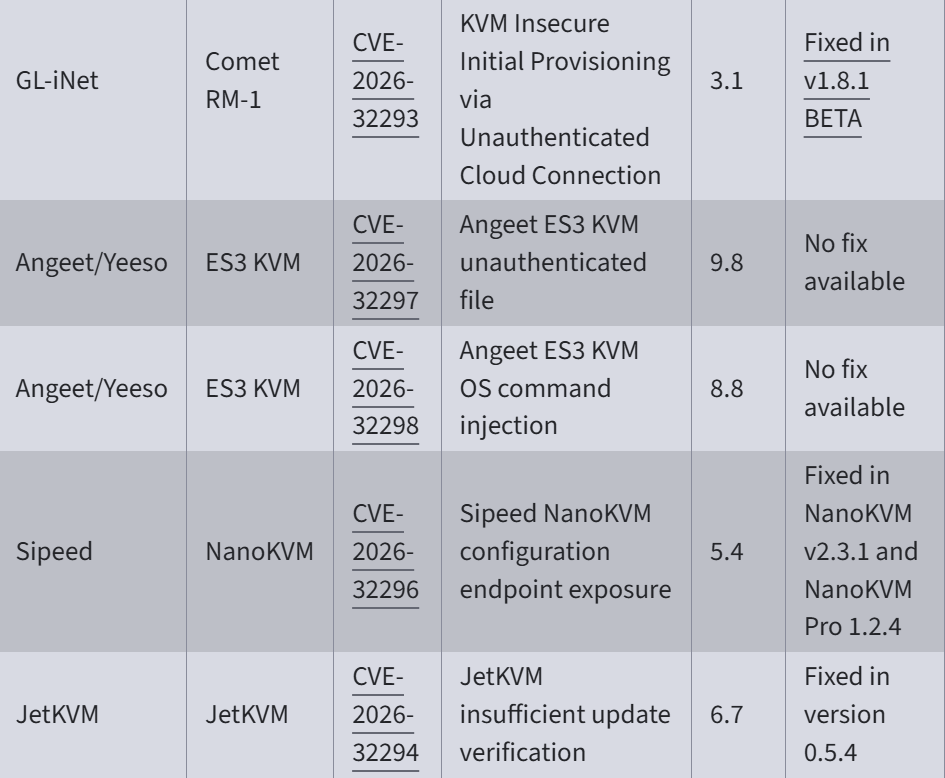
The vulnerabilities are catalogued as CVE-2026-32290, CVE-2026-32291, CVE-2026-32292, CVE-2026-32293, CVE-2026-32294, CVE-2026-32295, CVE-2026-32296, CVE-2026-32297 and CVE-2026-32298, with CVSS scores ranging from 3.1 to 9.8 and some fixes already in place (for example, JetKVM updates and NanoKVM versions) while others remain unpatched.

The analysis notes that an attacker could inject keystrokes, boot from removable media to bypass protections, circumvent lock screens, or remain undetected by OS-level security software, given the devices’ remote BIOS/UEFI access.

Threat Mitigation

Mitigations include enforcing MFA where supported, isolating KVM devices on a dedicated management VLAN, restricting internet access, monitoring traffic, and keeping firmware up-to-date, according to Eclypsium.

This vulnerability alone dictates the term immediate network isolation of any deployed Angeet ES3 device.

Requirement of Robust firmware validation and strong access controls

For robust Firmware validation, testing is must but here testing do not imply checking if the coding is working or not. Instead it is a systematic process of assessing whether firmware meets the defined specifications and quality standards.

We have BI and Data Analytics to redefined outcomes of testing and are measured, with key performance indicators (KPIs) drawn from vast amounts of operation data stored in testing logs and real-time deployment environments.

(Sources: Your KVM is the Weak Link: How $30 Devices Can Own Your Entire Network – Eclypsium | Supply Chain Security for the Modern Enterprise)

AI Surge in CyberSecurity Redefining Threat & Defense; Reshaping Software Development & Security

Currently enterprise Cyber Security strategy with AI has become a game changer, reshaping is critical for both threat and defense. Embracing Gen AI for a robust defensive system empowers organizations to analyze vast amount of data is key requirement for enterprise security where software development is key to enterprise security , embracing ‘security by design’.

In 2024-2025, we have witnessed how mainstream enterprise deployment of AI has changed the strategic cyber security requirement. Thereby creating a strong defense mechanism around enterprise security, redefining the threat landscape and shaping software development.

AI is changing the way we look at products being a risk multiplier. How organization balancing innovation with protection?

AI can track and break commonly used passwords within minutes. So this is scary as more powers are in the hands of hackers, on the other side AI can improve password security again a boon. The Dark Web is already selling Fraud GPT and Worm GPT.

For Organizational cyber security strategy AI is being used now to tackle threats and cyber defense. Again AI has the capability to accelerate the speed of cyber attacks.

So what are leaders deciding when chasing AI based products. The way leaders are looking at products is products that give practical and actionable outlook and being embedded in delivery workflows.

Strategically, this means evolving away from rigid, checkbox-based compliance toward dynamic, adaptive security models that reflect how modern teams really build software—especially in AI-accelerated environments.

As per statistics 2025 witnessed the following AI based cyber attacks.16% of all breaches in 2025 involved attackers using AI. (IBM),and other AI attacks included 37% used phishing attacks and 35% used deepfake attacks. (IBM). 63% of breached organizations had no AI governance policy or were still developing one, highlighting the governance gap around AI adoption (IBM).

OpenText has released their survey and the report entails, AI is rapidly changing the threat landscape for organizations . Organizations are navigating a high-stake balancing act to enable innovation while managing risk.

Here are the key findings

Top AI-related concerns among respondents include data leakage (29%), AI-enabled attacks (27%), and deepfakes (16%).

95% of respondents are confident in their ability to recover from a ransomware attack, but only 15% of those attacked fully recovered their data.

88% allow employees to use GenAI tools, yet less than half (48%) have a formal AI use policy.

Enterprises lead AI governance (52%) compared to SMBs (43%) by having a formal AI policy in place.

52% report increased phishing or ransomware due to AI; 44% have seen deepfake-style impersonation attempts.

Surge in AI Threats via sophisticated attacks

One of the reasons cited by threat researchers is organizations are embracing GenAI, allowing employees to use generative AI tools and few less then 50% have a formal AI-use or data privacy policy in place, the report noted.

This is added with hackers innovative way in tricking using AI, bypassing any defense mechanism which is traditional. 

AI tools are now being used to create such convincing phishing emails, fake websites and even deepfake videos to injecting malicious code giving leverage to cyber criminals

In the last few months we witnessed how Ransomware attacks round the world surged and quite complex in nature as third-party service providers or software supply chains were prime targets. The Qantas airline breach and M&S data beach that hit UK’s top retail brand.

While Qantas did not to Information Age whether AI voice deepfakes were used in the breach, the cybercrime group experts believe may be linked to the hack — dubbed ‘Scattered Spider’ — has a track record of using voice-based phishing (or ‘vishing’) in its attacks. This is clear AI being used and surge is quite high in AI based cyber attacks.

AI for Cyber Defense for Organizational Cyber Security Strategy

It is not hackers who are benefiting but for Organizations it is a game changer as AI being used to detect attack at faster pace meaning mean time.

Findings of this survey reinforces that protecting against ransomware now depends not just on internal defenses, but also on how effectively organizations’, partners, and technology providers collaborate to close security gaps before they are exploited.

Key pointer for building pragmatic and strategic choices and this approach starts with embracing security by design approach in developmental life cycle.

  • Continuously Embedding security in developer workflows keeping automating, scanning, policy enforcement and anomaly detection in tools used by developers.
  • Cybersecurity AI tools are better at identifying patterns and anomalies in large datasets including vulnerabilities. teams have to highly prioritize and contextualize them in term of developing products.
  • Supposedly there is an attack and the security tools not able to detect. So continuous testing is mandatory.
  • Developers can favor simple solutions that favors pragmatic security patterns and transparency in architecture. In this way trust is developed with clients.

Few important developers keep in focus is to sponsor bug bounties, publish advisories using standards like the Common Security Advisory Framework (CSAF) and provide context on severity and exploitability.

Threat researcher suggest organizations who are building in products accept all vulnerability reports, investigate them, and fix the issues. Any critically important advisory to be used for root cause analysis to improve tools, training and various threat models. Developers are suggested to give feedback for external tools if they help them evolve. Understanding no software can ever be perfect.

Offerings from IntruceptLabs are exactly what you need to develop organizational cyber defense capabilities

Intru360

Intru360 gives security analysts and SOC managers a clear view across the organization, helping them fully understand the extent and context of an attack. It also simplifies workflows by automatically handling alerts, allowing for faster detection of both known and unknown threats.

Identify latest threats without having to purchase, implement, and oversee several solutions or find, hire, and manage a team security analyst. Unify latest threat intelligence and security technologies to prioritize the threats that pose the greatest risk to your company.

Here are some features we offer:

  • Over 400 third-party and cloud integrations.
  • More than 1,100 preconfigured correlation rules.
  • Ready-to-use threat analytics, threat intelligence service feeds, and prioritization based on risk.
  • Prebuilt playbooks and automated response capabilities.

(Sources: https://www.mckinsey.com/about-us/new-at-mckinsey-blog/ai-is-the-greatest-threat-and-defense-in-cybersecurity-today)

Sources: https://investors.opentext.com/press-releases/press-releases-details/2025/OpenText-Cybersecurity-2025-Global-Ransomware-Survey-Rising-Confidence-Meets-a-Growing-AI-Threat/default.aspx)

Scroll to top