
Patch management

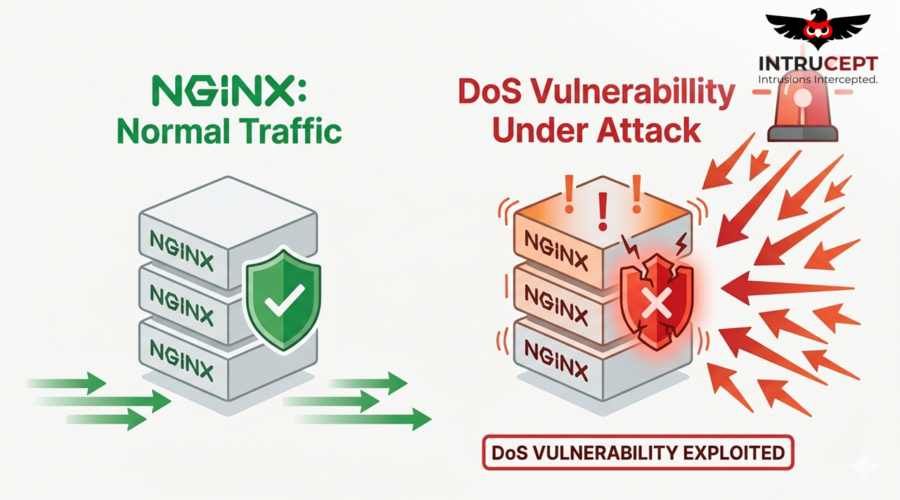
Security Vulnerabilities in NGINX Causing DoS in RCE

NGINX rewrite module, is used to redirect or modify web requests.

The NGINX vulnerability known as CVE-2026-42945, is a programming mistake in the software where it writes or reads more data in memory than it should, causing a heap buffer overflow and is 18 year old, where in certain rewrite rules are configured in a vulnerable way.

This enables attackers to send specially crafted network requests that cause the NGINX server process to crash. Further attackers don’t need any authentication to send malformed requests to servers. The vulnerability was discovered with the help of AI models in recent months, missed by scanners and humans over the years.

The attack can be leveraged & Potential Impact

Nginx is one of the most popular web servers, powering almost one third of all websites on the internet, and is integrated into many commercial products as well. 

  • Crash or restart the NGINX server remotely
  • Cause websites or applications to become unavailable
  • Launch Denial-of-Service (DoS) attacks

In worst case if a Windows/Linux security protection called ASLR (Address Space Layout Randomization) is disabled:

  • Attackers may be able to run malicious code on the server
  • This could potentially lead to full server compromise
  • Attackers require no authentication and can be performed remotely, while 5.7 million internet-facing NGINX servers may be exposed
  • Exploitation is already happening in real-world attacks
  • The vulnerable code has reportedly existed for nearly 18 years
VulnerabilityDetails
CVE IDCVE-2026-42945
SeverityHigh / Critical
Affected ProductNGINX OSS & NGINX Plus
ImpactDoS / Possible Remote Code Execution
Attack RequirementSpecially crafted web requests
Authentication NeededNo

Researchers also found additional medium-severity vulnerabilities affecting:

  • HTTP/3 QUIC module
  • HTTP/2 proxy mode
  • SSL module
  • SCGI and uWSGI modules
  • Charset handling module

These may cause:

  • Memory exhaustion
  • Data leakage
  • Spoofing attacks
  • Service instability

This causes a buffer overflow in the NGINX worker process, meaning the server tries to handle more data than expected in memory. As a result, the NGINX service crashes and restarts, causing a Denial-of-Service (DoS) condition.

Immediate Patching Recommendation

Upgrade to the latest patched NGINX versions immediately.

  • Review and modify vulnerable rewrite rules.
  • Restrict unnecessary internet exposure of NGINX servers.
  • Monitor for unexpected NGINX crashes or restarts.
  • Ensure ASLR and other OS-level security protections remain enabled.

The recently disclosed NGINX vulnerability (CVE-2026-42945) affecting the ngx_http_rewrite_module can allow unauthenticated attackers to remotely crash vulnerable servers and, in certain conditions, potentially execute malicious code.

How GaarudNode Helps Secure Against This Vulnerability

GaarudNode helps organizations proactively identify, prioritize, and remediate such vulnerabilities across the complete application and infrastructure lifecycle through its unified Shift-Left and Shift-Right security capabilities.

Security CapabilityHow It Helps
Continuous OS & Infrastructure Vulnerability ScanningDetects vulnerable NGINX OSS and NGINX Plus versions across servers, containers, and cloud workloads
Missing Patch DetectionIdentifies systems missing critical NGINX security updates and tracks remediation status
Misconfiguration AssessmentDetects insecure rewrite rules and vulnerable NGINX configurations that may trigger the flaw
CSPM (Cloud Security Posture Management)Identifies internet-exposed NGINX instances and insecure cloud deployments
Network Security VisibilityDetects externally exposed web services and risky attack surfaces
Runtime Monitoring (Shift Right)Monitors abnormal NGINX crashes, unexpected restarts, and suspicious traffic patterns linked to exploitation attempts
Risk PrioritizationCorrelates internet exposure, vulnerable configurations, and exploitability to prioritize remediation
Unified Risk DashboardProvides centralized visibility across applications, infrastructure, cloud, OS, and network risks

Sources: NGINX: DoS vulnerability is being attacked | heise online

ZeroDay Vulnerability ‘MiniPlasma’ Grant’s Attackers SYSTEM privileges

A newly disclosed Windows zero-day vulnerability named ‘MiniPlasma’ allows attackers to gain SYSTEM-level privileges on fully patched Windows 11 systems.

  • The vulnerability affects the Windows Cloud Files Mini Filter Driver (cldflt.sys), a core component used by cloud synchronization services such as Microsoft OneDrive.
  • Researchers released a public proof-of-concept (PoC) exploit, increasing the risk of real-world exploitation by threat actors and ransomware groups.
  • The flaw enables a normal user account to escalate privileges without requiring administrator access, making it highly dangerous in enterprise environments.

  • The exploit reportedly abuses:
    • Weak access validation
    • Registry interactions
    • Undocumented Windows APIs
    • Logic flaws in the cloud synchronization subsystem

How enterprise will address the risk

Researchers claim the same underlying weakness still exists and remains exploitable.The vulnerability is still present in fully patched systems running the latest May 2026 updates. The original proof-of-concept code published by Forshaw worked without modification.

The flaw allows attackers with physical access to bypass BitLocker protections and gain unrestricted shell access to encrypted volumes through the Windows Recovery Environment (WinRE).

The attack is triggered by placing specially crafted files inside a specific directory on a USB drive or directly in the EFI partition.

The flaw is disturbing as the vulnerable component exists exclusively within the WinRE image, not in standard Windows installations, and an identical component appears in normal installations but without the triggering functionality.

Microsoft has not publicly addressed the claim and neither dedicated emergency patch or confirmed whether MiniPlasma represents a new vulnerability class .

Sources: Windows MiniPlasma Zero-Day Exposes SYSTEM Access Risk

Critical Vulnerability in cPanel & WHM; Patch Now

Critical vulnerability in cPanel and WHM that allows attackers to bypass authentication and gain root access to servers

Continue Reading

Network Security in Litecoin Compromised by ZeroDay Bug

  • Litcoin network security compromised
  • A zero-day bug caused a DoS attack that disrupted major mining pools.
  • Unpatched Litecoin Nodes Created the Vulnerability, allowed an invalid MWEB transaction allowing them to peg out coins to third party DEX’s

 A sophisticated zero-day bug triggered a chain of events that included a Denial of Service (DoS) attack on Litcoin a major mining pools and a specialized exploit of the MimbleWimble Extension Blocks (MWEB). The zero-day specifically targeted MWEB, Litecoin’s privacy feature which are complex in nature and that creates attack surfaces. The specific vulnerability has been patched in version 0.21.5.4,

How is Litecoin different from Bitcoin?

Litecoin is a 2011 fork of Bitcoin with faster block times (2.5 minutes vs. 10 minutes), a larger supply cap (84 million vs. 21 million), and the Scrypt mining algorithm instead of SHA-256. The biggest functional difference today is MWEB, which gives Litecoin optional transaction privacy that Bitcoin does not offer at the base layer.

Attack Module

The attack had two components. First, the attackers used a DoS scheme to take mining nodes running the updated code offline. Then, unprotected nodes formed an alternative chain that included invalid MWEB transactions.

What caused the zero day vulnerability?

The bug or flaw led to a denial-of-service assault that temporarily interrupted operations at several prominent mining pools. The event, which occurred over the weekend, exposed a narrow window of risk but was contained efficiently through coordinated technical measures.

At the core of the disruption were mining nodes that had not yet applied the most recent security patches. Litcon said now the bug has now been fully patched, and the network continues to operate normally. A new core version was released subsequently, including important security updates.

The zero-day attack succeeded because many Litecoin nodes ran outdated software that improperly validated MWEB transactions. This created a two-tier network in which different participants operated under distinct consensus rules.

Bitcoin and Litecoin have no mandatory update mechanism so mostly Nodes can run old software indefinitely. Attackers seized this opportunity and the exact vulnerability exploited in the attack.

Litecoin developers have fixed the issue and the zeroday incident exposes how dependent decentralized networks are on coordinated node updates and careful operator behavior. The network was recovered, but it did not emerge unscathed.

Team Litcoin confirmed the bug on their official X account and stated a patch has been fully deployed, with node operators urged to update immediately. No user funds were lost, but the reorg reversed transactions across those 13 blocks, a depth that qualifies as a serious network event by any measure.

Conclusion:

As per security experts the incident exposed a vulnerability in the update mechanism in Proof-of-Work (PoW) networks and there is a level of risk in its privacy layers as threat actors took advantage by channeling funds through external platforms.

At the same time causing a Denial of Service attack (DoS) on large mining pools. The incident proved how important it is for nodes and miners to stay up to date and patch timely.

Sources: Litecoin Network Security: Zero-Day Bug Fixed

Litecoin MWEB Exploit Explained | 13-Block Reorg and What It Means | 2026

Microsoft April 2026 Patch Tuesday- Fixes 165 Flaws including 2 Zero-Days

Summary: Microsoft released its April 2026 Patch Tuesday addressing 165 security vulnerabilities across Windows, Office, SharePoint, Microsoft Defender, .NET Framework, Azure, SQL Server and other components.

The April release brings in relevant update and significant accessibility improvements, display and hardware enhancements, and several quality-of-life additions across Settings and File Explorer. 

The first of the two zero-days is CVE-2026-32201, a spoofing vulnerability leading to cross-site scripting (XSS) in Microsoft SharePoint Server.The issue stems from an input validation failure that lets an attacker inject malicious scripts through improperly sanisised input fields.

Elevation of privilege (EoP) vulnerabilities accounted for 57.1% of the vulnerabilities patched this month, followed by information disclosure vulnerabilities and remote code execution (RCE) vulnerabilities at 12.3% each.

OEMMicrosoft
SeverityCritical
Date of Announcement2026-04-14
No. of Vulnerability165
Actively ExploitedYes
Exploited in WildYes
Advisory Version1.0

Overview

This is the second-largest Patch Tuesday release in Microsoft’s history. The update includes two zero-day vulnerabilities one actively exploited in the wild (SharePoint spoofing) and one publicly disclosed (Microsoft Defender privilege escalation linked to the BlueHammer exploit).

Here are the CVE addresses for Microsoft April 2026:

  • 165 Microsoft CVEs
  • 82 Non Microsoft CVEs

Breakdown of April 2026 Vulnerabilities

  • 93 Elevation of Privilege (EoP)
  • 20 Remote Code Execution
  • 21 Information Disclosure
  • 10 Denial of Service (DoS)
  • 9 Spoofing
  • 13 Security Feature Bypass
Vulnerability NameCVE IDProduct AffectedSeverityCVSS Score
Windows Internet Key Exchange (IKE) Service Extensions RCECVE-2026-33824Windows IKE ServiceCritical9.8
Windows TCP/IP Remote Code Execution (Wormable via IPv6)CVE-2026-33827Windows TCP/IP StackCritical9.8
Windows Active DirectoryRemote Code ExecutionCVE-2026-33826Windows Active DirectoryCritical9.1
Remote Desktop Client Remote Code ExecutionCVE-2026-32157Remote Desktop ClientHigh8.8
Microsoft Office Remote Code Execution (Preview Pane)CVE-2026-32190Microsoft OfficeHigh8.4
Microsoft Word Remote Code Execution (Preview Pane)CVE-2026-33114Microsoft WordHigh8.4
Microsoft  Word Remote Code Execution (Preview Pane)CVE-2026-33115Microsoft WordHigh8.4

Technical Summary

This month’s Patch Tuesday is largely driven by Elevation of Privilege vulnerabilities, which make up a significant portion of the fixes and can be leveraged by attackers after initial access to escalate privileges and move laterally.

The release also includes several critical remote code execution issues in core Windows components. Notably, vulnerabilities such as those affecting the Windows IKE service and TCP/IP stack demonstrate the risk of unauthenticated or low-interaction exploitation, particularly in network-exposed scenarios. Other issues in Office, Word, and Remote Desktop highlight continued risk from user-driven attack vectors such as malicious documents and crafted connection files.

The update also addresses zero-day vulnerabilities, including one actively exploited and another publicly disclosed prior to patching, increasing the urgency for remediation.

Key vulnerabilities in this cycle show a mix of attack paths from preview pane-based document exploitation to wormable network flaws and Active Directory-based code execution through authenticated access.

This combination of network-level and user-interaction-based risks, along with the volume of privilege escalation issues, makes this a high-priority update cycle. Organizations should prioritize testing and deployment to reduce exposure across both endpoint and infrastructure layers.

CVE IDSystem AffectedVulnerability DetailsImpact
CVE-2026-33824Windows IKE Service ExtensionsUnauthenticated attacker can send crafted UDP packets to IKEv2-enabled systems (UDP 500/4500), achieving full remote code execution with no prior access requiredRemote Code Execution
CVE-2026-32190Microsoft OfficeExploitation via preview pane allows execution of malicious payload without explicit user interaction beyond viewing fileRemote Code Execution
CVE-2026-33114 / 33115Microsoft WordMalicious document processed via preview triggers RCE; commonly used in phishing delivery chainsRemote Code Execution
CVE-2026-32157Remote Desktop ClientRCE triggered when user connects using a crafted RDP file; attack surface includes lateral movement scenariosRemote Code Execution
CVE-2026-33827Windows TCP/IP StackRace condition in IPv6/IPsec stack enables unauthenticated wormable RCE across enterprise networksRemote Code Execution
CVE-2026-33826Windows Active DirectoryAuthenticated attacker executes code via crafted RPC calls within domain; high likelihood of privilege chainingRemote Code Execution

Key Affected Products and Services

April 2026 updates address vulnerabilities across:

  • Windows Core Components

Kernel, TCP/IP stack, Active Directory, IKE Service, BitLocker, NTFS, SMB, and Remote Desktop components are impacted, including critical RCE and privilege escalation vulnerabilities.

  • Microsoft Office Suite

Word, Excel, and PowerPoint are affected by multiple remote code execution vulnerabilities, including cases exploitable through the preview pane.

  • SharePoint & Collaboration

SharePoint Server (2016, 2019, Subscription Edition) is impacted, including an actively exploited zero-day vulnerability requiring immediate attention.

  • Microsoft Defender

A publicly disclosed elevation of privilege vulnerability is addressed through updates to the Antimalware Platform.

  • .NET Framework & Developer Tools

.NET and related developer components, including Visual Studio, are affected by denial of service and privilege escalation vulnerabilities.

  • Azure & Cloud Services

Azure components such as Logic Apps and monitoring agents include vulnerabilities related to information disclosure and privilege escalation.

  • SQL Server

Multiple vulnerabilities affecting SQL Server components, including privilege escalation and remote code execution risks, are addressed.

Remediation:

  • Apply April 2026 security updates on all Windows systems as a priority

Here are some recommendations

  • Prioritize patching internet-facing and critical services, particularly SharePoint and core Windows components.
  • Ensure Microsoft Defender and other security components are updated to the latest platform versions.
  • Review network exposure and apply temporary mitigations where patching may be delayed.
  • Monitor for suspicious activity, especially related to privilege escalation, remote code execution, and authentication anomalies.
  • Validate that systems are aligned with ongoing platform security updates, including Secure Boot-related changes.

Conclusion:
April 2026 Patch Tuesday addresses a significant number of vulnerabilities across Windows and related Microsoft products, including an actively exploited issue, multiple critical remote code execution flaws, and a high volume of privilege escalation vulnerabilities. Given the breadth of affected components and the potential for attack chaining, organizations should prioritize timely testing and deployment of updates, especially for critical and externally exposed systems.

References:

Vulnerable ABAP Program Patched by SAP in April Security Updates

SAP security patch day saw the release of 19 new security notes on April 14th. There is 1 update to previously released security note. The update addresses several severe flaws, including critical SQL injection, denial of service (DoS) and code injection vulnerabilities.

Vulnerability Details:

[CVE-2026-27681] SQL Injection vulnerability in SAP Business Planning and Consolidation and SAP Business Warehouse is most critical with CVSS score 9.9. This flaw may allow attackers to run arbitrary database queries, potentially compromising sensitive information and system integrity.

SAP also released a security note that addresses a high-severity missing authorization check in ERP and S/4 HANA. Tracked as CVE-2026-34256, is missing authorization check in SAP ERP and SAP S/4 HANA. With a CVSS score of 7.1, this vulnerability could enable unauthorized users to perform restricted actions in both private cloud and on‑premise deployments

Further it could be exploited to execute an ABAP program and rewrite existing eight‑character executable programs.

[CVE-2025-64775] Denial of Service Vulnerability in SAP BusinessObjects Business Intelligence Platform, the criticality is medium

[CVE-2026-34264] Information Disclosure vulnerability in SAP Human Capital Management for SAP S/4HANA, medium criticality

Key inputs:

Of the remaining security notes, 16 (15 new and 1 updated) deal with medium-severity vulnerabilities that could lead to information disclosure.

The vulnerabilities may trigger denial-of-service (DoS), XSS attacks, code injection, redirection to malicious content or code execution in the victim’s browser.

Patching:

The flaws were patched in BusinessObjects, Business Analytics, Content Management, S/4HANA, Supplier Relationship Management, NetWeaver, HANA Cockpit and HANA Database Explorer, Material Master Application and S4CORE.

The two remaining notes address low-severity code injection bugs in NetWeaver and Landscape Transformation.

Refer to

Dec 2025 Security Advisory SAP Security Patch Released, Critical RCE Fixed & DoS Vulnerabilities 

Conclusion: SAP strongly recommends that the customer visits the support portal and applies patches on priority to protect their SAP landscape.

Sources: https://support.sap.com/en/my-support/knowledge-base/security-notes-news/april-2026.html

Sources: https://www.securityweek.com/sap-patches-critical-abap-vulnerability/

Scroll to top