
IoT devices

Vulnerabilities in IP-KVMs from 4 Vendors; Risk for Unauthenticated Root Access

Severe vulnerabilities found in IP KVM may allow unauthenticated hackers to gain root access or run malicious code on them. These vulnerabilities have CVSS scores ranging from 3.1 to 9.8.

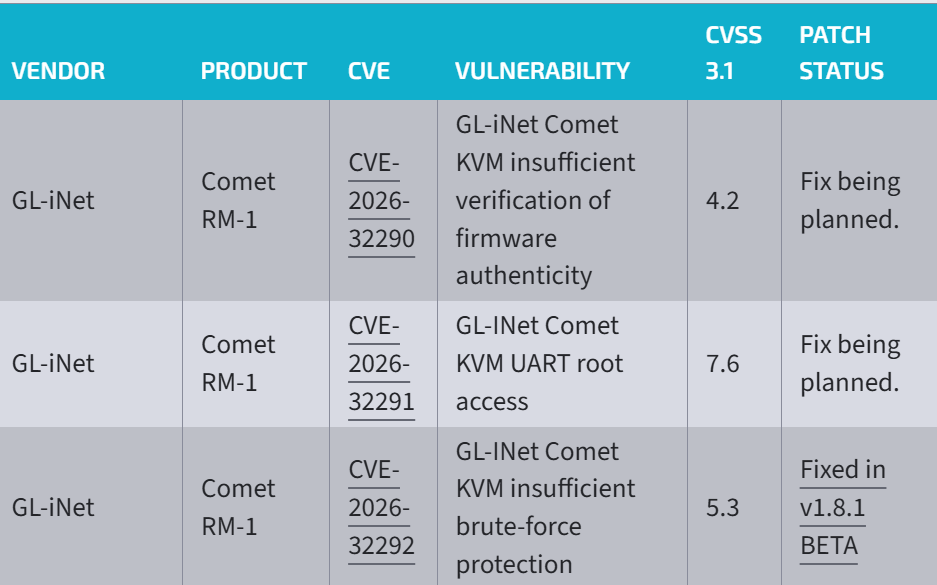
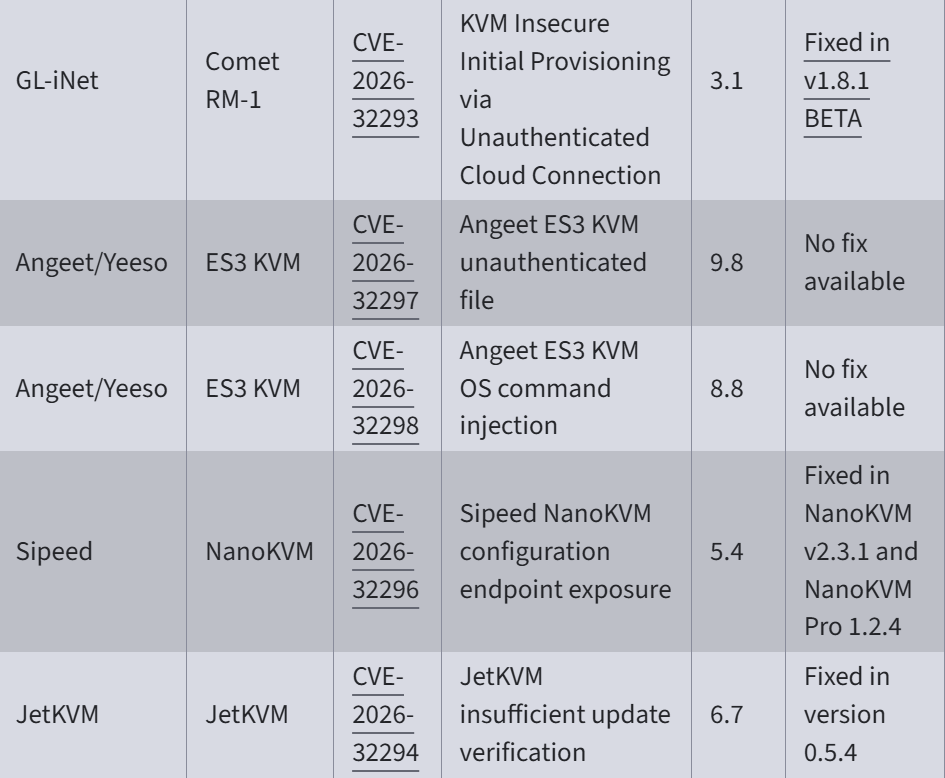
There are great risks associated as a low-cost device have the ability to provide insiders and hackers unusually broad powers in networks that are often not so secured or vulnerable. Recently researchers from security firm Eclypsium disclosed a total of nine vulnerabilities in IP KVMs from four manufacturers.

IP-KVMs

When a device sell for $30 to $100, are known as IP KVMs. Administrators often use them to remotely access machines on networks. The devices, not much bigger than a deck of cards, allow the machines to be accessed at the BIOS/UEFI level, the firmware that runs before the loading of the operating system.

Risk Associated with IP KVM

If hackers get hands of they might misuse capabilities even in a secured network. Risks are posed when the devices are exposed to the web or internet—are deployed with weak security configurations or surreptitiously connected to by insiders. Firmware vulnerabilities also leave them open to remote takeover.

Its easy for attackers to manipulate device behavior by overwriting configuration files or system binaries, by an attacker can manipulate the device’s behavior. subsequently gain unauthorized access and use the KVM as a pivot point to compromise any target machine connected to it.

“These are not exotic zero-days requiring months of reverse engineering,” Eclypsium researchers Paul Asadoorian and Reynaldo Vasquez Garcia wrote. “These are fundamental security controls that any networked device should implement. Input validation. Authentication. Cryptographic verification. Rate limiting. We are looking at the same class of failures that plagued early IoT devices a decade ago, but now on a device class that provides the equivalent of physical access to everything it connects to.

Analysis:

The vulnerabilities are catalogued as CVE-2026-32290, CVE-2026-32291, CVE-2026-32292, CVE-2026-32293, CVE-2026-32294, CVE-2026-32295, CVE-2026-32296, CVE-2026-32297 and CVE-2026-32298, with CVSS scores ranging from 3.1 to 9.8 and some fixes already in place (for example, JetKVM updates and NanoKVM versions) while others remain unpatched.

The analysis notes that an attacker could inject keystrokes, boot from removable media to bypass protections, circumvent lock screens, or remain undetected by OS-level security software, given the devices’ remote BIOS/UEFI access.

Threat Mitigation

Mitigations include enforcing MFA where supported, isolating KVM devices on a dedicated management VLAN, restricting internet access, monitoring traffic, and keeping firmware up-to-date, according to Eclypsium.

This vulnerability alone dictates the term immediate network isolation of any deployed Angeet ES3 device.

Requirement of Robust firmware validation and strong access controls

For robust Firmware validation, testing is must but here testing do not imply checking if the coding is working or not. Instead it is a systematic process of assessing whether firmware meets the defined specifications and quality standards.

We have BI and Data Analytics to redefined outcomes of testing and are measured, with key performance indicators (KPIs) drawn from vast amounts of operation data stored in testing logs and real-time deployment environments.

(Sources: Your KVM is the Weak Link: How $30 Devices Can Own Your Entire Network – Eclypsium | Supply Chain Security for the Modern Enterprise)

NIST Wrapped Up ‘Lightweight Cryptography’ Algorithm to protect small devices, as IoT & Embedded Devices being prime Target of cybercriminals

The National Institute of Standards and Technology (NIST) has finalized four lightweight cryptographic algorithms designed to safeguard data generated and transmitted by the Internet of Things (IoT) and other small-scale technologies.

The four lightweight cryptographic algorithms that NIST has finalized the standard after a multiyear public review process followed by extensive interaction with the design community.

In the wake of  IoT and embedded devices increasingly targeted by cybercriminals, the lightweight cryptography standard ensures strong security without overburdening limited hardware, paving the way for safer adoption in critical sectors like healthcare, transportation, and smart infrastructure.

There are many connected device such as smart home systems, fitness tracker and other IoT applications that lack the processing power and memory to run conventional encryption methods.

NIST’s new lightweight cryptography standard addresses this challenge by offering algorithms that require significantly less computing power and time, while still providing strong protection against cyberattacks.

The new framework, Ascon-Based Lightweight Cryptography Standards for Constrained Devices (NIST SP 800-232), provides tools for authenticated encryption and hashing while minimizing energy, time, and memory usage.

Selected in 2023 after a global review, the Ascon algorithm family forms the core of the standard. Originally developed in 2014 by researchers at Graz University of Technology, Infineon Technologies, and Radboud University, Ascon has already proven its resilience through the CAESAR competition, where it was recognized as a leading lightweight encryption solution.

Key Features of the Standard

The standard is the result of a multiyear public review and extensive collaboration with the cryptographic design community. Its adoption will help ensure that even resource-constrained devices can securely protect sensitive information.

As NIST emphasizes, “it’s the little things that matter most.” With this new standard in place, even the smallest of networked electronics now have robust defenses against cyber threats.

Four related algorithms are now ready for use to protect data created and transmitted by the Internet of Things and other electronics.

Many networked devices do not possess the electronic resources that larger computers do, but they still need protection from cyberattacks. NIST’s lightweight cryptography standard will help. 

The four algorithms in the standard require less computing power and time than more conventional cryptographic methods do, making them useful for securing data from resource-constrained devices such as those making up the Internet of Things. 

In the standard are four variants from the Ascon family that give designers different options for different use cases. The variants focus on two of the main tasks of lightweight cryptography: authenticated encryption with associated data (AEAD) and hashing. 

ASCON-128 AEAD – Enables secure data encryption and integrity checks while resisting side-channel attacks.

ASCON-Hash 256 – Provides lightweight integrity verification for firmware updates, passwords, and digital signatures.

ASCON-XOF 128 / ASCON-CXOF 128 – Flexible hash functions with customizable lengths for efficiency and collision resistance.

The CXOF variant also adds the ability to attach a customized “label” a few characters long to the hash. If many small devices perform the same encryption operation, there is a small but significant chance that two of them could output the same hash, which would offer attackers a clue about how to defeat the encryption. Adding customized labels would allow users to sidestep this potential problem.

McKay said the NIST team intends the standard not only to be of immediate use, but also to be expandable to meet future needs.

NIST researchers emphasize the standard’s immediate applicability across industries, from smart appliances to healthcare. Future updates may expand functionalities, including a dedicated message authentication code.

In India, regulatory bodies have issued frameworks such as TEC’s Code of Practice for Securing Consumer IoT Devices and the IoT System Certification Scheme to enforce baseline security.

These measures focus on secure boot, encrypted communications, and safe software updates for connected devices.

Sources: ‘Lightweight cryptography’ standard to protect small devices finalized

Scroll to top