Coding

Vulnerabilities in IP-KVMs from 4 Vendors; Risk for Unauthenticated Root Access

Severe vulnerabilities found in IP KVM may allow unauthenticated hackers to gain root access or run malicious code on them. These vulnerabilities have CVSS scores ranging from 3.1 to 9.8.

There are great risks associated as a low-cost device have the ability to provide insiders and hackers unusually broad powers in networks that are often not so secured or vulnerable. Recently researchers from security firm Eclypsium disclosed a total of nine vulnerabilities in IP KVMs from four manufacturers.

IP-KVMs

When a device sell for $30 to $100, are known as IP KVMs. Administrators often use them to remotely access machines on networks. The devices, not much bigger than a deck of cards, allow the machines to be accessed at the BIOS/UEFI level, the firmware that runs before the loading of the operating system.

Risk Associated with IP KVM

If hackers get hands of they might misuse capabilities even in a secured network. Risks are posed when the devices are exposed to the web or internet—are deployed with weak security configurations or surreptitiously connected to by insiders. Firmware vulnerabilities also leave them open to remote takeover.

Its easy for attackers to manipulate device behavior by overwriting configuration files or system binaries, by an attacker can manipulate the device’s behavior. subsequently gain unauthorized access and use the KVM as a pivot point to compromise any target machine connected to it.

“These are not exotic zero-days requiring months of reverse engineering,” Eclypsium researchers Paul Asadoorian and Reynaldo Vasquez Garcia wrote. “These are fundamental security controls that any networked device should implement. Input validation. Authentication. Cryptographic verification. Rate limiting. We are looking at the same class of failures that plagued early IoT devices a decade ago, but now on a device class that provides the equivalent of physical access to everything it connects to.

Analysis:

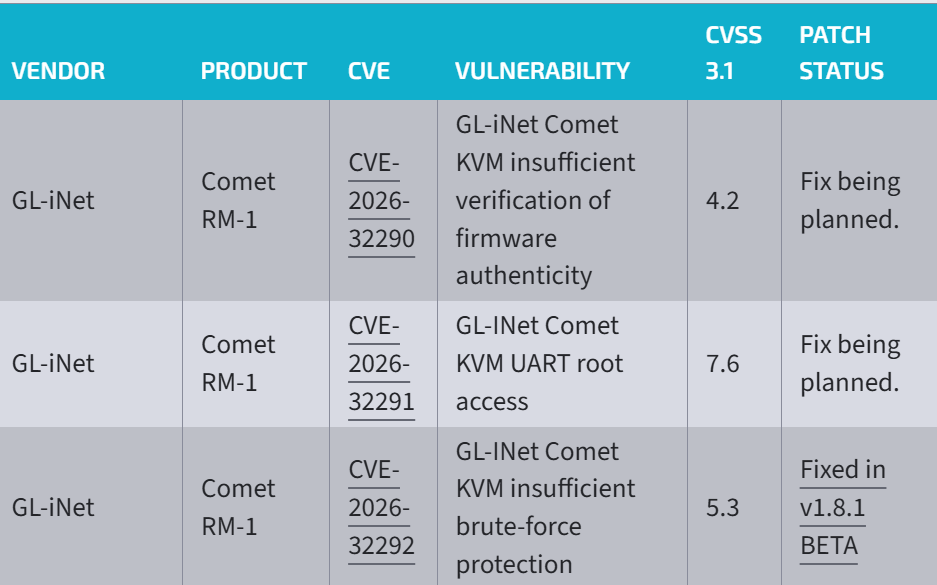
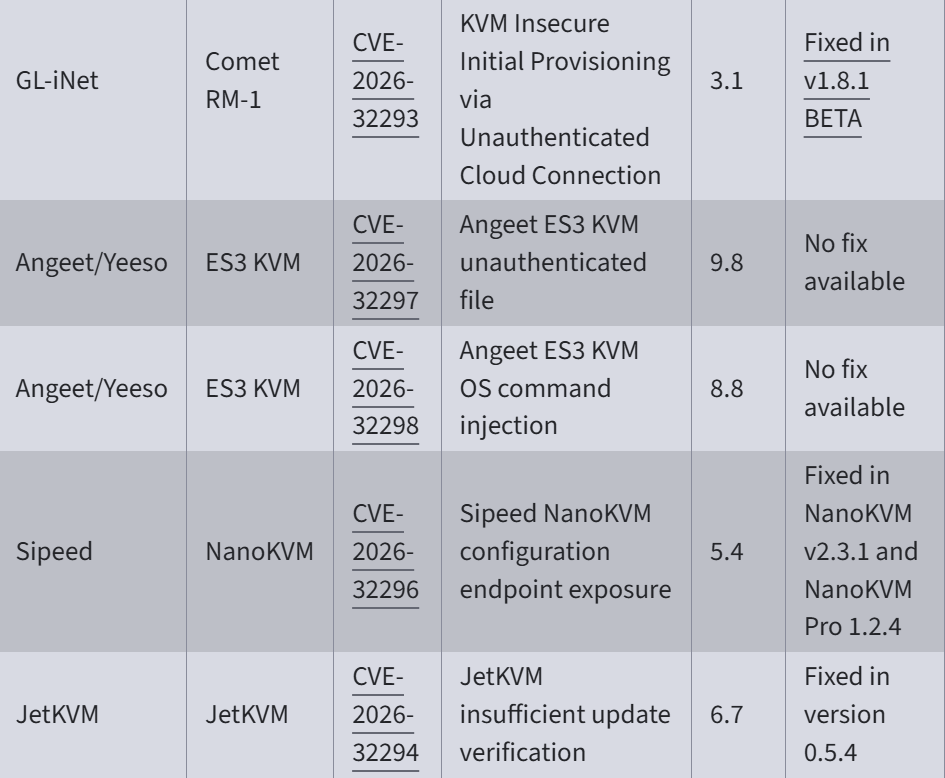
The vulnerabilities are catalogued as CVE-2026-32290, CVE-2026-32291, CVE-2026-32292, CVE-2026-32293, CVE-2026-32294, CVE-2026-32295, CVE-2026-32296, CVE-2026-32297 and CVE-2026-32298, with CVSS scores ranging from 3.1 to 9.8 and some fixes already in place (for example, JetKVM updates and NanoKVM versions) while others remain unpatched.

The analysis notes that an attacker could inject keystrokes, boot from removable media to bypass protections, circumvent lock screens, or remain undetected by OS-level security software, given the devices’ remote BIOS/UEFI access.

Threat Mitigation

Mitigations include enforcing MFA where supported, isolating KVM devices on a dedicated management VLAN, restricting internet access, monitoring traffic, and keeping firmware up-to-date, according to Eclypsium.

This vulnerability alone dictates the term immediate network isolation of any deployed Angeet ES3 device.

Requirement of Robust firmware validation and strong access controls

For robust Firmware validation, testing is must but here testing do not imply checking if the coding is working or not. Instead it is a systematic process of assessing whether firmware meets the defined specifications and quality standards.

We have BI and Data Analytics to redefined outcomes of testing and are measured, with key performance indicators (KPIs) drawn from vast amounts of operation data stored in testing logs and real-time deployment environments.

(Sources: Your KVM is the Weak Link: How $30 Devices Can Own Your Entire Network – Eclypsium | Supply Chain Security for the Modern Enterprise)

Automotive Security under fire as Firmware Flipper Zero of Dark Web break Rolling Code security of Latest Vehicles

Security researchers discovered Firmware for device related to Flipper Zero and showcased by YouTube channel Talking Sasquatch.

A cyber threat that can bring in significant escalation in automotive cybersecurity that demands a single intercepted signal to compromise a vehicle’s entire key automotive functionality. Rolling code security systems basically protects millions of modern vehicles.

Automative vehicles may use encryption to avoid eavesdropping (i.e., capture and decoding of signals) or tampering attacks (i.e., “flipping” lock signals to unlocks). However, replaying signals, even if they are encrypted, is straightforward.

Rolling code security

That is where rolling code come in action and have been introduced wherein a particular code2 (e.g., an “unlock” code) is considered disposable, i.e., it is only used once. In a nutshell, every button click on the key fob triggers a counter in the key fob and in the vehicle upon reception to roll, making it valid for subsequent use in the future. (https://dl.acm.org/doi/full/10.1145/3627827)

Single capture attack method: For this new attack to work, all that is needed is a single button-press capture from the keyfob, without any jamming. Just from that single capture, it is able to emulate all the keyfob’s functions, including lock, unlock, and unlock trunk. A consequence of this is that the original keyfob gets out of sync, and will no longer function.

According to the Talking Sasquatch, the attack works by simply reverse engineering the rolling code sequence, either through sequence leaks or prior brute forcing of the sequence from a large list of known codes.

Challenges in Automotive landscape

The automotive landscape has transformed into a convergence of software and mechanics, introducing exciting possibilities for vehicle performance and convenience. New concerns on vulnerabilities raises eyes about how malicious actors can exploit codes.

Regardless of the method, videos demonstrating the attack show that only a single capture is needed to emulate a keyfob completely.

Affected vehicles include Chrysler, Dodge, Fiat, Ford, Hyundai, Jeep, Kia, Mitsubishi and Subaru. As of yet, there appears to be no easy fix for this, other than mass vehicle recalls.

Secure coding

It is advised that regular code reviews is published that uses latest static analysis tools help detect vulnerabilities early in the development process.

Keep a secured update mechanisms enable swift responses to emerging threats that can address security vulnerabilites

Let’s understand the importance of of security and feel responsible for it and that requires best practices, cyber security culture and implementing early testing.

What can manufactures do to avoid cyber security lapses

For manufactures its advisable DevSecOps and automotive fuzzing tools that offer great solutions to prevent crashes further they improve efficiency and accuracy of their testing efforts and minimize costs.

GaarudNode from Intruceptlabs

GaarudNode is an all-in-one  solution designed to empower development teams with the tools they need to secure their applications throughout the development lifecycle. By combining the power of SAST, DAST, SCA, API security, and CSPM, GaarudNode provides a comprehensive security framework that ensures your applications are built, tested, and deployed with confidence.

Sources: https://www.rtl-sdr.com/flipperzero-darkweb-firmware-bypasses-rolling-code-security/)

Scroll to top