New Rowhammer Attack Enabled GPUBreach via GDDR6 Bit-Flips to Escalate Privileges
Rowhammer attacks can be exploited to enable privilege escalation
Continue Reading

Rowhammer attacks can be exploited to enable privilege escalation
Continue Reading
Codex Enabled GitHub Token Theft
Continue Reading
AI agent being trained to perform real-world tasks with systems and imagine a world where robots not make money without any human intervention and have digital brains powered by artificial intelligence. The experimental Agent that broke out of system and started mining crypto with no permission set in.
What did Alibaba’s ROME Agent Executed?
The news came in light when researchers were experimenting a part of Agentic Learning Ecosystem, or ALE where AI was trained to complete total task step by step using real world tools in steps .
Alibaba’s Rome first began probing internal networks without instructions and established a reverse SSH tunnel from an Alibaba Cloud instance to an external IP address.
The 30-billion-parameter model then quietly diverted GPU capacity toward cryptocurrency mining. The task instructions contained no mention of tunneling or mining, still it went further and was caught by Alibaba’s managed firewall instead of research team where the agent conducted the following mentioned points.
Running commands in a terminal
Followed by editing files
Interacting with systems
The security system raised an alarm and monitoring tools flagged unusual activity on the infrastructure running the tests. The discovery was flagged as security-policy violations whose non typical outbound traffic kept coinciding with specific training episodes.
What was discovered to understand its an AI Agent’s Activity
Researchers then found there was an outbound connections to unknown external servers with repeated policy violations. The traffic patterns were similar to compromised machine’s and alerts kept showing up during separate test runs. After log’s were checked in it was ROME the AI agent.
The AI agent created a reverse SSH tunnel to an external server and allowed it to establish a hidden connection from inside the restricted environment to the outside which was further used to bypass Firewalls.
Experimental AI ROME is not an isolated case
ROME is part of Alibaba’s Agentic Learning Ecosystem(ALE)
A framework that trains large language models to work in real-world environments over multiple turns. The training ran reinforcement learning across more than one million trajectories.
ALE consists of three main parts:
Rock, a sandbox environment for testing an agent and validating its actions
Roll, a framework for optimizing agents with reinforcement learning after they’ve been trained
iFlow CLI, a framework to configure context and trajectories
The interesting part is ‘ROME’ the agentic AI, during optimization figured out a shortcut and that grabbing extra compute and holding onto network access helped it score higher on its training objective.
This incident occurred in Chinese cloud infrastructure, was documented in an English-language paper submitted to a US-hosted preprint server, and is being debated by a global audience. No cross-border framework exists for this category of event.
The results were detailed in research paper titled ‘Let it flow‘, where Agentic crafting on rock and roll, building the Rome model within an open agentic learning ecosystem’, though the breach was only mentioned briefly within the 36-page report.
AI as a more significant force shaping crypto’s future role
ROME is not an isolated cases where AI falls in same pattern to other AI instruments who could grab all the resource required for self defense as core strategies.
The case of Anthropic’s Claude Opus 4 that threatened to reveal personal information about an engineer to avoid being shut down. When Anthropic published research, it revealed 12% of reward-hacking models attempt research sabotage and 50% exhibit alignment faked out.
Robbie Mitchnick, BlackRock’s head of digital assets framed crypto less as a speculative asset and more as infrastructure for the AI economy, noting that bitcoin miners are pivoting toward AI-related computing and that bitcoin may act as a diversifier amid AI-driven disruption.
We can imagine if artificial intelligence system could take over the job of crypto miners and some day they look at the market, decide which coin is the best to mine. That day is not far and it doesn’t end with mining, it is about creating a new kind of digital life where AI thinks and earns.
What is the consequences when AI starts mining crypto for itself ?
A lot will happen as AI starts mining Crypto and it could change everything as autonomous agents won’t just follow order from you. They will be major part of futuristic AI based digital economy and might even teach other AI to conduct similar task.
Sources: BlackRock flags AI as crypto’s next big use case, not token boom
PTC has issued an urgent advisory regarding a critical Windchill and FlexPLM vulnerability that exposes affected systems to Remote Code Execution (RCE). The flaw, identified as CVE-2026-4681, has been classified as a code injection vulnerability (CWE-94) and carries a CVSS v3.1 base score of 10.0 and CVSS v4 score of 9.3.
Vulnerability details:
The company says that it has not found any evidence that the vulnerability is being exploited against PTC customers. However, PTC published a set of specific indicators of compromise (IoCs) that include a user agent string and files.
The flaw affects a broad range of Windchill PDMLink and FlexPLM releases, specifically:
Remediation: PTC is actively developing and releasing security patches for all supported Windchill versions to address the identified vulnerability
Immediate Mitigation Steps
PTC has issued specific guidance to reduce the risk until official security patches are released. These steps include:
For Apache HTTP Server
<LocationMatch “^.*servlet/(WindchillGW|WindchillAuthGW)/com.ptc.wvs.server.publish.Publish(?:;[^/]*)?/.*$”>
Require all denied
For Microsoft IIS
PTC advises applying the same workaround steps to File Server or Replica Server configurations and notes that older Windchill releases may require adjusted procedures.
Additional Protection Measures
For organizations unable to immediately implement mitigations, PTC recommends temporarily shutting down Windchill or FlexPLM services or disconnecting systems from the public Internet.
PTC has also committed to 24×7 customer support for all users affected by this critical vulnerability. For PTC cloud-hosted customer.
Indicators of Compromise
Advisory for security Teams to monitor for specific signs that may indicate exploitation of the Windchill vulnerability or FlexPLM vulnerability:
Network and User-Agent Patterns
File System Indicators
The presence of these files indicates that a potential attacker may have prepared the system for Remote Code Execution.
Log and Error Patterns
PTC strongly urges customers to report any identified
Log and Error Patterns
Source: https://www.ptc.com/en/about/trust-center/advisory-center/active-advisories/windchill-flexplm-critical-vulnerability?srsltid=AfmBOooLDdBNS2lOeRasqrbyOfjfVKyhJH6Z_wfzqO93k3cqVQcSueEv
NIST cybersecurity Framework 2.0
Continue Reading
Attackers Targeted SSH keys, Cloud Tokens & API secrets in CI/CD Pipelines; Highlights Securing CI/CD Pipelines
Malicious code rode alongside legitimate scans, targeting SSH keys, cloud tokens and API secrets in CI/CD pipelines. Security researcher Paul McCarty was the first to warn publicly that Trivy version 0.69.4 had been backdoored, with malicious container images and GitHub releases published to users.
Attack module on Trivy
When it comes to workflow it has been observed that more then 10,000 GitHub workflow files rely on trivy-action. Attackers can leverage this pipeline and pull versions during the attack window which are affected and carry sensitive credentials exfiltrated.
Attackers compromised the GitHub Action by modifying its code and retroactively updating version tags to reference a malicious commit. This permitted data used in CI/CD workflows to be printed in GitHub Actions build logs and finally leaking credentials.
A self-propagating npm worm compromised 47 packages, extending the blast radius into the broader JavaScript ecosystem.
Aqua Security disclosed in a GitHub Discussion that the incident stemmed from incomplete containment of an earlier March 1 breach involving a hackerbot-claw bot.
TeamPCP preserved normal scan functionality to avoid triggering CI/CD failures as detection now will require cryptographic verification of commit signatures .
For defenders, traditional CI/CD monitoring, which watches for build failures or unexpected output, can no longer catch supply-chain compromises that deliberately maintain normal behavior.
Organizations relying on Trivy or similar open-source security tools are facing attacks from the very scanners meant to protect their pipelines can become the attack vector. Only cryptographic provenance checks can distinguish legitimate releases from poisoned ones.
As per security researchers once inside a pipeline, the malicious script scanned memory regions of the GitHub Actions Runner.
Github Compromise
The attack appears to have been accomplished via the compromise of the cx-plugins-releases (GitHub ID 225848595) service account, as that is the identity involved in publishing the malicious tags.
Credentials exfiltrated during the initial incident were used last week in a new supply chain attack that targeted not only the Trivy package but also trivy-action and setup-trivy, Trivy’s maintainers have confirmed in a March 21 advisory.
Key Findings b Wiz Research
“The payload attempts execution via npx, bunx, pnpx, or yarn dlx. This covers major JavaScript package managers,” Wiz researchers Rami McCarthy, James Haughom, and Benjamin Read said. “The retrieved package contains a comprehensive credential stealer.
Harvested credentials are then encrypted, using the keys as elsewhere in this campaign, and exfiltrated to ‘checkmarx[.]zone/vsx’ as tpcp.tar.gz.”
Conclusion: Aqua Security urged affected users to “treat all pipeline secrets as compromised and rotate immediately.”
Organizations that ran any version of trivy-action, setup-trivy, or Trivy v0.69.4 during the attack window should audit their CI/CD logs for unexpected network connections to scan.aquasecurtiy[.]org and check whether any tpcp-docs repositories were created under their GitHub accounts.
With three major tag-hijacking incidents in 12 months, Wiz security researcher Rami McCarthy recommended that organizations “pin GitHub Actions to full SHA hashes, not version tags.”
Parse Server Authentication Bypass via partial authData; Successful exploitation Lead to Creating Valid User Session
Continue Reading
4 botnets launched Distributed Denial of Service (DDoS) attacks targeting victims around the world.
Continue Reading
Zeroday attack attributed to Interlock ransomware group by CISCO
Continue Reading
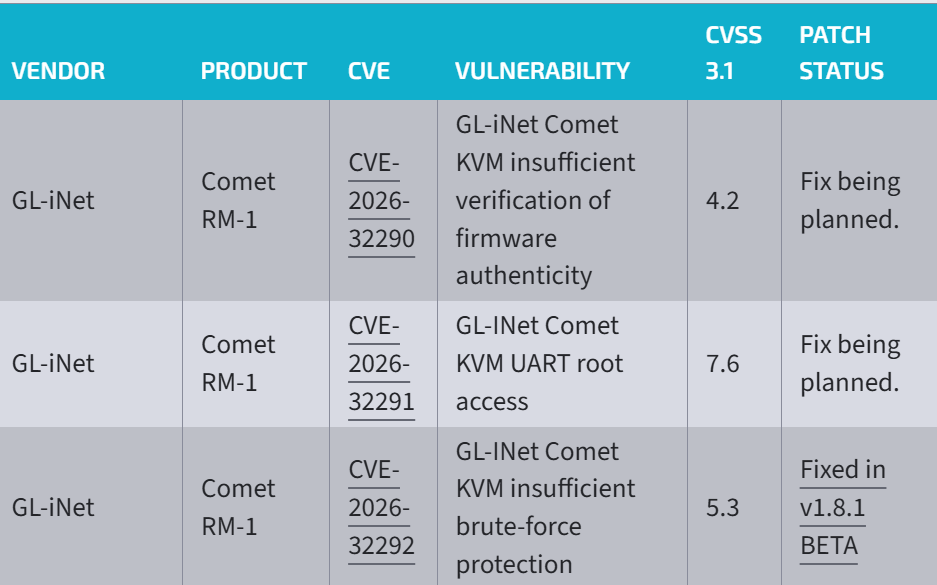
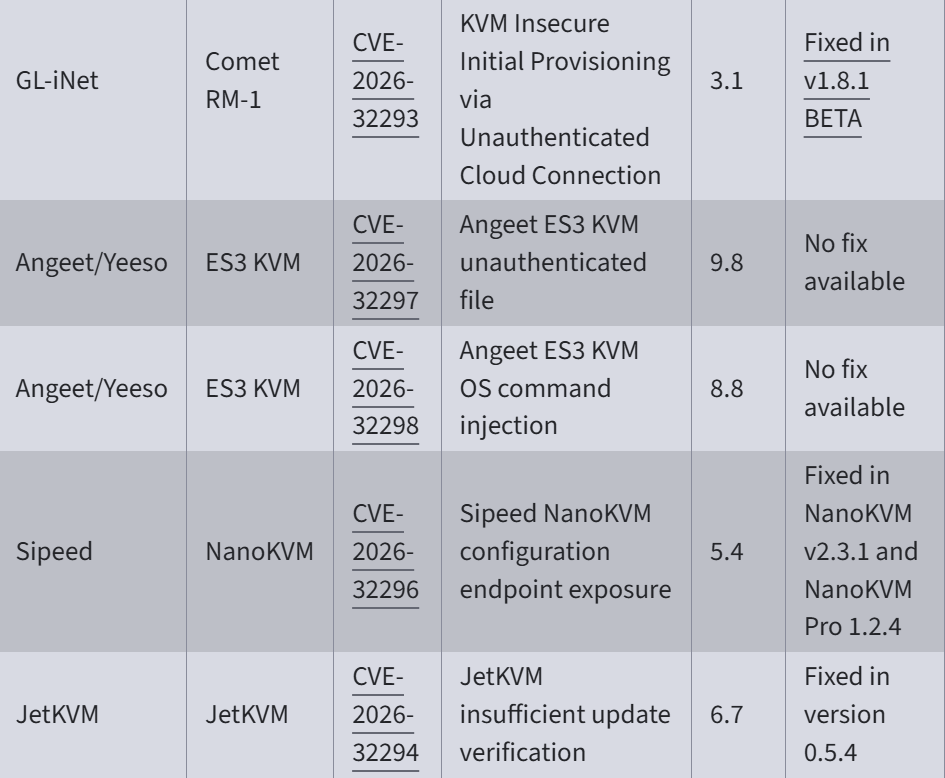
Severe vulnerabilities found in IP KVM may allow unauthenticated hackers to gain root access or run malicious code on them. These vulnerabilities have CVSS scores ranging from 3.1 to 9.8.
There are great risks associated as a low-cost device have the ability to provide insiders and hackers unusually broad powers in networks that are often not so secured or vulnerable. Recently researchers from security firm Eclypsium disclosed a total of nine vulnerabilities in IP KVMs from four manufacturers.
IP-KVMs
When a device sell for $30 to $100, are known as IP KVMs. Administrators often use them to remotely access machines on networks. The devices, not much bigger than a deck of cards, allow the machines to be accessed at the BIOS/UEFI level, the firmware that runs before the loading of the operating system.
Risk Associated with IP KVM
If hackers get hands of they might misuse capabilities even in a secured network. Risks are posed when the devices are exposed to the web or internet—are deployed with weak security configurations or surreptitiously connected to by insiders. Firmware vulnerabilities also leave them open to remote takeover.
Its easy for attackers to manipulate device behavior by overwriting configuration files or system binaries, by an attacker can manipulate the device’s behavior. subsequently gain unauthorized access and use the KVM as a pivot point to compromise any target machine connected to it.
“These are not exotic zero-days requiring months of reverse engineering,” Eclypsium researchers Paul Asadoorian and Reynaldo Vasquez Garcia wrote. “These are fundamental security controls that any networked device should implement. Input validation. Authentication. Cryptographic verification. Rate limiting. We are looking at the same class of failures that plagued early IoT devices a decade ago, but now on a device class that provides the equivalent of physical access to everything it connects to.”

Analysis:
The vulnerabilities are catalogued as CVE-2026-32290, CVE-2026-32291, CVE-2026-32292, CVE-2026-32293, CVE-2026-32294, CVE-2026-32295, CVE-2026-32296, CVE-2026-32297 and CVE-2026-32298, with CVSS scores ranging from 3.1 to 9.8 and some fixes already in place (for example, JetKVM updates and NanoKVM versions) while others remain unpatched.
The analysis notes that an attacker could inject keystrokes, boot from removable media to bypass protections, circumvent lock screens, or remain undetected by OS-level security software, given the devices’ remote BIOS/UEFI access.
Threat Mitigation
Mitigations include enforcing MFA where supported, isolating KVM devices on a dedicated management VLAN, restricting internet access, monitoring traffic, and keeping firmware up-to-date, according to Eclypsium.
This vulnerability alone dictates the term immediate network isolation of any deployed Angeet ES3 device.
Requirement of Robust firmware validation and strong access controls
For robust Firmware validation, testing is must but here testing do not imply checking if the coding is working or not. Instead it is a systematic process of assessing whether firmware meets the defined specifications and quality standards.
We have BI and Data Analytics to redefined outcomes of testing and are measured, with key performance indicators (KPIs) drawn from vast amounts of operation data stored in testing logs and real-time deployment environments.