
Vendor security

Vulnerabilities in IP-KVMs from 4 Vendors; Risk for Unauthenticated Root Access

Severe vulnerabilities found in IP KVM may allow unauthenticated hackers to gain root access or run malicious code on them. These vulnerabilities have CVSS scores ranging from 3.1 to 9.8.

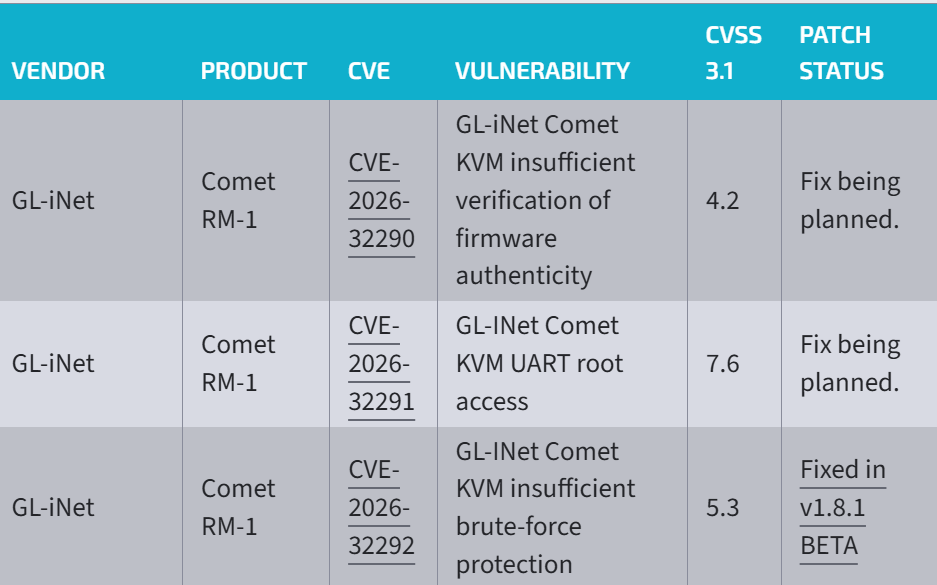
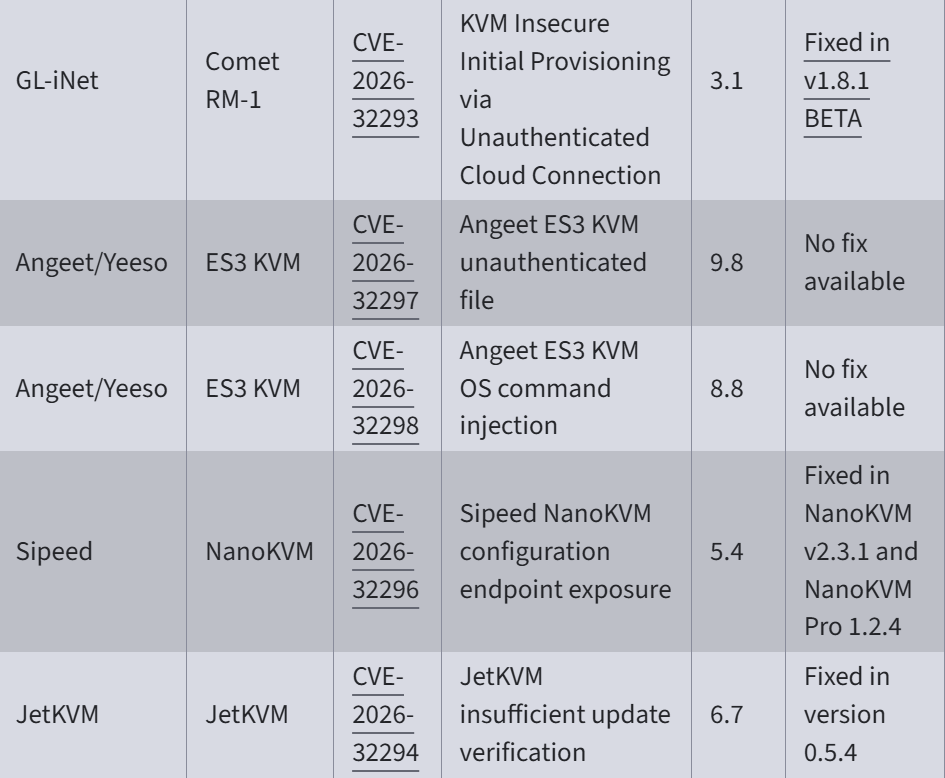
There are great risks associated as a low-cost device have the ability to provide insiders and hackers unusually broad powers in networks that are often not so secured or vulnerable. Recently researchers from security firm Eclypsium disclosed a total of nine vulnerabilities in IP KVMs from four manufacturers.

IP-KVMs

When a device sell for $30 to $100, are known as IP KVMs. Administrators often use them to remotely access machines on networks. The devices, not much bigger than a deck of cards, allow the machines to be accessed at the BIOS/UEFI level, the firmware that runs before the loading of the operating system.

Risk Associated with IP KVM

If hackers get hands of they might misuse capabilities even in a secured network. Risks are posed when the devices are exposed to the web or internet—are deployed with weak security configurations or surreptitiously connected to by insiders. Firmware vulnerabilities also leave them open to remote takeover.

Its easy for attackers to manipulate device behavior by overwriting configuration files or system binaries, by an attacker can manipulate the device’s behavior. subsequently gain unauthorized access and use the KVM as a pivot point to compromise any target machine connected to it.

“These are not exotic zero-days requiring months of reverse engineering,” Eclypsium researchers Paul Asadoorian and Reynaldo Vasquez Garcia wrote. “These are fundamental security controls that any networked device should implement. Input validation. Authentication. Cryptographic verification. Rate limiting. We are looking at the same class of failures that plagued early IoT devices a decade ago, but now on a device class that provides the equivalent of physical access to everything it connects to.

Analysis:

The vulnerabilities are catalogued as CVE-2026-32290, CVE-2026-32291, CVE-2026-32292, CVE-2026-32293, CVE-2026-32294, CVE-2026-32295, CVE-2026-32296, CVE-2026-32297 and CVE-2026-32298, with CVSS scores ranging from 3.1 to 9.8 and some fixes already in place (for example, JetKVM updates and NanoKVM versions) while others remain unpatched.

The analysis notes that an attacker could inject keystrokes, boot from removable media to bypass protections, circumvent lock screens, or remain undetected by OS-level security software, given the devices’ remote BIOS/UEFI access.

Threat Mitigation

Mitigations include enforcing MFA where supported, isolating KVM devices on a dedicated management VLAN, restricting internet access, monitoring traffic, and keeping firmware up-to-date, according to Eclypsium.

This vulnerability alone dictates the term immediate network isolation of any deployed Angeet ES3 device.

Requirement of Robust firmware validation and strong access controls

For robust Firmware validation, testing is must but here testing do not imply checking if the coding is working or not. Instead it is a systematic process of assessing whether firmware meets the defined specifications and quality standards.

We have BI and Data Analytics to redefined outcomes of testing and are measured, with key performance indicators (KPIs) drawn from vast amounts of operation data stored in testing logs and real-time deployment environments.

(Sources: Your KVM is the Weak Link: How $30 Devices Can Own Your Entire Network – Eclypsium | Supply Chain Security for the Modern Enterprise)

Cyber Security Trends 2026; Cloud Environments, Identity systems & Third-Party Tools Key Area’s of Threat

Cyber Security Trends 2026; Cloud Environments, Identity systems & Third-Party Tools Key Area’s of Threat

Continue Reading

Tenable & More Cyber Vendor’s Impacted by Third Party Salesforce Breach

Proofpoint, Tenable, CyberArk are other Third-Party vendors impacted by Salesforce Breach.

In an advisory released Tenable disclosed that it “was among the many organizations impacted” in the Salesloft Drift attacks, during which “an unauthorized user had access to a portion of some of our customers’ information stored in our Salesforce instance.”

Impacted data includes “subject lines and initial descriptions provided by our customers when opening a Tenable support case” as well as standard contact information such as name, business email address, phone number and location reference.

Tenable products and data stored in the vendor’s products, were not affected, the company said. CRN has reached out to Tenable for further comment.

Tenable stated that standard business contact information, such as customer names, email addresses, phone numbers and location details, was also accessed. At this point, the company stated there is no evidence that this information has been misused.

The information accessed by the unauthorized party was limited to data within Tenable’s Salesforce environment. This included:

  • Commonly available business contact information, such as customer names, business email addresses, and phone numbers.
  • Regional and location references associated with customer accounts.
  • Subject lines and initial descriptions that customers provided when opening a support case.

Third party vendor’s prime target of cyber attack increase Enterprise Cyber Risk

Targeting vendors indicate how critical it is to maintain third-party risk and be cautious while managing security risks associated with these external partners, focal point of target and critical for any organization’s data security.

The Tenable and other vendors being targeted increase the responsibility of enterprise based Third-party cyber risk associated as vendors can be targets for cyberattacks.

If their security measures are weak, your company’s data could be compromised. Ensuring vendors have strong cybersecurity protocols is essential to protecting sensitive information.

Enterprise security posture indicate how third-party security is a set of practices that can identify these risks and protect your organization from security threats associated with any third-party entity.

Risks arising from third-party vendors, contractors and business partners who have access to your data and systems is more then critical.

Three more well-known cybersecurity vendors have joined the lengthy list of companies impacted in the recent breach of a third-party Salesforce application, with Proofpoint, Tenable and CyberArk disclosing they were affected in the widespread Salesloft Drift attacks.

CyberArk, a publicly traded identity security vendor that Palo Alto Networks has a deal to acquire for $25 billion.

In similar pattern an unauthorized actor accessed Proofpoint’s Salesforce tenant through the compromised Drift integration and viewed certain information stored in our Salesforce instance,” the company said.

Attack module

The attacks involved stolen authentication tokens for Salesloft-owned workflow automation app Drift, which threat actors have used to steal data from Salesforce CRM systems. It’s unclear how threat actors obtained the tokens.

As per researchers, breach at Tenable was not an isolated attack but is linked to a wider, sophisticated campaign that security experts have been tracking. This campaign specifically exploits a vulnerability in the integration between Salesforce and Salesloft Drift, a popular sales engagement platform.

Scattered Spider Group Target Aviation Sector; Third Party Providers to Vendors at Risk. Solutions to Improve Security Posture

Recently the Scattered Spider Hacker group or cybercriminals are targeting the airline industry at large and keen interest on aviation sector.

The Scattered Spider group relies mostly on social engineering techniques that can impersonate employees or contractors to deceive IT help desks into granting access” and frequently involves methods to bypass multifactor authentication (MFA), as per observation by FBI.

Earlier the group breached at least two major US airlines in June, bypassed security protocols by exploiting remote access tools and manipulating support staff as reported by CNN .

There is a growing cyber risk on aviation sector and how the air traffic control is managed during attack which makes subsequent aviation systems vulnerable to cyberattacks due to outdated technology in many cases.

And cyber criminals are resorting to advanced techniques by which they can halt operations via cyberattacks that have the ability to take over or invade technology systems which in turn disrupt information flow from the aircraft to pilots to the airlines’ operations center resulting in chaos and delay in flight operations.

Every operation and service delivered by airlines is supported by technology and once that is not responding ,subsequent operations are halted i.e. flight management software, air traffic control communications, baggage handling systems and in-flight entertainment platforms will fail inevitability.
Recently the Scattered Spider group was behind a big data breach potentially exposing Social Security numbers, insurance claims and health information of tens of millions of customers.

Repercussions of Data Breaches Impacting Third parties

Cybercriminals often take advantage of fragile cyber security posture linked to smaller third parties that provide services to larger, well-established enterprises or industry. In-fact many vendors dont have cybersecurity protection and proper cybersecurity awareness in place to mitigate against attacks.

Cyber attacks have evolved to become increasingly complex, making vendor risk management critical. With rise in digital transformation, cloud services and AI technology has given cyber criminals greater potential to penetrate unsecured networks and systems more then ever.

Address the Threat Landscape with Best Practices

Data breaches that originate from third-party vendors cause big fines and legal consequences are huge and affect primary organization. Along with these challenges, organizations often rely on third parties for critical services and cyber criminals take advantage of these vulnerability.

Organizations can still take steps to mitigate and defend against these attacks even as they onboard new vendors or service providers.

Let us see the emerging threats across third-party vendors:

  • Supply chain attacks by cybercriminals often target companies that supply services to many different companies (e.g. MSPs, IT) they cause great impact as IoT and other hardware devices manufactured by third parties can be infected malicious firmware .These malware can steal sensitive data. 
  • Ransomware-as-a-Service (RaaS)The dark web often sells kits (RaaS) and now it is combined with generative AI making attractive for cyber criminals to launch attacks. RaaS can disrupt critical services of organizations.
  • Threat from third parties Unintentional human error occur where providers misconfigure not so accurate data or data deletion happens or poor cybersecurity practices of easy passwords circulating among users. There could also be vendors with financial motives who don’t go through the same security process known as insider threat and don’t pass security test laid for regular employees.
  • Software supply chain attacks As we witnessed outsourcing third-party SaaS services and cloud technology makes it easy to target vulnerabilities in software code. This impacting hundreds of well-established organizations using the same software and same chain of malware flows.
  • Cloud vulnerabilities The provider or cloud service is responsible for securing the cloud infrastructure while the customer or vendor is responsible for securing their data and applications. A lack of proper security measures by the customer or third party can result in data breaches, data loss or supply chain attacks. Since cloud service or data center is all outsources so security lapse may happen
  • Advanced Persistent Threats (APTs) is linked to State-sponsored attacks who generally target third parties to penetrate into systems over an extended period of time. For example, they might compromise a third-party network to gain lateral access to the main organization’s IT infrastructure, making it difficult to detect in time.   
  • Deepfake and social engineering attacks. Emerging AI-technology can manipulate employee or C-level executives to trick users into divulging information to execute identity fraud, phishing attacks, sign fraudulent contracts, or gain unauthorized access to restricted systems and networks. 
  • Zero-day exploits exploited by cyber criminals before they are identified by developers and third-party providers and patched. At times if patch is slow process attackers launch attacks during this delay.   

Solutions that will improve Security Posture with Intru360 from Intruceptlabs

The new business environment demands IT support for a wider range of monitoring, security and compliance requirements. This creates significant burdens on network performance and network security as more appliances need access to incoming data.

Intrucept platform (Intru360) cover overall risk, detection, prevention, correlation, investigation, and response across endpoints, users, networks, and SaaS applications, offering end-to-end visibility.

Intru360 gives security analysts and SOC managers a clear view across the organization, helping them fully understand the extent and context of an attack. It also simplifies workflows by automatically handling alerts, allowing for faster detection of both known and unknown threats.

Identify latest threats without having to purchase, implement, and oversee several solutions or find, hire, and manage a team security analyst.

Sources: https://www.darkreading.com/cyberattacks-data-breaches/scattered-spider-hacking-spree-airline-sector

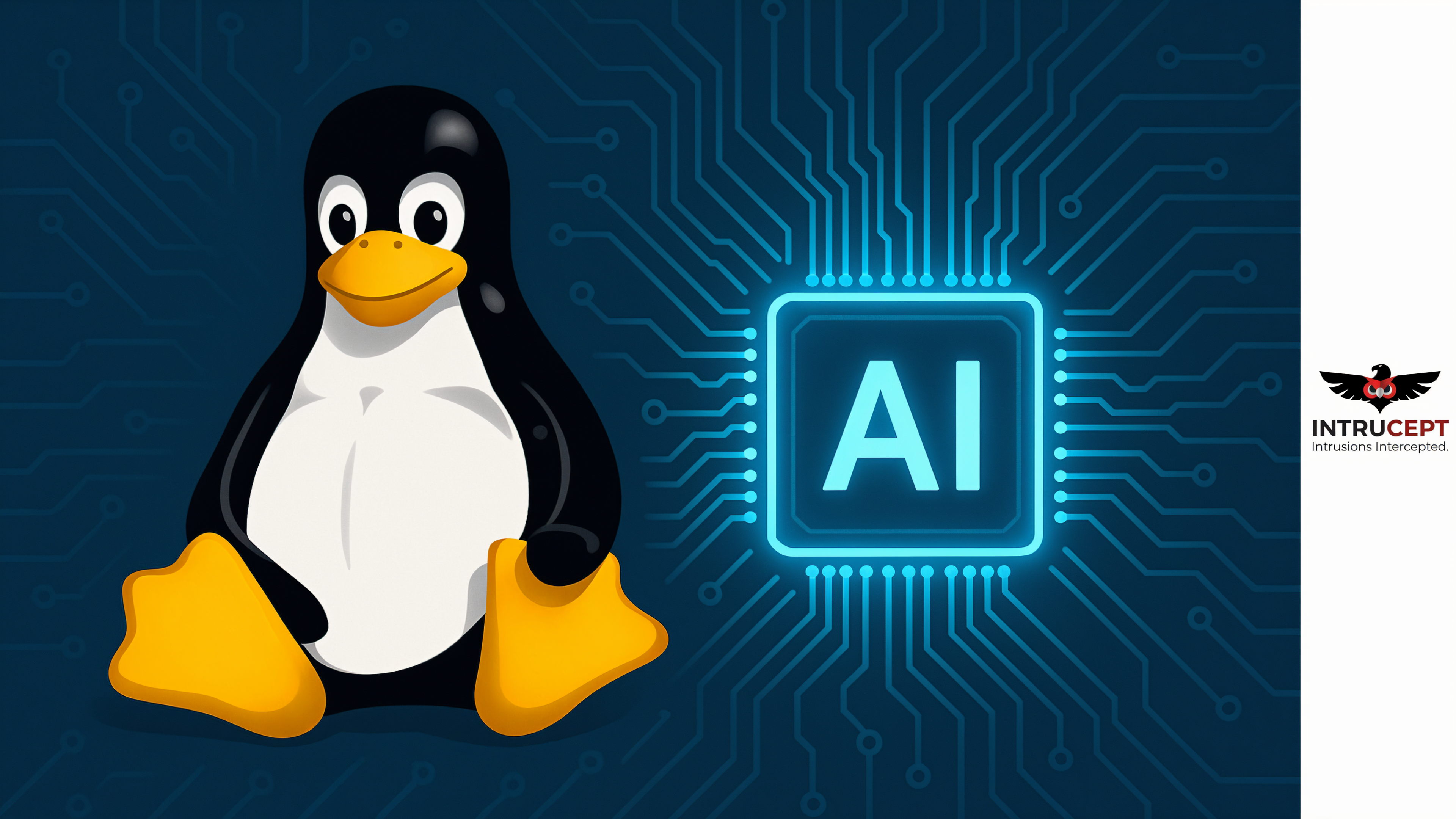
Linux Kernel Exploitation in ksmbd (CVE-2025-37899) Discovered with AI Assistance

Summary: A high-severity use-after-free vulnerability (CVE-2025-37899) has been discovered in the ksmbd component of the Linux kernel, which implements the SMB3 protocol for file sharing.

OEMLinux
SeverityHigh
CVSS ScoreN/A
CVEsCVE-2025-37899
Actively ExploitedNo
Exploited in WildNo
Advisory Version1.0

Overview

The vulnerability, confirmed on May 20, 2025 which was uncovered through AI-assisted code analysis using OpenAI’s o3 model. It affects multiple versions of the Linux kernel and may lead to arbitrary code execution with kernel privileges. As of now, no official fix is available, but Linux distributions including SUSE team are actively working on patches.

Vulnerability NameCVE IDProduct AffectedSeverity
​ksmbd use-after-free vulnerability  CVE-2025-37899Linux kernel  High

Technical Summary

The vulnerability lies in the ksmbd kernel server component responsible for SMB3 protocol handling.

A use-after-free bug occurs when one thread processes a logoff command and frees the sess->user object, while another thread bound to the same session attempts to access the same object simultaneously. This results in a race condition that can lead to memory corruption and potentially enable attackers to execute arbitrary code with kernel privileges.

CVE IDSystem AffectedVulnerability DetailsImpact
    CVE-2025-37899  Linux kernel (ksmbd)A race condition during handling of SMB2 LOGOFF commands. sess->user is freed in one thread while still being accessed in another, leading to a classic use-after-free vulnerability. The absence of synchronization around sess->user allows attackers to exploit the freed memory during concurrent SMB operations.  Kernel memory corruption, privilege escalation, remote code execution

Remediation:

  • Fix status: As of now, an official fix has not been released. Linux distributions, including SUSE, are actively developing and testing patches.

General Recommendations

  • Monitor your distribution’s security advisories and apply patches as soon as they are available.
  • Consider disabling or restricting ksmbd (in-kernel SMB3 server) if not explicitly required.
  • Use firewall rules to restrict access to SMB services to trusted networks.
  • Employ kernel hardening options (e.g. memory protections, SELinux/AppArmor policies).
  • Audit SMB traffic for signs of abnormal session setup and teardown behavior.

Conclusion:
CVE-2025-37899 highlights the increasing role of AI in modern vulnerability discovery and the complex nature of concurrency bugs in kernel components. While no fix is yet available, administrators should apply defense-in-depth strategies and watch for updates from their Linux vendors.

The discovery underscores the importance of rigorous code audits, especially in components exposed to network traffic and multithreaded processing.

References:

Scroll to top