Supplychain

Jaguar Land Rover Data Hack reveal Significance of Security & Privacy by Design

Jaguar Land Rover announced suffering they hit by a cyberattack in August that severely disrupted its production and retail activities. Cyber criminals stole data, held by the carmaker, it has said, as its factories in the UK and abroad face prolonged closure. This massive data hack reveal that every stakeholder in the supply chain must be embed and lazed with security and privacy by design.

Principle of security by design

So the ever evolving automotive industry and modern vehicles are more of software, which means more coding which goes upto 100 million codes and this is growing in numbers and run more applications then ever before.

So the more coding and software, the more lucrative it is for attackers to target systems and codes and if security flaws exist then its a heaven for cyber criminal as it is now easy target for data privacy leaks etc.

Best practices for Securing by Design principles and software development are enough to address the emerging risk to automotive systems and other systems within the vehicle.

According to the BBC, three plants were affected: the ones in Solihull, Halewood and Wolverhampton. Also the cyberattack forced the company to disconnect some systems, which led to factories in China, Slovakia and India getting shut down and workers being instructed to stay at home. 

As per the company suppliers and retailers for JLR are also affected, some operating without computer systems and databases normally used for sourcing spare parts for garages or registering vehicles.

Scattered Spider group behind the cyber attack

As per reports the notorious Scattered Spider  the hackers group is credited for the attack on JLR. The threat actor was also linked to recent attacks against major UK retailers, as well as several other industries worldwide. 

This is the second cyberattack that hit JLR this year. In March, the Hellcat ransomware group claimed to data theft which were in hundreds of gigabytes of data from the carmaker.

July we witnessed how Scattered spider group targeted the aviation and retail sector

https://intruceptlabs.com/2025/07/scattered-spider-group-target-aviation-sector-third-party-providers-to-vendors-are-at-risk-solutions-that-will-improve-security-posture/

Addressing cyber security challenges in Automotive security

Organization addressing such cyber incident in near future will require dedication that will extend to all levels. This includes data layer, connection layer, authentication layer and more.

If organizations are proactive enough in establishing comprehensive protective measures and ensuring reliable systems that wont fail and in place, ultimately will create safe environment for entire ecosystem more resilient against cyber disruptions.

Cybersecurity challenges in automotive innovation

The integration of advanced technology has brought the automotive industry face-to-face with complex cybersecurity challenges. Vehicle technology, now deeply intertwined with software, exposes both consumers and manufacturers to varied threats.

The challenge for manufacturers is finding the right balance between advancing connected features and securing those very connections against evolving threats.

Transformation in Automotive industry while navigating cautiously in the midst of cyber attack

The year 2025 is transformative for automotive industry as the industry witnessing many groundbreaking technological advancements that is lazed with challenges in cybersecurity and supply chain resilience.

Navigate cyber challenges

For automotive industry as a whole, opportunities are huge for the industry as a whole but will take concrete shape when fitted with with robust architecture, zero-trust security frameworks and being transparent. There is a need to have more collaborative mindset and approaches among manufacturers, suppliers and leaders in technology of which cyber security is now important part.

Intercept offers Mirage Cloak

Mirage Cloak the Deception Technology, offers various deception methods to detect and stop threats before they cause damage.

These methods include adding decoys to the network, deploying breadcrumbs on current enterprise assets, using baits as tripwires on endpoints, and setting up lures with intentionally misconfigured or vulnerable services or applications. The flexible framework also lets customers add new deception methods as needed.

Sources: https://www.theguardian.com/business/2025/sep/10/jaguar-land-rover-says-cyber-attack-has-affected-some-data

High-Severity RCE Vulnerability in WinDbg (CVE-2025-24043) 

Security Advisory

A high-severity remote code execution (RCE) vulnerability exists in Microsoft’s WinDbg debugging tool and related .NET diagnostic packages.

The vulnerability poses severe supply chain risks, as WinDbg is widely embedded in CI/CD pipelines and enterprise developer toolchains.

Compromised debugging sessions could lead to lateral movement across networks, credential theft, persistent backdoor injections, and disruption of crash dump analysis workflows.

Microsoft confirmed no viable workarounds other than immediate patching, as the lack of certificate pinning in the affected packages worsens the risk, enabling attackers to leverage forged or stolen Microsoft Authenticode certificates.

OEM Microsoft 
Severity HIGH 
CVSS 7.5  
CVEs CVE-2025-24043 
Publicly POC Available No 
Patch/Remediation Available Yes 
Advisory Version 1.0 

Overview 

This issue is caused by insufficient validation of cryptographic signatures in the SOS debugging extension, potentially allowing attackers with network access to execute arbitrary code. Microsoft has released patches to address the vulnerability. 

Vulnerability Name CVE ID Product Affected Severity 
 Remote Code Execution Vulnerability  CVE-2025-24043  Microsoft Windows   High 

Technical Summary 

The vulnerability arises from the SOS debugging extension’s failure to properly validate cryptographic signatures during debugging operations.

This enables attackers with authenticated network access to inject malicious debugging components, leading to arbitrary code execution with SYSTEM privileges. The attack vector leverages NuGet package integrations in Visual Studio and .NET CLI environments, increasing the risk of supply chain compromises. 

CVE ID System Affected Vulnerability Details Impact 
 CVE-2025-24043  WinDbg and associated .NET diagnostic packages   Flaw in cryptographic signature validation in the SOS debugging extension allows tampered components to be loaded.  Arbitrary code execution  

Remediation

  • Update Affected Packages: Ensure that all instances of affected NuGet packages are updated to the latest patched versions. Refer to the table below for the affected and patched versions. 
  •  Upgrade WinDbg: Make sure that WinDbg is updated to the most recent release available. 
  • Audit Dependencies: Review all .NET Core project dependencies to identify and replace vulnerable packages. 
  • Monitor Network Activity: Implement monitoring for any suspicious network activity related to windbg.exe. 
  • Enforce Security Policies: Apply security policies, such as Windows Defender Application Control, to prevent the execution of unsigned debugging components. 

The table below outlines the affected and patched versions of the relevant packages: 

Package Name Affected Version Patched Version 
dotnet-sos < 9.0.607501 9.0.607501 
dotnet-dump < 9.0.557512 9.0.607501 
dotnet-debugger-extensions 9.0.557512 9.0.607601 

Conclusion: 

CVE-2025-24043 highlights the need to secure developer toolchains, as debugging environments are becoming more targeted in cyberattacks. Organizations using .NET diagnostics should quickly apply patches and implement strict security measures to reduce the risk of exploitation. With no effective workarounds available, postponing remediation heightens the chances of an attack. Prompt action is essential to safeguard critical development and production environments. 

The security impact extends beyond developers, as the exploitation of debugging tools could facilitate attacks on production infrastructure.

Additional security measures include certificate transparency logging for NuGet packages and enforcing Windows Defender Application Control (WDAC) policies to restrict unsigned debugger extensions. While no active exploits have been reported, the patching window is critical, and organizations using .NET diagnostics must act immediately before threat actors weaponize the vulnerability.

References: 

  • https://securityonline.info/windbg-remote-code-execution-vulnerability-cve-2025-24043-exposes-critical-security-risk/ 

Blue Yonder SaaS giant breached by Termite Ransomware Gang

The company acknowledged it is investigating claims by a public threat group linked to the November ransomware attack. 

Continue Reading

Advisory on MUT-8694: Threat Actors Exploiting Developer Trust in Open-Source Libraries

MUT-8694: Threat Actors Exploiting Developer Trust in Open-Source Libraries

Overview

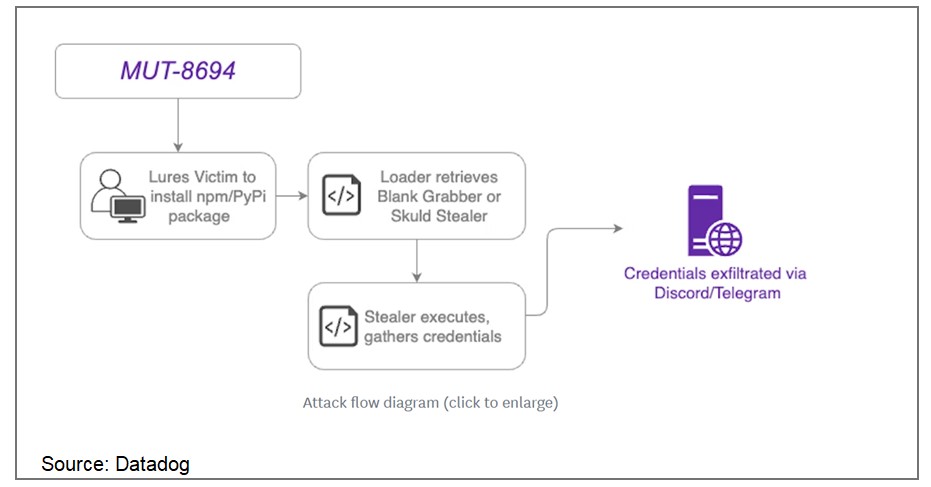
In November 2024, a supply chain attack designated as MUT-8694 was identified, targeting developers relying on npm and PyPI package repositories. This campaign exploits trust in open-source ecosystems, utilizing typosquatting to distribute malicious packages. The malware predominantly affects Windows users, delivering advanced infostealer payloads.

MUT-8694 Campaign Details

The threat actors behind MUT-8694 use malicious packages that mimic legitimate libraries to infiltrate developer environments. The campaign employs techniques such as:

  • Typosquatting: Using package names that closely resemble popular or legitimate libraries.
  • Payload Delivery: Embedded scripts download malware such as Blank Grabber and Skuld Stealer hosted on GitHub and repl.it.
  • Targeted Ecosystems: npm and PyPI, critical platforms for developers.

             Source: Datadog

Key Findings

One identified package, larpexodus (version 0.1), executed a PowerShell command to download and run a Windows PE32 binary from github[.]com/holdthaw/main/CBLines.exe. Analysis revealed the binary was an infostealer malware, Blank Grabber, compiled from an open-source project hosted on GitHub. Further inspection of the repository exposed another stealer, Skuld Stealer, indicating the involvement of multiple commodity malware samples.

Capabilities of Malware

The deployed malware variants include advanced features that allow:

  • Credential Harvesting: Exfiltrating usernames, passwords, and sensitive data.
  • Cryptocurrency Wallet Theft: Targeting and compromising crypto assets.
  • Application Data Exfiltration: Stealing configuration files from popular applications

Affected Packages

Some known malicious packages include:

  • larpexodus (PyPI): Executes a PowerShell script to download malware.
  • Impersonations of npm libraries: Host binaries leading to infostealer deployment.

Remediation:

To mitigate the risks associated with this attack, users should:

  • Audit Installed Packages: Use tools like npm audit or pip audit to identify vulnerabilities.
  • Validate Package Sources: Verify package publishers and cross-check names carefully before installation.
  • Monitor Network Activity: Look for unusual connections to GitHub or repl.it domains.
  • Use Security Tools: Implement solutions that detect malicious dependencies.

General Recommendations:

  • Avoid downloading software from unofficial or unverified sources.
  • Regularly update packages and dependencies to the latest versions.
  • Conduct periodic security awareness training for developers and IT teams.

References:

Scroll to top