Microsoft Patches SharePoint RCE Flaw Enabling RCE Attacks
Microsoft SharePoint Remote Code Execution Vulnerability CVE-2026-45659 Patches Rolled out
Continue Reading

Microsoft SharePoint Remote Code Execution Vulnerability CVE-2026-45659 Patches Rolled out
Continue Reading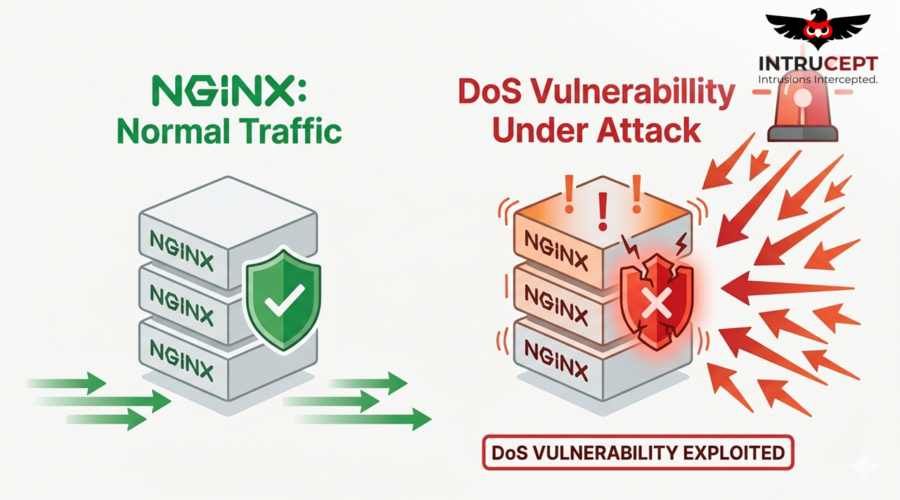
The NGINX vulnerability known as CVE-2026-42945, is a programming mistake in the software where it writes or reads more data in memory than it should, causing a heap buffer overflow and is 18 year old, where in certain rewrite rules are configured in a vulnerable way.
This enables attackers to send specially crafted network requests that cause the NGINX server process to crash. Further attackers don’t need any authentication to send malformed requests to servers. The vulnerability was discovered with the help of AI models in recent months, missed by scanners and humans over the years.
Nginx is one of the most popular web servers, powering almost one third of all websites on the internet, and is integrated into many commercial products as well.
In worst case if a Windows/Linux security protection called ASLR (Address Space Layout Randomization) is disabled:
| Vulnerability | Details |
|---|---|
| CVE ID | CVE-2026-42945 |
| Severity | High / Critical |
| Affected Product | NGINX OSS & NGINX Plus |
| Impact | DoS / Possible Remote Code Execution |
| Attack Requirement | Specially crafted web requests |
| Authentication Needed | No |
Researchers also found additional medium-severity vulnerabilities affecting:
These may cause:
This causes a buffer overflow in the NGINX worker process, meaning the server tries to handle more data than expected in memory. As a result, the NGINX service crashes and restarts, causing a Denial-of-Service (DoS) condition.
Immediate Patching Recommendation
Upgrade to the latest patched NGINX versions immediately.
The recently disclosed NGINX vulnerability (CVE-2026-42945) affecting the ngx_http_rewrite_module can allow unauthenticated attackers to remotely crash vulnerable servers and, in certain conditions, potentially execute malicious code.
How GaarudNode Helps Secure Against This Vulnerability
GaarudNode helps organizations proactively identify, prioritize, and remediate such vulnerabilities across the complete application and infrastructure lifecycle through its unified Shift-Left and Shift-Right security capabilities.
| Security Capability | How It Helps |
|---|---|
| Continuous OS & Infrastructure Vulnerability Scanning | Detects vulnerable NGINX OSS and NGINX Plus versions across servers, containers, and cloud workloads |
| Missing Patch Detection | Identifies systems missing critical NGINX security updates and tracks remediation status |
| Misconfiguration Assessment | Detects insecure rewrite rules and vulnerable NGINX configurations that may trigger the flaw |
| CSPM (Cloud Security Posture Management) | Identifies internet-exposed NGINX instances and insecure cloud deployments |
| Network Security Visibility | Detects externally exposed web services and risky attack surfaces |
| Runtime Monitoring (Shift Right) | Monitors abnormal NGINX crashes, unexpected restarts, and suspicious traffic patterns linked to exploitation attempts |
| Risk Prioritization | Correlates internet exposure, vulnerable configurations, and exploitability to prioritize remediation |
| Unified Risk Dashboard | Provides centralized visibility across applications, infrastructure, cloud, OS, and network risks |
Sources: NGINX: DoS vulnerability is being attacked | heise online

Security updates released for Exim Mail Transfer Agent (MTA) and addressed multiple possible remote-triggered critical vulnerabilities allowing RCE.
The flaw affected outdated Exim deployments. It is a user-after-free (UAF) flaw triggered during the TLS shutdown while handling BDAT chunked SMTP traffic.
Exim is a widely used open-source mail transfer agent deployed across enterprise, ISP, academic, and government infrastructures for internet-connected Unix systems. CVE-2026-45185 was discovered and reported by XBOW researcher Federico Kirschbaum. It impacts Exim versions 4.97 through 4.99.2 on builds compiled with GnuTLS that have STARTTLS and CHUNKING advertised. OpenSSL-based builds are not affected.
The Exim Project has confirmed
The vulnerability impacts some Exim versions before 4.99.3 that use the default GNU Transport Layer Security (GnuTLS) library for secure communication. It is a user-after-free (UAF) flaw triggered during the TLS shutdown while handling BDAT chunked SMTP traffic.
There is a great deal of flexibility in the way mail can be routed, and there are extensive facilities for checking incoming mail. Exim can be installed in place of sendmail, although the configuration of Exim is quite different.
Vulnerability Exploitation
Attackers exploiting the vulnerability could execute commands on the server as well as access Exim data and emails, and potentially pivot further into the environment depending on server permissions and configuration.
Findings from EXBOW research:
XBOW Native successfully produced a working exploit for a simplified target Exim server that had no Address Space Layout Randomization (ASLR) and non-PIE (Position Independent Executables) binary.
In a second attempt, the LLM achieved an exploit on a machine with ASLR, but still a non-PIE binary.
“[…] instead of continuing to attack glibc’s allocator with off-the-shelf mechanisms, XBOW Native had taken on Exim’s own allocator,” XBOW researchers say.
Despite the surprising result below, it was the human researcher who won the race, with assistance from the LLM for tasks such as assembling files and testing exploitation avenues.
Threat actors commonly target internet-facing mail transfer agents due to their direct exposure to external networks and critical role in enterprise communication infrastructure.
| Security Area | Details |
|---|---|
| Product | Exim Mail Transfer Agent (MTA) |
| Current Secure Version | 4.99.3 |
| Affected Versions | All versions prior to 4.99.3 |
| Legacy Risk | Exim 3.x releases are obsolete |
| Attack Surface | Internet-facing SMTP services |
| Potential Impact | Remote exploitation, mail service compromise, unauthorized access |
| Type | Indicator | Description |
|---|---|---|
| Network Activity | Unusual SMTP connections | Suspicious external mail interactions |
| Service Behaviour | Unexpected Exim crashes/restarts | Possible exploitation attempts |
| Log Activity | Unauthorized mail relay events | Potential abuse of mail routing |
| Authentication | Unknown SMTP authentication attempts | Credential abuse indicators |
| System Activity | Unexpected child process execution | Possible remote code execution attempts |
For users of Ubuntu and Debian-based Linux distributions should apply the available Exim updates (v4.99.3) through their package managers.
Sources: Exim Remote Code Execution Vulnerability
Sources: New critical Exim mailer flaw allows remote code execution

Multi-Component Qualcomm Vulnerabilities
Continue Reading
PaloAlto Networks has issued strict advisory for its customers after an actively exploited zero-day vulnerability, affected its firewall operating system, PAN-OS. CVE 2026-0300 allows attackers to gain full control of affected systems without authentication.
The zero-day bug stems from a buffer overflow weakness, allowing unauthenticated attackers to execute arbitrary code with root privileges on Internet-exposed PA-Series and VM-Series firewalls via specially crafted packets.
Active Exploitation Observed in the Wild
Palo Alto Networks confirmed that exploitation attempts have already been observed in its advisory and urged its customers and organizations to mitigate exposure immediately.
What did the vulnerability affect:
Excluded from vulnerability are Prisma Access, Cloud Next-Generation Firewall (Cloud NGFW), and Panorama appliances are not impacted by this vulnerability.
PoC of CVE 2026-0300
PaloAlto published a PoC on May 6, showing how an unauthenticated request to the User-ID Authentication Portal can reliably trigger the buffer overflow and achieve root-level RCE on affected PAN-OS versions.
While the repository is framed as research code and includes legal disclaimers, it materially lowers the barrier to exploitation by validating exploit mechanics.
Palo Alto Networks has not shared details about who is behind the attacks and has not released indicators of compromise at the time of writing.
Patching & Remediation
Since security patches takes time, PaloAlto recommends reducing exposure is the most effective way to contain risk. Palo Alto Networks proactively alerted customers to the zero-day, a step that allowed defenders to take action on potentially exposed instances.
If the User-ID Authentication Portal is not required for business operations, Palo Alto Networks recommends disabling it entirely. Firewalls that do not have the Authentication Portal enabled are not affected by this vulnerability.
The company has stated that security fixes will be released in stages between May 13-28, depending on the PAN‑OS version in use.
In advance of these patches, Palo Alto released a Threat Prevention signature on May 5 for PAN-OS 11.1 and newer to help detect or block exploitation attempts. Applying this signature, where supported, provides interim protection but does not replace the need to reduce exposure and deploy patches once available.
For security teams, immediate focus should be on identifying PA-Series and VM-Series firewalls with the User-ID Authentication Portal enabled, confirming whether those services are reachable from untrusted networks, and scheduling timely deployment of Palo Alto’s fixes as they are released.
Monitoring unexpected firewall behavior or unplanned configuration changes provides additional awareness during the period of active exploitation.
A similar authentication bypass vulnerability (CVE-2025-0108) was discovered in Palo Alto Networks PAN-OS allows unauthenticated attackers with network access to bypass authentication on the management web interface on 20 feb 2025. https://intruceptlabs.com/2025/02/palo-alto-firewall-vulnerabilities-under-active-exploitation/
Firewall infrastructure attack increased in recent years so are the Stakes for Enterprise and Critical Infrastructure
Firewalls are the prime targets because if firewall can be controlled the entire network is in hands of hackers. In recent years, the frequency and success of exploits targeting firewall vulnerabilities have been alarmingly high. Threat actors take on management interfaces, login pages and authentication portals as most common targets for both opportunistic and targeted campaigns.
A successful compromise in the firewall can allow attackers to:
For stronger defense allow Intrucept to proactively test your defenses by identifying vulnerabilities fast. You can start the process to enhance your security posture and protect your digital assets from evolving threats.
Call us for a demo–https://intruceptlabs.com/contact/
Sources: https://fieldeffect.com/blog/palo-alto-firewall-zero-day-unauthenticated-root-access#:~:text=On%20May%205%2C%202026%2C%20Palo,systems%20accessible%20from%20untrusted%20networks.

CVE-2026-34197, an Apache ActiveMQ flaw
Continue Reading
SAP security patch day saw the release of 19 new security notes on April 14th. There is 1 update to previously released security note. The update addresses several severe flaws, including critical SQL injection, denial of service (DoS) and code injection vulnerabilities.
Vulnerability Details:
[CVE-2026-27681] SQL Injection vulnerability in SAP Business Planning and Consolidation and SAP Business Warehouse is most critical with CVSS score 9.9. This flaw may allow attackers to run arbitrary database queries, potentially compromising sensitive information and system integrity.
SAP also released a security note that addresses a high-severity missing authorization check in ERP and S/4 HANA. Tracked as CVE-2026-34256, is missing authorization check in SAP ERP and SAP S/4 HANA. With a CVSS score of 7.1, this vulnerability could enable unauthorized users to perform restricted actions in both private cloud and on‑premise deployments
Further it could be exploited to execute an ABAP program and rewrite existing eight‑character executable programs.
[CVE-2025-64775] Denial of Service Vulnerability in SAP BusinessObjects Business Intelligence Platform, the criticality is medium
[CVE-2026-34264] Information Disclosure vulnerability in SAP Human Capital Management for SAP S/4HANA, medium criticality
Key inputs:
Of the remaining security notes, 16 (15 new and 1 updated) deal with medium-severity vulnerabilities that could lead to information disclosure.
The vulnerabilities may trigger denial-of-service (DoS), XSS attacks, code injection, redirection to malicious content or code execution in the victim’s browser.
Patching:
The flaws were patched in BusinessObjects, Business Analytics, Content Management, S/4HANA, Supplier Relationship Management, NetWeaver, HANA Cockpit and HANA Database Explorer, Material Master Application and S4CORE.
The two remaining notes address low-severity code injection bugs in NetWeaver and Landscape Transformation.
Refer to
Dec 2025 Security Advisory SAP Security Patch Released, Critical RCE Fixed & DoS Vulnerabilities
Conclusion: SAP strongly recommends that the customer visits the support portal and applies patches on priority to protect their SAP landscape.
Sources: https://support.sap.com/en/my-support/knowledge-base/security-notes-news/april-2026.html
Sources: https://www.securityweek.com/sap-patches-critical-abap-vulnerability/

CVE-2026-20160, Vulnerability in CISCO’s smart software manager may allows attackers to gain complete control over the affected system without needing authentication which is gaining prior access to exploit the system. The CVSS severity score of 9.8 out of 10, indicating its high risk level.
Authentication and access controls play a crucial role in web application and system security. What can happen?
CISCO’s Smart Software Manager Flaw
In this case the vulnerability exposure allowed unauthorized access, as attackers do not need login credentials when a hacker can execute arbitrary commands on the operating system. Further escalating by creating crafted request to the service’s API. The vulnerability impacted certain versions of the Cisco SSM On-Prem environments, particularly software releases from 9-202502 to 9-202510.
Remediation for organizations
Organizations can prevent authentication bypass through regular patching, multi-factor authentication, encryption, and strong password policies.
The vulnerability did not impact CISCO’s smart software newly released version 9-202601 includes a patch that fixes the flaw.
Cisco advises to upgrade to version 9-202601 immediately, as there are no current workarounds or temporary mitigations to block potential attacks.
For IT teams notes include devices meet the necessary memory and hardware specifications before proceeding with the update.
Key findings from CVE-2026-20160 Vulnerability
The vulnerability was discovered internally by Cisco’s Technical Assistance Center (TAC) team and they found no immediate exploitations in the wild
With the disclosure can motivate hackers to reverse-engineer the patch and search for vulnerable systems. Following Cisco’s guidelines and maintaining up-to-date security measures will be essential in mitigating risks associated and stop any kind of data breaches.
Conclusion:
Research shows that, making timely patching critical for authentication security is essential and failing to do that can lead to data breaches.
The Cisco Product Security Incident Response Team (PSIRT) validates only the affected and fixed release information that is documented in this advisory. Cisco strongly recommends that customers upgrade to the fixed software indicated in this advisory.
Sources: Cisco Smart Software Manager On-Prem Arbitrary Command Execution Vulnerability

PTC has issued an urgent advisory regarding a critical Windchill and FlexPLM vulnerability that exposes affected systems to Remote Code Execution (RCE). The flaw, identified as CVE-2026-4681, has been classified as a code injection vulnerability (CWE-94) and carries a CVSS v3.1 base score of 10.0 and CVSS v4 score of 9.3.
Vulnerability details:
The company says that it has not found any evidence that the vulnerability is being exploited against PTC customers. However, PTC published a set of specific indicators of compromise (IoCs) that include a user agent string and files.
The flaw affects a broad range of Windchill PDMLink and FlexPLM releases, specifically:
Remediation: PTC is actively developing and releasing security patches for all supported Windchill versions to address the identified vulnerability
Immediate Mitigation Steps
PTC has issued specific guidance to reduce the risk until official security patches are released. These steps include:
For Apache HTTP Server
<LocationMatch “^.*servlet/(WindchillGW|WindchillAuthGW)/com.ptc.wvs.server.publish.Publish(?:;[^/]*)?/.*$”>
Require all denied
For Microsoft IIS
PTC advises applying the same workaround steps to File Server or Replica Server configurations and notes that older Windchill releases may require adjusted procedures.
Additional Protection Measures
For organizations unable to immediately implement mitigations, PTC recommends temporarily shutting down Windchill or FlexPLM services or disconnecting systems from the public Internet.
PTC has also committed to 24×7 customer support for all users affected by this critical vulnerability. For PTC cloud-hosted customer.
Indicators of Compromise
Advisory for security Teams to monitor for specific signs that may indicate exploitation of the Windchill vulnerability or FlexPLM vulnerability:
Network and User-Agent Patterns
File System Indicators
The presence of these files indicates that a potential attacker may have prepared the system for Remote Code Execution.
Log and Error Patterns
PTC strongly urges customers to report any identified
Log and Error Patterns
Source: https://www.ptc.com/en/about/trust-center/advisory-center/active-advisories/windchill-flexplm-critical-vulnerability?srsltid=AfmBOooLDdBNS2lOeRasqrbyOfjfVKyhJH6Z_wfzqO93k3cqVQcSueEv

Microsoft Tuesday Patch March 2026 fixes 83 Vulnerabilities Including 2 Actively Exploited Zero-Days
Continue Reading