
Vulnerability in Nessus Enables Arbitrary Malicious Code Execution, Patch Now
Tenable has released Nessus Agent 11.1.3 to address this issues
Continue ReadingTenable has released Nessus Agent 11.1.3 to address this issues
Continue ReadingAI usage in recent Cyber security events triggering AI-enabled threats
Continue ReadingSystemic remote code execution vulnerability in Anthropic’s Model Context Protocol (MCP) SDK
Continue ReadingParse Server Authentication Bypass via partial authData; Successful exploitation Lead to Creating Valid User Session
Continue ReadingSevere vulnerabilities found in IP KVM may allow unauthenticated hackers to gain root access or run malicious code on them. These vulnerabilities have CVSS scores ranging from 3.1 to 9.8.
There are great risks associated as a low-cost device have the ability to provide insiders and hackers unusually broad powers in networks that are often not so secured or vulnerable. Recently researchers from security firm Eclypsium disclosed a total of nine vulnerabilities in IP KVMs from four manufacturers.
IP-KVMs
When a device sell for $30 to $100, are known as IP KVMs. Administrators often use them to remotely access machines on networks. The devices, not much bigger than a deck of cards, allow the machines to be accessed at the BIOS/UEFI level, the firmware that runs before the loading of the operating system.
Risk Associated with IP KVM
If hackers get hands of they might misuse capabilities even in a secured network. Risks are posed when the devices are exposed to the web or internet—are deployed with weak security configurations or surreptitiously connected to by insiders. Firmware vulnerabilities also leave them open to remote takeover.
Its easy for attackers to manipulate device behavior by overwriting configuration files or system binaries, by an attacker can manipulate the device’s behavior. subsequently gain unauthorized access and use the KVM as a pivot point to compromise any target machine connected to it.
“These are not exotic zero-days requiring months of reverse engineering,” Eclypsium researchers Paul Asadoorian and Reynaldo Vasquez Garcia wrote. “These are fundamental security controls that any networked device should implement. Input validation. Authentication. Cryptographic verification. Rate limiting. We are looking at the same class of failures that plagued early IoT devices a decade ago, but now on a device class that provides the equivalent of physical access to everything it connects to.”


Analysis:
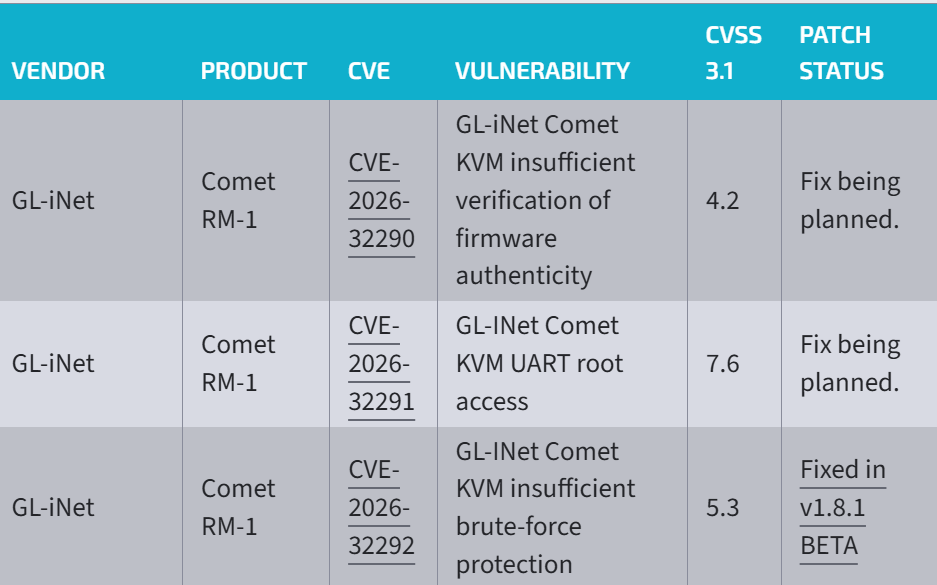
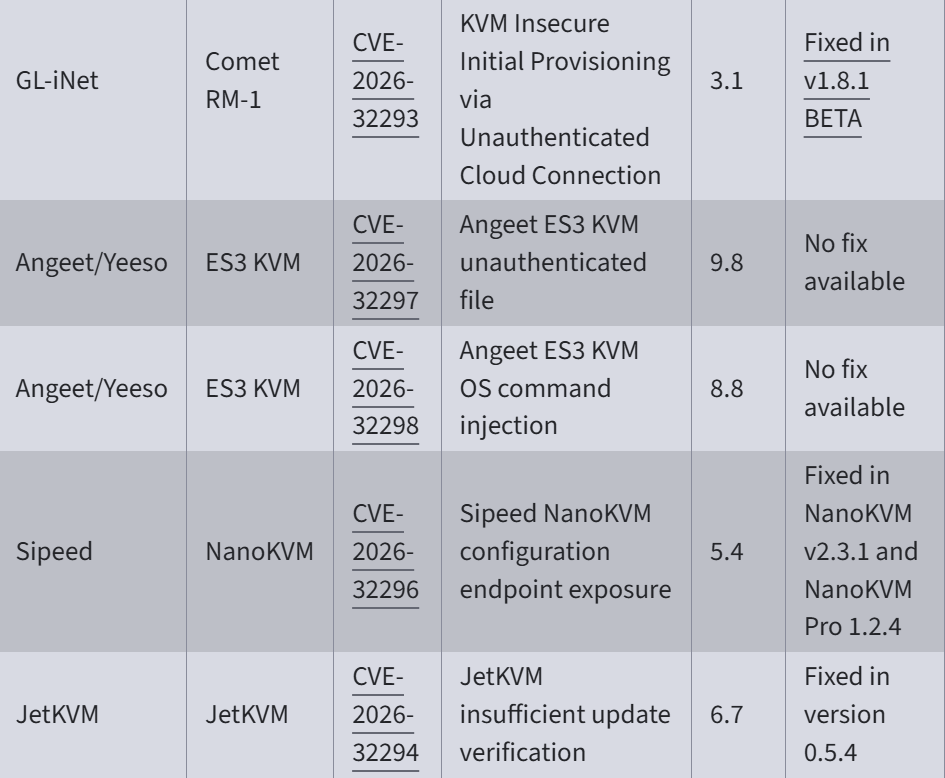
The vulnerabilities are catalogued as CVE-2026-32290, CVE-2026-32291, CVE-2026-32292, CVE-2026-32293, CVE-2026-32294, CVE-2026-32295, CVE-2026-32296, CVE-2026-32297 and CVE-2026-32298, with CVSS scores ranging from 3.1 to 9.8 and some fixes already in place (for example, JetKVM updates and NanoKVM versions) while others remain unpatched.
The analysis notes that an attacker could inject keystrokes, boot from removable media to bypass protections, circumvent lock screens, or remain undetected by OS-level security software, given the devices’ remote BIOS/UEFI access.
Threat Mitigation
Mitigations include enforcing MFA where supported, isolating KVM devices on a dedicated management VLAN, restricting internet access, monitoring traffic, and keeping firmware up-to-date, according to Eclypsium.
This vulnerability alone dictates the term immediate network isolation of any deployed Angeet ES3 device.
Requirement of Robust firmware validation and strong access controls
For robust Firmware validation, testing is must but here testing do not imply checking if the coding is working or not. Instead it is a systematic process of assessing whether firmware meets the defined specifications and quality standards.
We have BI and Data Analytics to redefined outcomes of testing and are measured, with key performance indicators (KPIs) drawn from vast amounts of operation data stored in testing logs and real-time deployment environments.
Summary: USN-8018-1 fixed vulnerabilities in python3. That update introduced regressions. The patches for CVE-2025-15366 and CVE-2025-15367 caused behavior regressions in IMAP and POP3 handling, which upstream chose to avoid by not backporting them.
| OEM | Python |
| Severity | Medium |
| CVSS Score | 6.5 |
| CVEs | CVE-2026-0865, CVE-2025-15366, CVE-2025-15367 |
| POC Available | No |
| Actively Exploited | No |
| Exploited in Wild | No |
| Advisory Version | 1.0 |
Overview
Python is a widely used high-level programming language that powers many enterprise applications, automation frameworks, DevOps pipelines, web platforms and email-processing services. Many Linux distributions – Ubuntu provide Python runtime packages as core system components.
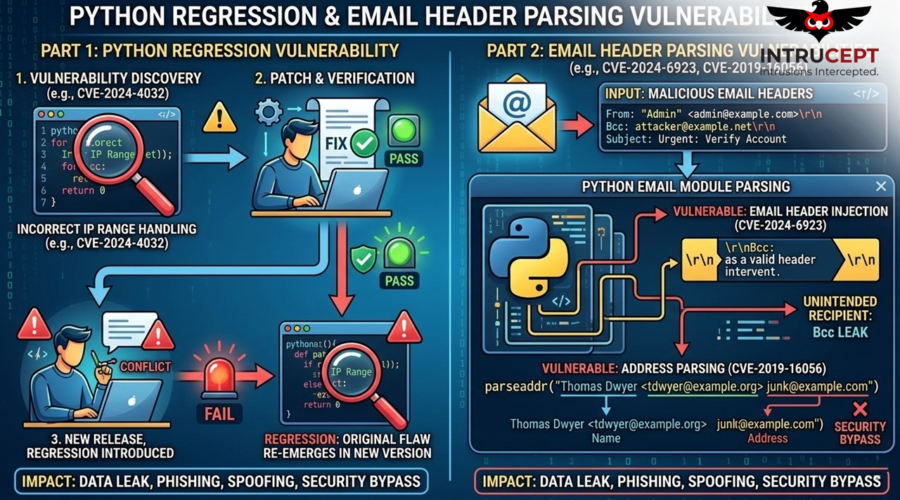
Ubuntu released USN-8018-2 to address regressions introduced in the previous security update USN-8018-1. The earlier update attempted to fix vulnerabilities related to email header parsing and input validation but unintentionally introduced compatibility issues affecting IMAP, POP3, and WSGI header processing.
The new advisory prioritizes the fix for CVE-2026-0865, while also addressing issues related to CVE-2025-15366 and CVE-2025-15367.
| Vulnerability Name | CVE ID | Product Affected | Severity | CVSS Score | Fixed Version |
| WSGI Header Parsing Regression Vulnerability | CVE-2026-0865 | Python | Medium | 6.5 | Updated Python packages |
| Email Header Injection Vulnerability | CVE-2025-15366 | Python | Medium | 5.9 | Updated Python packages |
| Improper Email Header Parsing Vulnerability | CVE-2025-15367 | Python | Medium | 5.9 | Updated Python packages |
Technical Summary
These vulnerabilities affect multiple Python versions distributed within Ubuntu systems.
The original security update introduced patches intended to address email header parsing vulnerabilities. However, those fixes resulted in unintended behavioural regressions.
The CVE-2026-0865 patch incorrectly rejected horizontal tab characters in WSGI headers, potentially causing web applications relying on Python frameworks to malfunction.
Additionally, patches for CVE-2025-15366 and CVE-2025-15367 affected IMAP and POP3 email processing behavior, which allow upstream developers to avoid backporting those changes due to compatibility concerns.
Ubuntu released updated packages to resolve these regressions while maintaining protection against the underlying vulnerabilities.
| CVE ID | System Affected | Vulnerability Details | Impact |
| CVE-2026-0865 | Python (multiple Ubuntu packages) | Incorrect rejection of horizontal tabs in WSGI headers after patch | Web application compatibility issues |
| CVE-2025-15366 | Python email parsing library | Improper parsing allowing email header injection | Email spoofing or message manipulation |
| CVE-2025-15367 | Python email processing modules | Improper validation of message headers | Header manipulation in email processing |
Affected Packages
The following Python packages are affected –
python3.4 python3.5 python3.6 python3.7 python3.8
python3.10 python3.12 python3.13 python3.14
Remediation:
Apply the latest Ubuntu security updates immediately-
Fixed Package Versions
| Ubuntu Release | Fixed Package Version |
| Ubuntu 25.10 | python3.13 – 3.13.7-1ubuntu0.4 / python3.14 – 3.14.0-1ubuntu0.3 |
| Ubuntu 24.04 LTS | python3.12 – 3.12.3-1ubuntu0.12 |
| Ubuntu 22.04 LTS | python3.10 – 3.10.12-1 22.04.15 |
| Ubuntu 20.04 LTS | python3.8 – 3.8.10-0ubuntu1 20.04.18 |
| Ubuntu 18.04 LTS | Updated ESM packages |
| Ubuntu 16.04 LTS | Updated ESM packages |
| Ubuntu 14.04 LTS | Updated ESM packages |
If immediate patching is not possible, apply the following temporary mitigations-
You can follow the recommendations below as a best practice-
Conclusion:
The vulnerabilities addressed in USN-8018-2 highlight the risks associated with improper email header parsing and regression issues in widely used programming libraries such as Python. The primary concern, CVE-2026-0865, affects WSGI header handling and could disrupt web applications, while CVE-2025-15366 and CVE-2025-15367 relate to email header parsing weaknesses.
Organizations using Python-based applications or email processing services should prioritize updating affected Ubuntu packages to ensure both security and application stability.
References:
Microsoft 365 Copilot Vulnerability Bypasses DLP Policies, Summarizes Confidential Emails; Bug Tracked CW1226324
Summary :
A recently disclosed issue in Microsoft 365 Copilot caused the AI assistant to summarize confidential emails despite sensitivity labels and Data Loss Prevention (DLP) policies being configured.
The bug, tracked under CW1226324, allowed Copilot’s “Work Tab” chat feature to process and summarize emails from Sent Items and Draft folders, even when those emails carried confidentiality labels designed to restrict automated access.
Microsoft findings
Microsoft’s investigation revealed a code-level defect as the root cause. The flaw allows Copilot to inadvertently pick up items stored in users’ Sent Items and Draft folders, bypassing the confidentiality labels applied to those messages.
Although Microsoft categorized the issue as an advisory with potentially limited scope, the incident raises significant concerns regarding AI governance, trust boundaries, and enterprise data protection controls.
As per CSN the flaw allows Copilot to inadvertently pick up items stored in users’ Sent Items and Draft folders, ignoring the confidentiality labels applied to those messages.
Vulnerability Details
The issue happened because of an internal coding mistake in Microsoft 365 Copilot’s Work Tab chat feature. Due to this error, Copilot was able to access emails stored in Sent and Draft folders, even if they were marked as confidential.
In normal conditions, sensitivity labels and DLP policies should block automated tools from processing such emails.
However, because of this flaw, Copilot treated those protected emails as regular content and created summaries from them until Microsoft began deploying a fix in February 2026.

Attack Flow
| Step | Description |
| Configuration | Organization applies confidentiality labels and DLP policies to sensitive emails. |
| Storage | Emails are stored in Sent Items or Draft folders. |
| Trigger | User interacts with Copilot “Work Tab” Chat. |
| Processing | Due to the code bug, Copilot accesses labeled emails. |
| Exposure | Copilot generates summaries of confidential content, bypassing expected DLP enforcement. |

Source:0din
Why It’s Effective
Broader Implications
This issue shows that AI tools inside business software can sometimes ignore security rules, even when protection like DLP and sensitivity labels are properly set. It proves that AI systems can create new risk areas that traditional security controls may not fully cover.
As more companies use AI assistants in daily work, security teams must regularly test and monitor how AI handles sensitive data. AI should be treated like a powerful internal system that needs strict oversight, not just a simple productivity feature.
Remediation:
Microsoft has initiated a fixed rollout and is monitoring deployment progress. However, organizations should take proactive measures:
Conclusion:
This incident highlights that AI integrations can introduce unexpected security gaps, even in well-configured enterprise environments. Organizations cannot assume that existing security controls will automatically work the same way with AI-powered features.
As AI adoption increases, companies must strengthen AI governance, continuously validate security policies, and monitor AI behavior just like any other critical system. Proactive testing and oversight are essential to prevent future data exposure risks.
Bypassing DLP policies by AI aided assistants signals huge security gap which needs to be addressed at enterprise level as AI tool taking over enterprise security posture cannot be undermined.
References:
Fortinet released security updates for CVE-2026-2164
Fortinet has recently addressed a critical security vulnerability, identified as CVE-2026-21643, in its FortiClientEMS product. This flaw is classified as a SQL injection vulnerability, enables unauthenticated remote attackers to execute arbitrary code or system commands on affected systems by sending specially crafted HTTP requests.
Fortinet has released security updates to address a critical flaw impacting FortiClientEMS that could lead to the execution of arbitrary code on susceptible systems.
Technical Details
With a CVSS v3.1 base score of 9.1, this vulnerability is considered critical and poses a significant risk to organizations relying on FortiClientEMS for endpoint management.
The flaws affect the following versions –
The vulnerability, CVE-2026-21643, resides in the FortiClientEMS administrative web interface.
Reason for the flaw or vulnerability to appear is caused by improper neutralization of user-supplied input in SQL queries. The flaw allows an unauthenticated attacker to send specially crafted HTTP requests to the FortiClientEMS GUI.
This resulted in the execution of arbitrary SQL statements, leading to unauthorized access, data exfiltration, privilege escalation and remote code execution (RCE) on any primary system.
Remediation
Immediate patching is strongly recommended to prevent potential exploitation, as the vulnerability allows attackers to bypass authentication and gain full control over the targeted system.
There is currently no evidence of exploitation in the wild but the flaw has been termed a high-priority issue for all organizations using the affected product version, reason the attack surface is vulnerable.
Fortinet has since acknowledged that the issue has been actively exploited by bad actors to create local admin accounts for persistence, make configuration changes granting VPN access to those accounts, and exfiltrate the firewall configurations.
Conclusion:
The vulnerability is not present in FortiClientEMS versions 7.2, 8.0, or FortiEMS Cloud. The issue has been resolved in FortiClientEMS version 7.4.5 and later.
In the past similar Fortinet SQL injection and remote code execution vulnerabilities were found in Fortinet products and was targeted by cybercriminals and state-sponsored actors for financial benefits.
2 critical vulnerabilities affecting Splunk Enterprise and Splunk Universal Forwarder on Windows platforms were disclosed, both involving incorrect permission assignments during installation or upgrade. The vulnerabilities addressed may enable attackers to exploit issues such as privilege escalation, information disclosure, or remote code execution.
Continue ReadingSummary : Security Advisory: Elastic disclosed vulnerability in Elastic Cloud Enterprise (ECE) that allows attackers with admin access to steal sensitive data or execute any commands through Jinjava template injection. This flaw impacts ECE versions from 2.5.0 up to and including 3.8.1, as well as versions 4.0.0 through 4.0.1.
| OEM | Elastic Cloud Enterprise (ECE) |
| Severity | Critical |
| CVSS Score | 9.1 |
| CVEs | CVE-2025-37729 |
| POC Available | No |
| Actively Exploited | No |
| Exploited in Wild | No |
| Advisory Version | 1.0 |
Overview
The vulnerability with CVE-2025-37729, affects multiple ECE versions starting from 2.5.0 up to and including 3.8.1, and versions starting from 4.0.0 up to and including 4.0.1. Users & Administrators are strongly advised to upgrade to the latest version of ECE immediately to stay protected.
| Vulnerability Name | CVE ID | Product Affected | Severity | Fixed Version |
| Improper Neutralization of Special Elements Vulnerability | CVE-2025-37729 | Elastic Cloud Enterprise | Critical | v3.8.2 & v4.0.2 |
Technical Summary
Improper neutralization of special elements can be used to issuing commands via a specially crafted string where Jinjava variables are evaluated.
Malicious actors are exploiting due to an improper neutralization of special characters vulnerability in the Jinjava template engine used by ECE.
Attackers with admin-level access to the ECE admin console and deployments with the Logging+Metrics feature enabled can inject malicious Jinjava expressions through specially crafted payloads. This vulnerability can allow them to exfiltrate sensitive data or execute arbitrary command on the system.
| CVE ID | System Affected | Vulnerability Details | Impact |
| CVE-2025- 37729 | Elastic Cloud Enterprise (ECE) v2.5.0-3.8.1, v4.0.0-v4.0.1 | Improper sanitization of user-supplied input in Jinjava templates allows admin users to inject malicious expressions, enabling code execution and data exfiltration | Sensitive Data Leakage, Arbitrary Command Execution, Potential Full System Compromise |
Recommendations:
Upgrade the Elastic Cloud Enterprise versions to v3.8.2 and v4.0.2 or the latest one.
Here are some recommendations below
Conclusion:
This is critical vulnerability in Elastic Cloud Enterprise that could allow attackers to data exfiltration and arbitrary command execution.
Although exploitation needs administrative access, but its high impact makes it a major security risk & needs immediate action. Upgrading to the fixed version and applying recommended actions are strongly advised by the organizations to stay secure.
References:
Recent Comments