MFA

Vulnerabilities in IP-KVMs from 4 Vendors; Risk for Unauthenticated Root Access

Severe vulnerabilities found in IP KVM may allow unauthenticated hackers to gain root access or run malicious code on them. These vulnerabilities have CVSS scores ranging from 3.1 to 9.8.

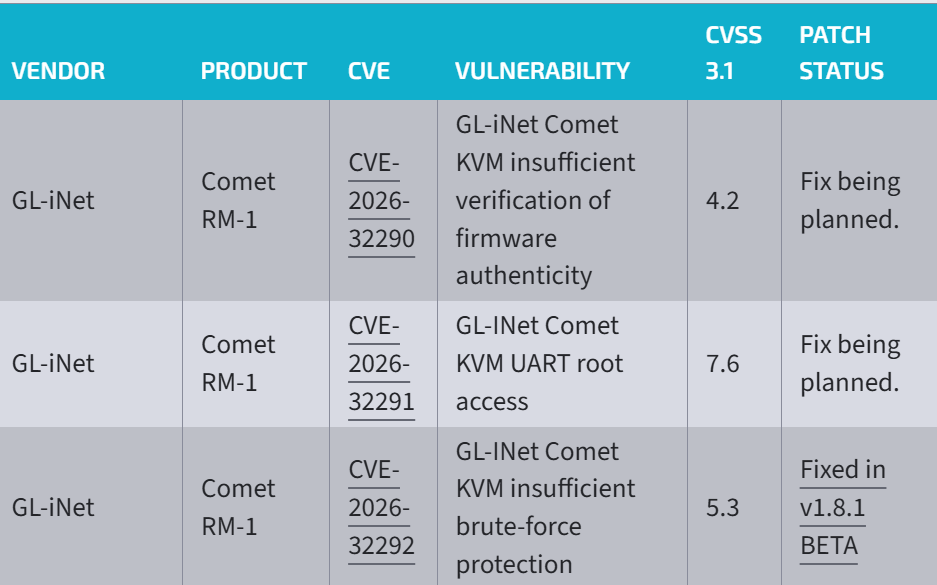
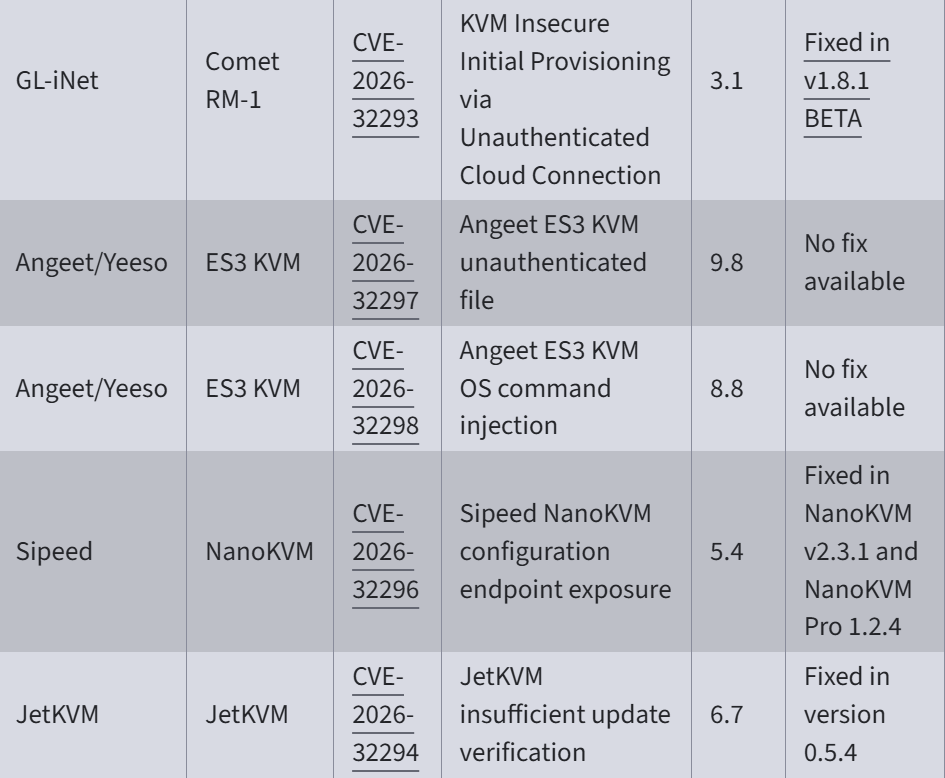
There are great risks associated as a low-cost device have the ability to provide insiders and hackers unusually broad powers in networks that are often not so secured or vulnerable. Recently researchers from security firm Eclypsium disclosed a total of nine vulnerabilities in IP KVMs from four manufacturers.

IP-KVMs

When a device sell for $30 to $100, are known as IP KVMs. Administrators often use them to remotely access machines on networks. The devices, not much bigger than a deck of cards, allow the machines to be accessed at the BIOS/UEFI level, the firmware that runs before the loading of the operating system.

Risk Associated with IP KVM

If hackers get hands of they might misuse capabilities even in a secured network. Risks are posed when the devices are exposed to the web or internet—are deployed with weak security configurations or surreptitiously connected to by insiders. Firmware vulnerabilities also leave them open to remote takeover.

Its easy for attackers to manipulate device behavior by overwriting configuration files or system binaries, by an attacker can manipulate the device’s behavior. subsequently gain unauthorized access and use the KVM as a pivot point to compromise any target machine connected to it.

“These are not exotic zero-days requiring months of reverse engineering,” Eclypsium researchers Paul Asadoorian and Reynaldo Vasquez Garcia wrote. “These are fundamental security controls that any networked device should implement. Input validation. Authentication. Cryptographic verification. Rate limiting. We are looking at the same class of failures that plagued early IoT devices a decade ago, but now on a device class that provides the equivalent of physical access to everything it connects to.

Analysis:

The vulnerabilities are catalogued as CVE-2026-32290, CVE-2026-32291, CVE-2026-32292, CVE-2026-32293, CVE-2026-32294, CVE-2026-32295, CVE-2026-32296, CVE-2026-32297 and CVE-2026-32298, with CVSS scores ranging from 3.1 to 9.8 and some fixes already in place (for example, JetKVM updates and NanoKVM versions) while others remain unpatched.

The analysis notes that an attacker could inject keystrokes, boot from removable media to bypass protections, circumvent lock screens, or remain undetected by OS-level security software, given the devices’ remote BIOS/UEFI access.

Threat Mitigation

Mitigations include enforcing MFA where supported, isolating KVM devices on a dedicated management VLAN, restricting internet access, monitoring traffic, and keeping firmware up-to-date, according to Eclypsium.

This vulnerability alone dictates the term immediate network isolation of any deployed Angeet ES3 device.

Requirement of Robust firmware validation and strong access controls

For robust Firmware validation, testing is must but here testing do not imply checking if the coding is working or not. Instead it is a systematic process of assessing whether firmware meets the defined specifications and quality standards.

We have BI and Data Analytics to redefined outcomes of testing and are measured, with key performance indicators (KPIs) drawn from vast amounts of operation data stored in testing logs and real-time deployment environments.

(Sources: Your KVM is the Weak Link: How $30 Devices Can Own Your Entire Network – Eclypsium | Supply Chain Security for the Modern Enterprise)

Copilot Studio SupplyChain Attack Steals OAuth Tokens via CoPhishing

Summary 

The CoPhish attack is a sophisticated phishing technique exploiting Microsoft Copilot Studio to steal OAuth tokens by tricking users into granting attackers unauthorized access to their Microsoft Entra ID accounts.

By Copilot Studio’s customizable AI agents, attackers create chatbots hosted on legitimate Microsoft domains that wrap traditional OAuth consent attacks in an authentic-looking interface, increasing the likelihood of successful deception. 

Technical Details 

The attackers often use a trial license or compromised tenant to create the agent, backdooring the authentication workflow so that, post-consent, OAuth tokens are exfiltrated via HTTP to attacker infrastructure.

Few Demo links like copilotstudio.microsoft.com add credibility, closely mimicking official Microsoft Copilot services, and victims see familiar branding and login flows.

While Microsoft has implemented consent policy updates including blocking risky permissions by default for most users significant gaps remain: unprivileged users can still approve internal apps and privileged admins retain broad consent authority.

Tokens exfiltrated by CoPhish can be used for impersonation, data theft or sending further phishing emails, often going undetected as the traffic is routed through Microsoft infrastructure. 

malicious CopilotStudio page                                                                                                                         Source: securitylabs.datadoghq.com 

Attack Flow 

Step Description 
1. Build Malicious Copilot Agent Attackers create a customized Copilot Studio chatbot, usually on a trial license within their own or a compromised Microsoft tenant, configuring it to appear as a legitimate assistant. 
2. Backdoor Authentication Workflow The agent’s “Login” topic is modified to include an HTTP request that will exfiltrate any OAuth tokens granted by users during authentication. 
3. Share Demo Link Attackers generate and distribute demo website URL (like, copilotstudio.microsoft.com) pointing to the malicious chatbot, mimicking official Copilot Studio services and passing basic domain trust checks. 
4. Victim and Trigger Consent Victims access the link, interact with the familiar interface, and are prompted to login, beginning an OAuth consent flow that requests broad Microsoft Graph permissions. 
5. Token Exfiltration After the victim consents, the agent collects the issued OAuth token and sends it via HTTP to an attacker-controlled server, often relaying through Microsoft IP addresses to avoid detection in standard traffic logs. 
6. Abuse Granted Permissions Attackers use the stolen token to impersonate the victim, accessing emails, calendars, and files or conducting further malicious actions such as sending phishing emails or stealing sensitive data. 
7. Persist and Retarget Due to policy gaps, attackers can repeat the process targeting both internal and privileged users, tailoring requested app permissions and adapting to Microsoft’s evolving security measures. 

                             Source: securitylabs.datadoghq.com 

Why It’s Effective 

  • Leverages trusted Microsoft domains and branding with realistic AI chatbot flows, bypassing phishing detection and user suspicion. 
  • Bypasses multi-factor authentication by stealing fully privileged OAuth tokens that persist until revoked. 
  • Targets both regular users and privileged admins by adapting requested permissions, making it scalable and versatile. 

Recommendations 

Here are some recommendations below 

  • Enforce strict Microsoft Entra ID consent policies to limit user approval of app permissions, especially high-risk scopes. 
  • Restrict or disable user creation and publishing of Copilot Studio agents unless explicitly authorized by admins. 
  • Monitor Entra ID audit logs and Microsoft Purview for suspicious app consent, agent creation or modifications in Copilot workflows. 
  • Apply Azure AD Conditional Access requiring MFA and device compliance for accessing Copilot Studio and related AI services. 
  • Implement tenant-level Data Loss Prevention (DLP) and sensitivity labeling 
  • Educate users on phishing risks and regularly reviewing/revoking app permissions and tokens. 

Conclusion: 
CoPhish highlights how AI-powered low-code platforms like Microsoft Copilot Studio can be exploited for advanced phishing attacks targeting identity systems.

Despite Microsoft’s improvements to consent policies, significant risks remain, requiring organizations to enforce strict consent controls, limit app creation, and monitor Entra ID logs vigilantly. As AI-driven tools grow, proactive security measures are essential to defend against these evolving hybrid threats leveraging trusted cloud services. 

References

Hashtags 

#Infosec #CyberSecurity #Microsoft #Copilot #Vulnerabilitymanagement # Patch Management #ThreatIntel CISO #CXO #Intrucept  

Fortinet Released Security Update’s; Patched Multiple High & Medium Severity Vulnerabilities

Summary: Fortinet disclosed multiple critical security vulnerabilities impacting several of its core products, including FortiPAM, FortiSwitch Manager and FortiOS platforms and patched them.

The vulnerabilities encompass issues such as improper privilege escalation, heap-based buffer overflow, weak authentication, improper certificate validation, denial-of-service risk, and race condition flaws in authentication modules.

One of the high severity issue is a weak authentication mechanism vulnerability (CVE-2025-49201) in FortiPAM & FortiSwitch Manager, and a heap overflow flaw (CVE-2025-57740) in the SSL VPN RDP bookmark functionality.

OEM Fortinet 
Severity High 
CVSS Score 7.8 
CVEs CVE-2025-49201, CVE-2025-58325, CVE-2025-57740, CVE-2025-57741 & others 
POC Available No 
Actively Exploited No 
Exploited in Wild No 
Advisory Version 1.0 

Overview 

These vulnerabilities pose significant risks to enterprise environments, potentially allowing attackers to bypass authentication controls or execute arbitrary code within targeted systems. Users & Administrators are urged to update to the patched version. 

                Vulnerability Name CVE ID Product Affected Severity Fixed Version 
Weak Authentication Mechanism CVE-2025-49201 FortiPAM, FortiSwitch Manager  High FortiPAM 1.5.1, 1.4.3 or later / FortiSwitch Manager 7.2.5 or later 
CLI Command Functionality Bypass  CVE-2025-58325 FortiOS High FortiOS 7.6.1+, 7.4.6+, 7.2.11+, 7.0.16+ 
Heap Overflow – Remote Code Execution (FortiProxy SSL VPN Bookmarks) CVE-2025-57741 FortiProxy High FortiProxy 7.2.5+, 7.0.5+ 
Heap Overflow – Remote Code Execution (SSL VPN RDP Bookmark) CVE-2025-57740 FortiOS, FortiProxy, FortiPAM, FortiSwitch Manager. Medium FortiOS 7.4.4+ / 7.2.8+ / 7.0.15+, FortiProxy 7.4.4+ / 7.2.10+, FortiPAM 1.3.0+, FortiSwitch Manager 7.2.4+ 

Technical Summary 

Multiple critical and medium-severity vulnerabilities have been identified across several Fortinet products, including FortiOS, FortiPAM, FortiProxy, FortiAnalyzer, and FortiSwitchManager.

Other vulnerabilities could allow attackers to escalate privileges, execute unauthorized code, or bypass authentication, threatening system integrity and confidentiality.

Additional flaws may enable unauthenticated users to disrupt services, intercept network traffic, or exploit race conditions to gain improper access within centralized management and authentication platforms. As the Fortinet released the security updates, quick deploy of the patches to ensure resilience against exploitation and to protect enterprise assets. 

CVE ID Component Affected  Vulnerability Details Impact 
 CVE-2025-49201 FortiPAM, FortiSwitch Manager This flaw enables remote attackers to bypass authentication by sending specially crafted HTTP requests, allowing unauthorized code or command execution within privileged access management and switch management interfaces.  Authentication Bypass / Remote Code Execution 
 CVE-2025-57740 FortiOS, FortiProxy, FortiPAM, FortiSwitch Manager This heap-based buffer overflow in the SSL VPN RDP bookmark feature can be triggered by authenticated users through crafted bookmark data, resulting in memory corruption and possible code execution in the VPN context. Remote Code Execution / System Compromise 
CVE-2025-58325 FortiOS A CLI command functionality bypass allows attackers to execute restricted administrative commands through improper input validation, potentially escalating privileges or modifying critical system parameters. Privilege Escalation / Remote Code Execution 
CVE-2025-57741 FortiProxy This heap overflow vulnerability in FortiProxy’s SSL VPN RDP bookmarks can result in memory corruption, giving attackers a pathway to execute arbitrary code remotely during VPN session initialization. Remote Code Execution / Service Compromise 

Additionally, multiple vulnerabilities have been disclosed that enable remote authentication bypass and include other issues with significant impact potential. 

Vulnerability Name CVE ID Affected Component Severity 
 FGFM protocol allows unauthenticated reset of the connection CVE-2025-26008 FortiOS, FortiProxy, FortiPAM, FortiSwitchManager. Medium 
Heap Overflow in fgfmsd CVE-2025-50571 FortiAnalyzer/Cloud, FortiManager/Cloud. Medium 
Heap buffer overflow in websocket CVE-2025-22258 FortiOS,FortiPAM, FortiProxy, FortiSRA Medium 
Improper autorization over static files CVE-2025-54822 FortiOS, FortiProxy Medium 
Insufficient Session Expiration in SSLVPN using SAML authentication CVE-2025-25252 FortiOS Medium 
Missing authentication check in OFTP service CVE-2025-53845 FortiAnalyzer Medium 
Race condion in FortiCloud SSO SAML authentication CVE-2025-54973 FortiAnalyzer Medium 
Stack-based buffer overflow on fortitoken import feature CVE-2025-46718 FortiOS, FortiProxy Medium 

Recommendations 

Update Fortinet products to the following fixed versions as soon as possible and check the updated version from the Fortinet website 

  • FortiPAM: Upgrade to version 1.5.1 or later, or 1.4.3 or latest version 
  • FortiSwitch Manager: Upgrade to version 7.2.5 or higher 
  • FortiOS: Upgrade to versions 7.6.6+, 7.4.9+, 7.2.11+,7.0.16+ depending on the release series 
  • FortiProxy: Upgrade to 7.6.3+, 7.4.9+ and latest version 
  • FortiAnalyzer: Upgrade to 7.6.3+, 7.4.7+, 7.2.11+, 7.0.14+ latest version 

Patches are available and should be applied immediately. For environments where immediate patching is not immediately feasible, you can also follow the below recommendations : 

  • Enable multi-factor authentication (MFA) to reduce unauthorized access risk 
  • Restrict network access to management interfaces to trusted personnel only 
  • Monitor logs for unusual brute-force attempts or anomalous login activity 
  • Apply the principle of least privilege to limit access to VPN and management services 
  • Use firewalls with strict whitelisting to block external attack vectors to vulnerable services 

Conclusion: 
The recent Fortinet advisories underscore the critical importance of timely vulnerability management, particularly for products controlling privileged access and remote connectivity.

The flaws in authentication and memory management can jeopardize the security posture of enterprise environments.

Organizations should urgently apply patches, monitor for suspicious login and session activity, and implement proactive security measures to reduce exploitation risks. Proactive response and regular updates are essential to maintaining robust security against evolving threats targeting critical infrastructure. 

References

Hashtags 

#Infosec #CyberSecurity #Fortinet #FortiPAM #SQL #RCE #SecurityAdvisory #Vulnerabilitymanagement # PatchManagement #CISO #CXO #Intrucept  

Service Provider for Volvo NA, ‘Miljödata’ hit by Ransomware; Critical Data exposed

Third-party supplier Miljödata, for Volvo North America,hit by ransomware disclosed a data breach that exposed the personal data of its employees . The ransomware attack happened in month of August 2025. and impacted at least 25 companies. The ransomware group DataCarry claimed responsibility for the attack on Miljödata and also published allegedly stolen data on its Tor leak site.

Ransomware attacks are increasingly targeting both enterprise of all sizes across all sectors. The attack affected Scandinavian airline SAS, Boliden and included 200 Swedish municipalities. The affected systems were mostly for HR purposes that handled medical certificates, rehabilitation matters, reporting and managing work-related injuries.

The service provider of Volvo, launched an investigation into the incident with the help of cybersecurity experts, enhanced the security of its hosted environment, and is working to prevent similar security breaches in the future.

According to the data breach notification service Have I Been Pwned (HIBP), the leaked data belongs to 870,000 accounts. Exposed data includes email addresses, names, physical addresses, phone numbers, government IDs, dates of birth, and gender.

DataCarry Ransomware Group

The DataCarry ransomware group claimed responsibility for the attack on Miljödata’s Adato system, and has Miljödata’s files available for download on its dark web-based site.

Need of the hour for Enterprise security who are soft target of ransomware attack.

  • Continuously monitor to detect breached credentials, leaked databases, and threat actor’s activites in near real-time before damage gas taken full control.
  • Assessment on cyber attack module as soon as an attack was initiated and do proper full incident review to determine how attackers infiltrated enterprise network and how data exfiltrated and if there is any existing threat.
  • Authenticate backups of data that have been stored currently and if they have been encrypted or stored offline. It is responsibility of enterprise to keep immutable backup solutions to defend against any ransomware attack that may encompass from encryption and deletion attempts by threat actors.
  • Implement threat intelligence for real time alert against any external threat that gets feeder into system . Enterprise security must Include indicators of compromise (IOCs), into company’s XDR platforms for real-time alerting .
  • Include phishing simulations and enforce multi-factor authentication (MFA) across all access points.

While Volvo did not specify the exact scale of its breach, it is one of many large organizations to be caught up in the data raid. As per reports Volvo Group provided the affected individuals with 18 months of free identity protection and credit monitoring services.

Source: Volvo North America disclosed a data breach following a ransomware attack on IT provider Miljödata

VoidProxy PhaaS Uses MFA Bypass, Hijacking Google & Microsoft Logins

Security Advisory

Security researchers from Okta have uncovered a stealthy and sophisticated Phishing-as-a-Service (PhaaS) framework known as VoidProxy.

This has been used to hijack Microsoft, Google and even integrated SSO accounts protected by providers like Okta. Unlike traditional phishing kits, VoidProxy employs Adversary-in-the-Middle (AiTM) tactics to capture real-time credentials, MFA tokens and bypassing several standard authentication protections.

VoidProxy’s infrastructure leverages disposable domains, Cloudflare protections, dynamic DNS which all of mimicking as legitimate enterprise setups becoming extremely difficult to detect, analyze. The attackers are running phishing campaigns with little technical effort, enabling wide-scale compromises that lead to email compromise, fraud and data breaches.

Its attack chain is built to evade modern email security, identity defenses, and analysis tools by leveraging the following:

  • CAPTCHA Filtering: Victims are first shown a CAPTCHA challenge before any phishing content loads. This helps block bots and automated security scanners.
  • Cloudflare Workers: Used to deliver customized phishing pages and smartly direct traffic to the attacker’s backend servers.
  • URL Redirection Chains: The phishing links in emails go through several redirects (often using shortened URLs) before landing on fake login pages. This helps bypass spam filters and security tools.
  • Dynamic DNS: These services let attackers quickly create domain names that point to specific IP addresses, making their infrastructure flexible and harder to track.    

Once a user enters their credentials and MFA tokens, the session is hijacked via a reverse proxy server, allowing the attacker to immediately access the legitimate account.

Here are some shortened url links

Attack Flow

StepDescription
1. DeliveryPhishing emails are sent from compromised accounts on email delivery services (like Postmarkapp or Constant Contact) increasing trust and shortening URL services for bypassing spam filters.
2. Redirecting & FilterClicking the phishing link redirects victims through several short URLs and presents a Cloudflare captcha to ensure human interaction.
3. PhishingVictims land on a fake Microsoft or Google login page using realistic subdomain patterns like “login.<phishing_domain>.<.com/.io>”. Additionally, integrated SSO accounts are redirected to additional fake SSO pages mimicking the login flows.
4. AiTM Session HijackThe backend proxy captures credentials, MFA tokens and session cookies, allowing attackers full account access.
5. ExfiltrationSession cookies and credentials are routed to the attacker’s admin panel in real-time. Integration with bots or webhooks enables instant alerts to the attackers.

Why It’s Effective

AiTM Infrastructure: Unlike static phishing kits, VoidProxy runs a live proxy in the middle of the authentication flow, stealing session tokens or mfa token immediately after login.

CAPTCHA & Cloudflare Layers: These challenges ensure only real human victims reach the phishing payload, filtering out scanners and sandboxes.

Integrated SSO Targeting: Accounts using Okta or other SSO providers are redirected to accurate second-stage phishing pages, increasing the likelihood of a full compromise.

Recommendations:

Here are some recommendations below

  • Harden the authentication by bind sessions to IP addresses (IP Session Binding) to block cookie replay attacks.
  • Block access from rarely used IP ranges or unmanaged devices.
  • Provide user awareness training to help recognize phishing links, suspicious email senders and fake login prompts.
  • Keep monitoring for any indications of suspicious activities.

Conclusion
VoidProxy’s layered architecture, real-time session hijacking and deep evasion mechanisms make it a potential threat even for environments with multi-factor authentication in place. We require a shift from traditional phishing detection toward real-time risk-based access controls, strong authenticators and persistent user education.

References:

Threat Actors Exploiting Microsoft Teams to Gain Remote Access & Transfer Malware 

Security Advisory:

A new wave of social engineering attacks is exploiting Microsoft Teams, one of the most trusted enterprise collaboration platforms as a malware delivery channel.

Threat actors are impersonating IT support staff to trick employees into installing remote access tools and running malicious PowerShell scripts, enabling full compromise of victim environments. 

This campaign represents an evolution beyond traditional phishing, weaponizing corporate communication channels that employees inherently trust. Once access is established, attackers deploy multifunctional malware loaders such as DarkGate and Matanbuchus, with capabilities for credential theft, persistence, lateral movement and ransomware deployment. 

Technical Summary 

Security researchers have observed financially motivated threat groups abusing Microsoft Teams chats and calls to impersonate IT administrators. Attackers create malicious or compromised Teams accounts often using convincing display names like “IT SUPPORT ” or “Help Desk Specialist” as looking like legitimate and verified account to initiate direct conversations with employees. The social engineering process typically follows this chain 

Attack Process                                                                             Source: permiso.io 

It included the malware features 

  • Credential theft via GUI-based Windows prompts. 
  • Persistence using Scheduled Tasks (e.g. Google LLC Updater) or Registry Run keys. 
  • Encrypted C2 communications with hardcoded AES keys & IVs. 
  • Process protection via RtlSetProcessIsCritical, making malware harder to remove. 
  • Harvesting system info for reconnaissance and follow-on payloads. 

The campaigns have been linked to threat actor groups such as Water Gamayun (aka EncryptHub), known for blending social engineering, custom malware and ransomware operations. 

Element Detail 
Initial Access Direct messages/calls via Microsoft Teams impersonating IT staff 
Social Engineering Fake IT accounts with display names like “IT SUPPORT ✅” and onmicrosoft.com domains 
Malicious Tools QuickAssist, AnyDesk, PowerShell-based loaders (DarkGate, Matanbuchus) 
Persistence Scheduled Tasks (Google LLC Updater), Registry autoruns 
Payload Features Credential theft, system profiling, encrypted C2, remote execution 
Target Enterprise employees, IT professionals, developers 
Objective Credential theft, long-term access, ransomware deployment 

IOCs 

Organizations are urged to block the following indicators immediately: 

Indicator Type 
https://audiorealteak[.]com/payload/build.ps1 URL 
https://cjhsbam[.]com/payload/runner.ps1 URL 
104.21.40[.]219 IPv4 
193.5.65[.]199 IPv4 
Mozilla/5.0 (Windows NT; Windows NT 10.0; en-US) AppleWebKit/534.6 (KHTML, like Gecko) Chrome/7.0.500.0 Safari/534.6 UA 
&9*zS7LY%ZN1thfI Initialization Vector 
123456789012345678901234r0hollah Encryption Key 
62088a7b-ae9f-2333-77a-6e9c921cb48e Mutex 
Help Desk Specialist  User Display Name 
IT SUPPORT User Display Name 
Marco DaSilva IT Support  User Display Name 
IT SUPPORT  User Display Name 
Help Desk User Display Name 
@cybersecurityadm.onmicrosoft.com User Principal Name 
@updateteamis.onmicrosoft.com User Principal Name 
@supportbotit.onmicrosoft.com User Principal Name 
@replysupport.onmicrosoft.com User Principal Name 
@administratoritdep.onmicrosoft.com User Principal Name 
@luxadmln.onmicrosoft.com User Principal Name 
@firewalloverview.onmicrosoft.com User Principal Name 

Remediation

  1. Strengthen Microsoft Teams Security 
  • Restrict external tenants and enforce strict access control on Teams. 
  • Implement anomaly detection for suspicious Teams account activity. 
  • Block installation of unauthorized remote access tools (QuickAssist, AnyDesk). 

2. Enhance Endpoint & Network Defenses 

  • Monitor PowerShell execution with EDR/XDR solutions. 
  • Detect persistence artifacts (scheduled tasks, autorun keys, rundll32 activity). 
  • Block known IoCs at DNS/firewall levels. 

 3. Employee Awareness & MFA Security 

  • Train employees to verify IT support requests through independent channels. 
  • Warn staff against installing software via unsolicited Teams messages. 
  • Enforce multi-factor authentication (MFA) for all accounts. 

Conclusion: 
By shifting malware delivery into Microsoft Teams, attackers are exploiting a platform that enterprises inherently trust. The blending of social engineering with technical abuse of PowerShell and remote access tools makes this campaign particularly dangerous, enabling attackers to infiltrate organizations without relying on traditional email phishing. 

Organizations must treat collaboration platforms as high-value attack surfaces not just communication tools. Strengthening monitoring, restricting external interactions and training employees to validate IT requests are critical to defending against this evolving threat.  

References

Scroll to top