Hackers

Cyber-Breach on Qantas Airliner re-echo’s Cyber Risk associated with Third Party

Third-party vendors are critical to and business or industry – but they confirm to significant amount of cyber risk. Qanatas airline confirmed of cyber attack where nearly  six million customers data may have been compromised. The airliner issued statement that said credit card details, financial information, and passport details were not part of the breach.

Qantas said in a statement: “We are continuing to investigate the proportion of the data that has been stolen, though we expect it will be significant. An initial review has confirmed the data includes some customers’ names, email addresses, phone numbers, birth dates and frequent flyer numbers.”

The alarming aspect of a third-party data breach is the sheer scale of impact. Hackers have the potential to attack thousands of organizations in one fell swoop.

KPMG, study showed how 73% of organizations have experienced at least one significant disruption from a third-party cyber incident within the last three years. 

Qantas Group chief executive Vanessa Hudson said the company was working closely with the National Cyber Security Coordinator and the Australian Cyber Security Centre.

We sincerely apologies to our customers and we recognize the uncertainty this will cause. Our customers trust us with their personal information, and we take that responsibility seriously,” she said.

In the breach that affected Qantas airliner which is one of the oldest, did not point to any hackers group. This data breach is one of Australia’s biggest breach in years which caused major setback and reputation damage to an airliner.

Last week, FBI said Scattered Spider group  was targeting airlines and that Hawaiian Airlines (HAII.UL) and Canada’s WestJet had already reported breaches. Read more on our blogs:

Key pointer of the Qantas Breach

The Cyber hacker broke into a database containing the personal information of millions of customer.

The breach was executed by hackers who targeted a call center and gained access to a third-party customer service platform containing six million names, email addresses, phone numbers, birth dates and frequent flyer numbers.

Third party risk management is complex but neglecting can be fatal for organizations whose data volume is huge such as airliners.

The airline is emailing affected customers and has set up a dedicated support line at 1800 971 541 (or +61 2 8028 0534 from overseas).

If we observe in recent past 2020, the solar Winds attack that happened where Solar winds confirmed that its network had been penetrated by a malicious actor and a complex malware program inserted into software updates of its technology platform – SolarWinds OrionⓇ.

Such is the magnitude of the attack that the malware program comprised a multistage process, scanning downstream customer networks to detect security tools it could avoid or disable, and stealthily connecting to the attacker’s command and control servers. The malware persisted for months before initial detection.

The solar winds attack cost to the company amounted to significant loss with Incident response and forensic services cost companies 11% of their annual revenue (an average of $12 million). 

How to make sure your vendor don’t create unnecessary risk that pose challenge for organization at large

First ensure your third party vendor’s meet the required robust security posture

Vendor risk assessment must be done holistically by streamlining due diligence

Upon discovery of any vulnerabilities, it is important that customizing and updating security requirements of the newly discovered threats and patch.

As a part of better threat mitigation strategy it is important that to automate vendors onboarding this will provide agility.

Managing Third party risk with Intru360

A research with KPMG found that found 61% of businesses underestimate third party risk management and often also struggle to have a healthy operation model and scale it same time.

KPMG research further found that Third-party/nth-party risk management that covers all third-party relationships over the entire life cycle; subjects vendors that support critical activities or are heavily relied upon to more comprehensive and rigorous oversight; and considers transition, contingency, recovery, and duplicity alternatives.

With most of the technology investments fail to provide visibility into third-party risk, we at Intercept help you to expand the scope and cover third parties related risk areas by identifying.

Intru360 gives security analysts and SOC managers a clear view across the organization, helping them fully understand the extent and context of an attack. It also simplifies workflows by automatically handling alerts, allowing for faster detection of both known and unknown threats.

In vendor security and management here are some of the features we offer to make sure cyber health of each and every supplier is checked and alerts are placed to get notification.

Prebuilt playbooks and automated response capabilities.

Over 400 third-party and cloud integrations.

More than 1,100 preconfigured correlation rules.

Ready-to-use threat analytics, threat intelligence service feeds, and prioritization based on risk.

Sources: https://www.techtarget.com/whatis/feature/SolarWinds-hack-explained-Everything-you-need-to-know


https://kpmg.com/us/en/articles/2022/ten-key-regulatory-challenges-2023-risk-governance.html
https://www.sbs.com.au/news/article/qantas-data-breach-everything-we-know-so-far-about-stolen-customer-details/49iggxre0

Scattered Spider Group Target Aviation Sector; Third Party Providers to Vendors at Risk. Solutions to Improve Security Posture

Recently the Scattered Spider Hacker group or cybercriminals are targeting the airline industry at large and keen interest on aviation sector.

The Scattered Spider group relies mostly on social engineering techniques that can impersonate employees or contractors to deceive IT help desks into granting access” and frequently involves methods to bypass multifactor authentication (MFA), as per observation by FBI.

Earlier the group breached at least two major US airlines in June, bypassed security protocols by exploiting remote access tools and manipulating support staff as reported by CNN .

There is a growing cyber risk on aviation sector and how the air traffic control is managed during attack which makes subsequent aviation systems vulnerable to cyberattacks due to outdated technology in many cases.

And cyber criminals are resorting to advanced techniques by which they can halt operations via cyberattacks that have the ability to take over or invade technology systems which in turn disrupt information flow from the aircraft to pilots to the airlines’ operations center resulting in chaos and delay in flight operations.

Every operation and service delivered by airlines is supported by technology and once that is not responding ,subsequent operations are halted i.e. flight management software, air traffic control communications, baggage handling systems and in-flight entertainment platforms will fail inevitability.
Recently the Scattered Spider group was behind a big data breach potentially exposing Social Security numbers, insurance claims and health information of tens of millions of customers.

Repercussions of Data Breaches Impacting Third parties

Cybercriminals often take advantage of fragile cyber security posture linked to smaller third parties that provide services to larger, well-established enterprises or industry. In-fact many vendors dont have cybersecurity protection and proper cybersecurity awareness in place to mitigate against attacks.

Cyber attacks have evolved to become increasingly complex, making vendor risk management critical. With rise in digital transformation, cloud services and AI technology has given cyber criminals greater potential to penetrate unsecured networks and systems more then ever.

Address the Threat Landscape with Best Practices

Data breaches that originate from third-party vendors cause big fines and legal consequences are huge and affect primary organization. Along with these challenges, organizations often rely on third parties for critical services and cyber criminals take advantage of these vulnerability.

Organizations can still take steps to mitigate and defend against these attacks even as they onboard new vendors or service providers.

Let us see the emerging threats across third-party vendors:

  • Supply chain attacks by cybercriminals often target companies that supply services to many different companies (e.g. MSPs, IT) they cause great impact as IoT and other hardware devices manufactured by third parties can be infected malicious firmware .These malware can steal sensitive data. 
  • Ransomware-as-a-Service (RaaS)The dark web often sells kits (RaaS) and now it is combined with generative AI making attractive for cyber criminals to launch attacks. RaaS can disrupt critical services of organizations.
  • Threat from third parties Unintentional human error occur where providers misconfigure not so accurate data or data deletion happens or poor cybersecurity practices of easy passwords circulating among users. There could also be vendors with financial motives who don’t go through the same security process known as insider threat and don’t pass security test laid for regular employees.
  • Software supply chain attacks As we witnessed outsourcing third-party SaaS services and cloud technology makes it easy to target vulnerabilities in software code. This impacting hundreds of well-established organizations using the same software and same chain of malware flows.
  • Cloud vulnerabilities The provider or cloud service is responsible for securing the cloud infrastructure while the customer or vendor is responsible for securing their data and applications. A lack of proper security measures by the customer or third party can result in data breaches, data loss or supply chain attacks. Since cloud service or data center is all outsources so security lapse may happen
  • Advanced Persistent Threats (APTs) is linked to State-sponsored attacks who generally target third parties to penetrate into systems over an extended period of time. For example, they might compromise a third-party network to gain lateral access to the main organization’s IT infrastructure, making it difficult to detect in time.   
  • Deepfake and social engineering attacks. Emerging AI-technology can manipulate employee or C-level executives to trick users into divulging information to execute identity fraud, phishing attacks, sign fraudulent contracts, or gain unauthorized access to restricted systems and networks. 
  • Zero-day exploits exploited by cyber criminals before they are identified by developers and third-party providers and patched. At times if patch is slow process attackers launch attacks during this delay.   

Solutions that will improve Security Posture with Intru360 from Intruceptlabs

The new business environment demands IT support for a wider range of monitoring, security and compliance requirements. This creates significant burdens on network performance and network security as more appliances need access to incoming data.

Intrucept platform (Intru360) cover overall risk, detection, prevention, correlation, investigation, and response across endpoints, users, networks, and SaaS applications, offering end-to-end visibility.

Intru360 gives security analysts and SOC managers a clear view across the organization, helping them fully understand the extent and context of an attack. It also simplifies workflows by automatically handling alerts, allowing for faster detection of both known and unknown threats.

Identify latest threats without having to purchase, implement, and oversee several solutions or find, hire, and manage a team security analyst.

Sources: https://www.darkreading.com/cyberattacks-data-breaches/scattered-spider-hacking-spree-airline-sector

16 Billion Passwords Leaked in Largest Data Breach; Impact of Infostealer Malware

Data Breach with 30 exposed Datasets & contained approx 10 to 3.5 billion records making it one of the largest data breach.

According to a report security researchers from Cybernews found about a Data breach that leaked important data or passwords that was mostly generated by various cybercriminals using info stealing malware. They exposed data was made to look like a breach but these login credentials were gathered from social media, corporate platforms, VPNs etc via infostealer.

Now cybercriminals have unprecedented access to personal credentials and these credentials be used for account takeover, identity theft and targeted phishing activities.

The concern is the structure and recency of these datasets as they are not old breaches being recycled. This is fresh, weaponizable intelligence at scale”, added researchers.

The data sets contains a mix of details from stealer malware, credential stuffing sets and repackaged leaks. There is no way to compare these datasets, but likely to contain at least some duplicated information. This makes it hard to determine how many people were affected by the data breach.

What are Data sets & how deadly can be Infostealer as a malware?

Datasets are basically structure collection of data collected over the years or so and organized as case specific models

In 2024 datasets containing billions of passwords have previously found their way on the internet. Last year, researchers came across what they called the Mother of All Breaches, which contained more than 26 billion records.

The data breach that happened had data in sets, following a particular pattern, containing an URL followed by a username and password. To those unaware, this is exactly how infostealing malware collects information and sends it to threat actors.

The exposed data came from platforms widely used round the world starting from Google, Apple, Github, Telegram & Facebook. So data was first collected over a period of time, further made into data sets and grouped together.

Info stealers are malware programs that are designed to silently steal usernames and passwords Basically designed to swipe of credentials from people’s devices and send them to threat actors for further them for sale on dark web forums.

An infostealer is malware that attempts to steal credentials, cryptocurrency wallets, and other data from an infected device. Over the years, infostealers have become a massive problem, leading to breaches worldwide. No device is spare from infostealer’s impact including Windows and Macs, and when executed, will gather all the credentials it can find stored on a device and save them in what is called a “log.”

If a organization or individual is infected with an infostealer and have hundreds of credentials saved in their browser, the infostealer will steal them all and store them in the log. These logs are then uploaded to the threat actor, where the credentials can be used for further attacks or sold on cybercrime marketplaces.

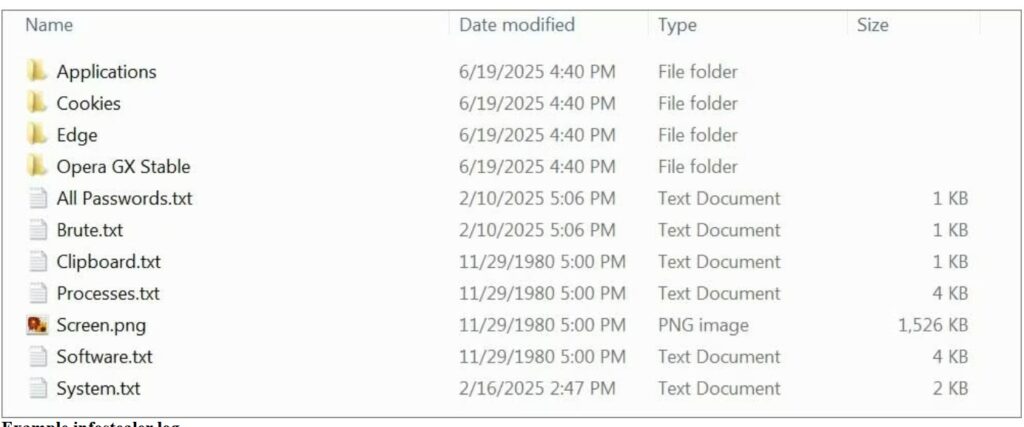
An infostealer log is generally an archive containing numerous text files and other stolen data.

Fig1:

(Image courtesy: Bleeping computers)

A devastating data breach is a nightmare for customers and affected organizations, but breaches can have a positive side also. Each incident is a learning opportunity. It’s easier to defend critical data when we understand the mistakes made by others and the tactics used by attackers.

How to be secure & keep your Data safe

If users are in midst of data breach or may find that their data is not safe as an infostealer might be there in your systems or devices then scan your device with an antivirus program. Once done then change password or your newly entered credentials could be stolen again. The system is clean so password hygiene can be maintained time to time.

At times even unique passwords won’t help you stay protected if you are hacked, fall for a phishing attack, or install malware. Its better not to change all credentials in one go instead having a cyber security hygiene in routine is better as an option.

Intru360

For organizations to stop and detect any intrusion by attackers prefer to have Intru360 in your list of cyber security go to products from Intruceptlabs.

Intru360 gives security analysts and SOC managers a clear view across the organization, helping them fully understand the extent and context of an attack. It also simplifies workflows by automatically handling alerts, allowing for faster detection of both known and unknown threats.

Globally every year cyberattacks are growing and mutating each month. Organizations have their Intelligent intrusion network detection systems in place analyze and detect anomalous traffic to face these threats.

Do visit our website for more information.

Source: https://www-bleepingcomputer-com.cdn.ampproject.org/c/s/www.bleepingcomputer.com/news/security/no-the-16-billion-credentials-leak-is-not-a-new-data-breach/amp/

Critical Privilege Escalation Vulnerability in Motors WordPress Theme

Summary: A critical privilege escalation vulnerability (CVE-2025-4322) has been identified in the Motors WordPress theme, a widely used premium theme tailored for car dealerships, rentals, and vehicle listings.

OEMWordPress
SeverityCritical
CVSS Score9.8
CVEsCVE-2025-4322
Actively ExploitedNo
Exploited in WildNo
Advisory Version1.0

Overview This vulnerability affects versions up to 5.6.67 and could allow unauthenticated attackers to reset passwords for any user, including administrators, leading to complete site compromise. The issue has been addressed in version 5.6.68, and immediate patching is strongly recommended.

Vulnerability NameCVE IDProduct AffectedSeverityFixed Version
​Privilege Escalation via Password Reset Bypass  CVE-2025-4322Motors WordPress Theme  Critical  5.6.68

Technical Summary

The vulnerability arises from insufficient input validation in the Login Register widget of the Motors theme, specifically within the password-recovery.php template. An attacker can manipulate the hash_check parameter using an invalid UTF-8 character, which is improperly sanitized by the esc_attr() function. This allows the attacker to bypass password reset validations and change passwords without authorization, even for administrator accounts.

CVE IDSystem AffectedVulnerability DetailsImpact
    CVE-2025-4322  Motors WordPress Theme (<= 5.6.67)The password-recovery.php file fails to properly validate whether the stm_lost_password_hash exists and is correct. If the hash is empty (e.g. – no reset was requested), an attacker can bypass the check using an invalid UTF-8 character. The esc_attr() sanitization strips the invalid character after validation, resulting in a successful hash match and unauthorized password update.  Complete site compromise.

Remediation:

  • Immediately update: To mitigate the vulnerability, users of the Motors WordPress theme should immediately update to version 5.6.68 or later.

Conclusion:
CVE-2025-4322 is a critical privilege escalation vulnerability affecting over 22,000+ WordPress sites using the Motors theme.

Exploiting this flaw, unauthenticated attackers can reset administrator passwords and gain full control of vulnerable sites. The vulnerability was responsibly disclosed and swiftly addressed by the vendor, with a patched version (5.6.68) released.

Given the ease of exploitation and potential for full site compromise, users are strongly advised to update immediately.

Organizations relying on the Motors theme should also implement multi-layered security practices, such as web application firewalls, routine patching, and access monitoring, to safeguard their digital assets against similar threats in the future.

References:

Recent Health Care Data Breaches Highlight Importance of Proactive Leadership

Recent data breaches on healthcare organisation be it insurance provider to  big hospitals and healthcare organisation witnesses how hackers were able to compromise the protected health information of patients.

Healthcare organisations collect an enormous amount of data and these are not only personal details but includes health insurance details, payment structure and  medical records etc. These information’s are extremely important from financial point and a big lucrative market for hackers to track down and use them for gains.

In 2024 there were 1,160 healthcare related cyber breaches, exposing 305 million patients record out in dark web a marked increase of 26% in 2025.

As of March 19, 2025, 734 large data breaches have been reported to OCR, a percentage decrease of 1.74% from the 747 large healthcare data breaches reported in 2023.

While a reduction in healthcare data breaches is a step in the right direction, 2024 was the worst-ever year in terms of breached healthcare records, which jumped by 64.1% from last year’s record-breaking total to 276,775,457 breached records, or 81.38% of the 2024 population of the United States.

The Star Health Data Breach

Star Health and Allied Insurance is delaing a difficult situation where a potential exodus of top executives following a massive data breaches affecting over 30 million customers.

The breach has led to internal cybersecurity investigations, possible financial penalties up to ₹250 crore and heightened scrutiny over leadership accountability.

Employee attrition is reportedly rising with the organization, especially in tier-2 and tier-3 cities and top it all the reputational damage and operational challenges.

The hacker responsible for a major data breach at Star Health and Allied Insurance last year has reportedly claimed responsibility for sending death threats and bullet cartridges to the insurer’s top executives.

As per reports the hacker reportedly said the recent threats were triggered after being contacted by Star Health policyholders who claimed their legitimate insurance claims were denied.

Star Health, India’s biggest health insurer, has faced criticism from customers and data security experts as per Reuters. Since last September the hacker known by alias name ‘xenZen’ had leaked sensitive client data, including medical reports. At the time, xenZen told Reuters in an email they possessed 7.24 terabytes of data related to over 31 million Star Health customers and was speaking to potential buyers for the data.

This incident brings in light top leadership crisis within the organisation.

Crisis Management is broader perspective that encompasses leadership decisions, communication strategies, stakeholder engagement, business continuity, fiscal management, and long-term reputational considerations.

Healthcare specific Cyber security performance goal(CPGs)

With record numbers of healthcare records being compromised, it is clear that more needs to be done to improve healthcare cybersecurity.

Beginning of 2024, the HHS’ Office for Civil Rights published two sets of healthcare-specific cybersecurity performance goals (CPGs).

In December 2024, the HHS published a long-awaited proposed update to the HIPAA Security Rule that will, if enacted, force healthcare organizations to implement a range of measures to improve their security posture. The proposed update includes some of the recommended measures in the CPGs, such as multifactor authentication, encryption for data at rest and in transit, mitigating known vulnerabilities, network segmentation, maintaining an accurate asset inventory and cyber security testing.

Stable Leadership to deal with un-certainties  of cyber threats

Organisations under stable leadership must undertake a rigorous risk-assessment process that encompasses disaster mitigation. This will include cyber incident recovery and business continuity planning to support the resilience of critical health care functions and systems. 

With strong new leadership companies can adopt bold steps to regain trust by investing heavily in cyber security infrastructure. This is led by launching new products focused on identity protection.

Having a transparent approach in addressing vulnerabilities and commitment to innovation will help restore customer confidence and set a new industry standard for data protection. To turn cybersecurity threats into oppertunites, CEO and CISO’s must embrace a multifaceted leadership approach to deal with advance cyber tactics employed by hackers and cyber criminals.

To go beyond technical solutions and extends to cultural, strategic and operational changes.

Adopting a cyber-security first culture within the Organization

  • First and foremost it is important to foster a security-first culture within an organization is critical. This will involve embedding cyber security considerations into every level of business decision-making.
  • Organisations and top leadership taking decisions from development to customer engagement. Leadership must set the tone by prioritizing security as a fundamental business value .
  • Cyber security training a must within the organisation will help build a culture that requires continuous reinforcement through regular training, internal etc.
  • The next step would be ad frameworks that allow businesses to quickly pivot in response to emerging risks.
  • The next step would be adopting frameworks that will allow business to quickly scale and impose proper response during emergency or any cyber threat.
  • The growing cyber risk is also an opportunity for cyber security leadership to stay ahead of their adversaries by improving certain aspects like involving real time threat visibility, gathering actionable insights from industry partners etc.. This will enable proactive security measures  that is resilient in building a cyber-security strategy . To reduce the after affect of breaches, top leadership must adopt cross-functional collaboration and investing in ongoing education to create a more security-conscious workforce.
  • All in all a proactive cyber security strategy will help organizations and this is possible by embracing innovation and having a transparent and proactive leadership.

A strong leadership will help to mitigate risks and enhance organisations competitive standing in the market. This can be followed by Iidentifing not only technical vulnerabilities but also operational weaknesses, supply chain risks, and human factors or insider threat .

.

Cyber Security News at a Glance; May 2025

For the month of May 2025 here are the Top News including Security Advisory & Blogs

Tesla Model 3 VCSEC Vulnerability Allows Remote Code Execution via TPMS Exploit

A high-severity vulnerability (CVE-2025-2082) in Tesla Model 3’s Vehicle Controller Security (VCSEC) module allows attackers within wireless range to remotely execute arbitrary code by exploiting a flaw in the Tire Pressure Monitoring System (TPMS)

The FBI issued an alert warning of ongoing exploitation of 13 EOL Linksys/Cisco routers by cybercriminal groups operating the 5Socks and Anyproxy services.

Microsoft May 2025 Patch Tuesday Released; Fixed 83 Vulnerabilities, Including 5 Zero-Days

Microsoft addressed 83 vulnerabilities across its product suite. Among them are 5 zero-day vulnerabilities have been confirmed as actively exploited in the wild. The updates span Windows components, Office, Visual Studio, and other core services.

11 vulnerabilities were rated critical, emphasizing the importance of timely remediation especially for enterprise environments.

5 non-Microsoft CVEs included

78 Microsoft CVEs addressed

Critical SAP NetWeaver Vulnerabilities Addressed in May 2025 Patch – Immediate Action Required 

SAP has released critical security updates for its May 2025 patch, including fixes for two actively exploited zero-day vulnerabilities in SAP NetWeaver Visual Composer.

SAP Visual Composer is not installed by default, however it is enabled because it was a core component used by business process specialists to develop business application components without coding.

CISA is officially changing the way it disseminates online security updates and guidance.

CISA says the enhanced information dissemination system will from now on use social media and email only to disperse cybersecurity alerts and advisories, saving its landing page for more critical warnings on May 12.

Updates on May 13

Just a day after announcing it was changing the way it sent out alerts, CISA has changed its mind and reverted back to its old system of putting everything on its website.

“We recognize this has caused some confusion in the cyber community,” the site now reads. “As such, we have paused immediate changes while we re-assess the best approach to sharing with our stakeholders.”

Zero-Day Threat in Chrome’s Loader Component (CVE-2025-4664) – CISA Flags Urgent Risk 

A zero-day vulnerability (CVE-2025-4664) in Google Chrome’s Loader component has been actively exploited in the wild.This flaw allows attackers to bypass security policies, leak cross-origin data, and potentially execute unauthorized code. CISA has added this vulnerability to its Known Exploited Vulnerabilities (KEV) catalog, urging immediate patching. 

Identity Based Attacks, the Growing Risk; How do Orgs’ Navigate

In 2025 identity based attacks have surged up and research reveals how identity based attacks  have affected  identities, endpoints and cloud assets over 4 million past year as reported by threat detection report 2025 by  Red Canary.

As organizations grow and continue to harness technology, identity based attacks grow to and risk associated with them. And this brings us to understand he urgent need for strong identity protection as adversaries explore new techniques.

The Threat landscape is vast and have variety to support the attack includes evolving ransomware tactics, supply chain weaponization and attacks on non-human identities.

In this blog we take a look at what rate identity based attacks are growing and what is required to strengthen organizational strategies for resilience.

Of late the type of attacks that are taking center stage are Social engineering based attacks that has gained popularity as per CrowdStrike report.

Voice phishing (vishing) attacks surged by 442% between the first and second half of 2024 as groups like CURLY SPIDER trick employees into handing over login details.

Those who don’t steal credentials can buy them — access broker activity was up nearly 50% in 2024, reflecting the growing market for illicit access.

Further, more than half (52%) of observed vulnerabilities in 2024 were tied to initial access.

The weakest link in Identity threats

With the usage of cloud most of the enterprises are shifting workload to cloud or hybrid cloud environment and now cloud infrastructure remains one of the points where frequency of attack has increased to achieve initial access.

This also includes increases in  macOS threats, info stealers and business email compromise. VPN based abuse is hard to detect so a easy gateway for criminals to launch ransomware based attacks and these products are actually leveraging identity based attacks including insider threats.

Threat researchers from Sygnia have noticed misconfigured Identity and Access Management (IAM) policies are one of the biggest culprits in creating openings for lateral movement and privilege escalation by attackers.

Popular social media websites and apps are breeding grounds for identity based attack that started from social engineering tactics being deployed by state sponsored threat groups to deliver their harmful intentions.

Example: Hackers gained access to Microsoft 365 tenant and authenticated against Entra ID using captured session tokens. This technique not only bypassed multi-factor authentication (MFA), but also circumvented other security controls that were in place.

AWS access keys were discovered on the compromised devices as well, giving the attackers two ways into the AWS environment—through direct API access and the web console via compromised Entra ID users.

Now business are looking to move beyond passwords and weak MFA. Passkeys, Biometric authentication, Risk-based access, and Continuous identity verification will become non-negotiable.

Bolstering organizations identity governance, adopting zero trust principles and participating in identity-focused red team assessments will be the need of the hour.

What can security leaders do to Stay Ahead of Identity-Based Attacks in 2025?

Passwords aren’t enough these day nor are MFA as attackers are advanced in techniques and wont wait to break authentication when they can bypass, manipulate, or socially engineer their way in.

  • Go passwordless: FIDO2, Passkeys, Biometrics are not required or eliminate them
  • Enforce phishing-resistant authentication: No SMS, no email-based resets, no security questions.
  • Implement real-time identity monitoring: Spot privilege escalations before attackers use them.
  • Require device trust: If a device isn’t secure you are not secured.

Organizations can stay ahead of this growing threat by leveraging GaarudNode which seamlessly integrate to detect and mitigate exposed credentials in real time. 

GaarudNode is an all-in-one solution designed to empower development teams with the tools they need to secure their applications throughout the development lifecycle. By combining the power of SAST, DAST, SCA, API security, and CSPM, GaarudNode provides a comprehensive security framework that ensures your applications are built, tested, and deployed with confidence.
GaarudNode Identifies security flaws early in the development process by scanning source code, helping developers detect issues like insecure coding practices or logic errors.
Tests running applications in real-time to identify vulnerabilities such as SQL injection, Cross-Site Scripting (XSS), and other runtime threats.
Detects third-party libraries and open-source components, ensuring that your dependencies don’t introduce risks.
Continuously tests and monitors your APIs for vulnerabilities such as authentication flaws, data exposure, and insecure endpoints.


Do connect or DM for queries

Source: https://www.crowdstrike.com/en-us/blog/how-to-navigate-2025-identity-threat-landscape/

Intruder Alert! Security Breach Leading to Data Breach

Recently 2.9 billion records of data stolen in cyber breach from National Public Data that includes Social Security numbers. Cyber experts assume that sensitive information including Social Security numbers for millions of people could be in the hands of a hacking group.

Reports suggest that after the breach occurred the data may have been released on an online marketplace or dark web.

What does this mean and how does organizations fight to save their clients and brand value?

It is a big question and something that can give restlessness to CISO’s and security teams. The results of breach remains for months and the impact too. This can result in financial losses and if hackers can have unauthorized access to online accounts or financial documents, the result is far reaching.

What it can do is first damage the brand value and result in expenses incurred from investigations.

This include legal fees for lawyers and if suit is bought by any customer or client and goes up to customer notification including compensation, fines.

Loosing brand value due to breach affects regaining the confidence of customers or partners and clients. This is long term as chance of possible loss of business opportunities and lasting reputational damage exist.

Gaining unauthorized access to a device or system leads to security breach and that leads to data breach or other malicious activity and as we know the devastating consequences for organizations at large. Now this can be defined as being over powering and surpassing all security measures that protect data or network systems of the organization including physical hardware assets.

Mostly we are accustomed with few names as

Malware: The attacker infects a system with malware that’s designed to steal sensitive data, hijack system resources.

Phishing: This technique involves a seemingly legitimate email or text or fake websites that come in surface as a scam

Physical asset: Sometimes  attackers gets involved in stealing or meddling with a piece of organizations assets if he can hold on the equipment, tool to get access in enterprise system and steal data.

Breach details of national Public Data:

The hacking group USDoD claimed it had allegedly stolen personal records of 2.9 billion people from National Public Data, according to a class-action lawsuit filed in U.S. District Court in Fort Lauderdale, Florida, reported by Bloomberg Law. The breach was believed to have happened in or around April, according to the lawsuit.

One major aspect of the breach is the data also included information about the individuals’ relatives. One of the unique aspects of the data was the longevity — the addresses spanned decades of residence, and some relatives have been deceased for as long as two decades.

In addition to neglecting to inform the victims, National Public Data has not released a public statement regarding the breach. The Los Angeles Times reported that the company responded to email inquiries with “We are aware of certain third-party claims about consumer data and are investigating these issues.” The lawsuit mentions the lack of notification as a top concern of the Plaintiff.

(Source: www.usatoday.com)

In recent years, plenty of high-profile examples of security breaches have captured public attention . One security breach that actually captured attention was the Nvidia breach in 2022.

Nvidia, a major chip manufacturer, experienced a cyberattack where up to 1TB of data was stolen, including employee credentials and proprietary information.

The impact was that Hackers demanded Nvidia remove limitations on its GPUs, and internal source code was leaked. The company had to take several security measures to mitigate further damage.

This incident proved that hackers and cybercriminals are in equal terms powerful in their methods and tactics as cyber security teams . Each hacker pushed the boundaries of what was thought possible in the cyber world and their actions have had far-reaching consequences.

They targeted financial institutions and government agencies to exposing vulnerabilities in national defense systems. These incidents have served as wake-up calls, highlighting the critical need for robust cybersecurity measures and a better understanding of digital ethics and law

Preventing security breach:

Enterprise and security teams at times may take more time to rectify or better to prevent a security breach than to resolve one after it occurs. Though not all security breaches are avoidable, applying a few tried-and-tested best practices is always on the cards.

Tips for Best practices for preventing data breaches

Data breach prevention requires a comprehensive, proactive approach and a enterprise level if ots followed its better for security measure to remain strong that are being implemented.

  • A secure coding principles in best practice strategy: Writing secure code involves following best practices such as avoiding hardcoded credentials, implementing input validation, and ensuring proper data encryption. This way organization can reduce vulnerabilities that attackers might exploit.
  • Conducting Regular security audits: Conducting penetration testing and threat modeling helps identify weaknesses in your security framework and routine security assessments to mitigate potential threats.
  • Implementing practices with DevSecOps: Embedding security into the SDLC ensures security considerations are addressed at every stage of development. By integrating application security testing and practices like shift left testing into software development workflows, organizations can identify and fix vulnerabilities early in the process.
  • Creating incident response plans: Having a clear incident response plan allows organizations to detect, contain, and mitigate security breaches more efficiently. Security teams get enough time and  can respond quickly to security incidents, minimizing damage and reducing downtime.
  • Security training for Teams : Educating development teams on cybersecurity best practices helps them recognize threats and implement secure coding practices. Security teams should stay updated on emerging threats and modern security measures.

Protect yourself with GaarudNode from Intruceptlabs

GaarudNode is an all-in-one  solution designed to empower development teams with the tools they need to secure their applications throughout the development lifecycle. By combining the power of SAST, DAST, SCA, API security, and CSPM, GaarudNode provides a comprehensive security framework that ensures your applications are built, tested, and deployed with confidence.

  • Our Platform:
    • Identifies security flaws early in the development process by scanning source code, helping developers detect issues like insecure coding practices or logic errors.
    • Tests running applications in real-time to identify vulnerabilities such as SQL injection, Cross-Site Scripting (XSS), and other runtime threats.
    • Detects vulnerabilities in third-party libraries and open-source components, ensuring that your dependencies don’t introduce risks.
    • Continuously tests and monitors your APIs for vulnerabilities such as authentication flaws, data exposure, and insecure endpoints.

Do connect or DM for queries

(Sources:https://www.ibm.com/think/news/national-public-data-breach-publishes-private-data-billions-us-citizens)

Critical Flaw in FortiSwitch of Fortinet Allows Attackers to Change Admin Password

An unverified password change vulnerability [CWE-620] in FortiSwitch GUI discovered.

This may allow a remote unauthenticated attacker to modify admin passwords via a specially crafted request as per Fortinet advisory released.

Summary

OEMFortinet 
SeverityCRITICAL
CVSS Score9.8
CVEsCVE-2024-48887
Actively ExploitedYes
Exploited in WildYes
Advisory Version1.0

Overview

Fortinet’s FortiSwitch product line has revealed a significant vulnerability noted as CVE-2024-48887. This flaw allows unauthenticated remote attackers to change administrative passwords by sending specially crafted requests to the device’s password management endpoint. With a CVSS score of 9.8, the vulnerability is classified as Critical and is actively being exploited in the wild.

Vulnerability NameCVE IDProduct AffectedSeverityCVSS Score
A unverified password change vulnerability  CVE-2024-48887Fortinet   CRITICAL  9.8

Technical Summary

A critical vulnerability (CVE-2024-48887) has been identified in Fortinet FortiSwitch devices, affecting versions 6.4.0 through 7.6.0. This flaw resides in the web-based management interface and allows remote, unauthenticated attackers to change administrator passwords by sending a specially crafted HTTP request to the set_password endpoint.

CVE IDSystem AffectedVulnerability DetailsImpact
    CVE-2024-48887  FortiSwitch v7.6, 7.4, 7.2, 7.0, 6.4CVE-2024-48887 is an unauthenticated password change vulnerability in FortiSwitch web GUI.
It enables remote unauthenticated attackers to modify admin passwords through crafted requests to the set_password endpoint.
    Unverified Password Change

Remediation:

  • Apply Security Patches: Install the latest security update for your FortiSwitch version. Fortinet has fixed the issue in 6.4.15 and above,7.0.11 and above,7.2.9 and above,7.4.5 and above,7.6.1 and above versions.

General Recommendations

  • Update Devices Regularly always install the latest firmware and security patches from Fortinet to fix known vulnerabilities.
  • Limit access to the FortiSwitch web GUI to trusted IP addresses and disable HTTP/HTTPS access if it is not required.
  • Set strong and unique passwords and change them regularly to prevent unauthorized access.
  • Monitor unusual Activity for suspicious logins or configuration changes.

Conclusion:


The CVE-2024-48887 vulnerability poses a serious security risk to organizations using affected FortiSwitch devices. Its ease of exploitation and the lack of authentication required make it particularly dangerous.

Organizations must act immediately by applying the relevant security patches, limiting administrative access, and monitoring for unusual activity.

References:

Scroll to top