cyber security news

New Malware Framework Highlight Attackers Tactics; Gain Browser Access

New malware TencShell, a previously undocumented, Go-based implant derived from the open-source Rshell C2 framework targets manufacturing based enterprises. The malware’s activity appeared in traffic associated with a third-party user connected to the customer environment. The malware framework is based on screen control, browser artifact access and User Account Control (UAC) bypass that highlights how attackers are increasingly adapting open-source tools for real-world intrusions. Their attack pattern reveal careful design that can blend into normal enterprise traffic.

The tactics was revealed in April 2026, when Cato CTRL identified and blocked an attempted intrusion against a global manufacturing customer involving TencShell.

The malware has been previously undocumented, Go-based implant derived from the open-source Rshell C2 framework.

The activity appeared in traffic associated with a third-party user connected to the customer environment.

Malware attack chain

The attack chain used a first-stage dropper, Donut shellcode, a masqueraded .woff web-font resource, memory injection, and web-like C2 communication.

Activity noticed an suspected China-linked based on the apparent Rshell lineage, Tencent-themed API impersonation, and infrastructure patterns, While this pattern is relevant to our suspected China-linked assessment, it is not sufficient on its own for attribution.

If successful, TencShell could have given the attacker remote command execution, in-memory payload execution, proxying, pivoting, system profiling, and a path to deploy additional tooling. We blocked the attempt before the attacker could establish durable remote control.

Command & control framework

A C2 framework deployed through third-party access can turn a trusted business connection into an attacker-controlled bridge.

According to Cato CTRL, TencShell is a customized, Go-based implant derived from the open-source Rshell in C2 framework.

Security analysts suspect the malware has ties to Chinese threat actors, largely due to its infrastructure patterns and its clever impersonation of Tencent API services, which are designed to camouflage malicious communication.

If TencShell had installed successfully, the attacker could potentially execute commands, inspect files, steal credentials or session material, stage additional tools, proxy traffic through the endpoint, and move toward internal systems that are not directly exposed to the internet.

Business Risk for manufacturers posed by the Malware

From the standpoint of manufacturers across the globe, the business risk extends beyond. If any endpoint connected is compromised to a regional site can further expose supplier relationships, production workflows, intellectual property, customer data, logistics processes and business continuity.

The C2 framework gives the attacker the control needed to decide what comes next.

What can attackers do from operational standpoint

To evade endpoint defenses, attackers can execute inline binaries, load dynamic link libraries and run .NET assemblies directly from memory.

The framework also enables operators to establish SOCKS5 proxies, allowing them to tunnel traffic and pivot deeper into segmented internal systems.

TencShell is derived from Rshell, an open-source Go-based C2 framework designed for cross-platform offensive security use. The original Rshell project includes remote command execution, file and process management, terminal access, in-memory payload execution, multiple C2 transports, and an MCP server. The version we observed was customized and repackaged for this operation, with communication and delivery changes that made it more suitable for the attacker’s campaign.

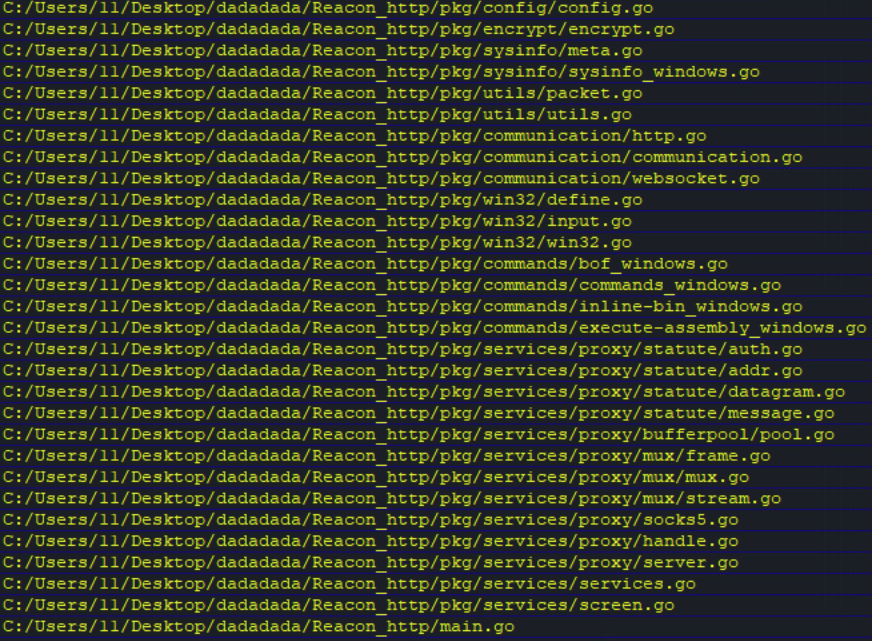
Embedded Go source paths in TencShell exposed the Reacon project structure and the threat actor user, as shown in Figure 1.

TencShell

Figure 1. TencShell Go paths revealing the threat actor’s REACON project

Conclusion: The framework for Malware classification system (MCS) if adopted to analyze malware behavior dynamically using a concept of information theory and a machine learning technique will be useful for manufacturing organizations.

Any proposed framework will extracts behavioral patterns from execution reports of malware in terms of its features and generates a data repository. The specific aim of any proposed framework detects the family of unknown malware samples after training of a classifier from malware data repository. 

Security researchers have the opinion, attackers no longer need custom malware development pipelines to conduct sophisticated intrusions. Adaptable open-source tooling is often enough for implementation and TencShell appears to have been customized from Rshell into a practical post-exploitation implant with web-like C2 communication. This assited the attacker to adapt available offensive tooling and attempted to blend the activity into normal enterprise traffic.

Sources: https://www.catonetworks.com/blog/cato-ctrl-suspected-china-linked-threat-actor-targets-global-manufacturer/

Chrome Latest Update Fixes Multiple High-Severity Security Flaws 

Summary : The recent Google Chrome update fixed several serious security issues that could let hackers take control of the browser or steal personal data. These vulnerabilities were mostly related to memory handling and scripting errors in important parts of Chrome like the JavaScript engine (V8) and browser interfaces.

OEM Google 
Severity High 
CVSS Score 8.8 
CVEs CVE-2025-12725, CVE-2025-12726, CVE-2025-12727, CVE-2025-12728, CVE-2025-12729 
POC Available No 
Actively Exploited No 
Exploited in Wild No 
Advisory Version 1.0 

Overview 

Problems like type confusion and memory misuse could allow attackers to run harmful code just by making users visit malicious websites. Some flaws also affected Chrome’s UI, media processing and extension systems exposing users to possible unauthorized access or data leaks. 

                Vulnerability Name CVE ID Product Affected Severity Fixed Version 
Out-of-Bounds Write in WebGPU  CVE-2025-12725 Chrome   High 142.0.7444.134/135 
Inappropriate Implementation in Views (UI Rendering)  CVE-2025-12726 Chrome  High 142.0.7444.134/135 
Inappropriate Memory Handling in V8 JavaScript Engine CVE-2025-12727 Chrome  High 142.0.7444.134/135 
Inappropriate Implementation in Omnibox (Unified Search Bar) CVE-2025-12728 Chrome  Medium 142.0.7444.134/135 
Inappropriate Implementation in Omnibox (Unified Search Bar) CVE-2025-12729 Chrome  Medium 142.0.7444.134/135 

Technical Summary 

The bugs included memory corruption issues such as out-of-bound writings and use-after-free errors, which can lead to unpredictable behavior and remote code execution (RCE).

The JavaScript engine vulnerabilities involved mishandling data types or incorrect implementation, enabling attackers to break security boundaries.

Other issues involved UI security logic problems that could mislead users or weaken protections. Google patched all these weaknesses by tightening input validations, fixing memory lifecycle bugs, correcting UI behavior and strengthening internal security checks. 

CVE ID Component Affected  Vulnerability Details Impact 
 CVE-2025-12725 Google Chrome (WebGPU) Out-of-bounds write in WebGPU due to improper bounds checking, allowing attackers to overwrite memory beyond allocated limits.  Remote Code Execution / Browser Crash 
 CVE-2025-12726 Google Chrome (Views UI) Inappropriate implementation in the Views component causing memory corruption. UI rendering 
CVE-2025-12727 Google Chrome (V8 Engine) Improper handling in the V8 JavaScript engine enabling potential arbitrary code execution through crafted scripts. Remote Code Execution  
CVE-2025-12728 Google Chrome (Omnibox) Flaws in Omnibox’s implementation could allow UI spoofing or navigation bar manipulation. UI Spoofing  
CVE-2025-12729 Google Chrome (Omnibox) Similar flaws in Omnibox affecting input validation, leading to potential security bypasses or deceptive UI. UI Spoofing / Security Bypass 

Recommendations 

Update Chrome immediately to the following versions: 

  • For windows 142.0.7444.134/.135  
  • For MacOS 142.0.7444.135 
  • For Linux 142.0.7444.134 

You can update by Open Chrome Settings → Help → About Google Chrome, then allow Chrome to check for and install updates immediately. 

Along with update you can follow the recommendations below as well 

  • Enforce Chrome auto-updates across managed endpoints using enterprise policy controls. 
  • Actively monitor browser crash reports or any suspicious logs potentially linked to exploit attempts. 
  • Use vulnerability & patch management tools to ensure all endpoints are running the latest version of all applications.  

Conclusion: 
The Chrome security flaws can compromise devices just through browsing. Because millions use Chrome daily, these gaps were a high risk and google already patched those issues. Keeping any application to the latest version which is the best defense against cyber threats aiming at browsers. 

References

Apple Releases iOS & iPadOS 26.1 Update, Fixed Multiple Security Vulnerabilities 

Summary: Apple released iOS 26.1 and iPadOS 26, addressed multiple security vulnerabilities across core system components including WebKit, Kernel, Accessibility, Apple Neural Engine, CloudKit etc.

OEM Apple 
Severity High 
CVEs CVE-2025-43438, CVE-2025-43429, CVE-2025-43442, CVE-2025-43455, CVE-2025-43398 & others 
POC Available No 
Actively Exploited No 
Exploited in Wild No 
Advisory Version 1.0 

Overview: 

These vulnerabilities could enable malicious apps to escape sandboxes, access sensitive user data, execute arbitrary code via web content, monitor keystrokes or disable theft protection mechanisms. Affected devices include iPhone 11 & later and iPad models from 3rd gen onward etc. Immediate update is strongly recommended to prevent any breaches, system crashes. 

                Vulnerability Name CVE ID Product Affected Fixed Version 
WebKit Use-After-Free (Safari Crash/RCE) CVE-2025-43438 iOS, iPadOS iOS/iPadOS 26.1 
WebKit Buffer Overflow (RCE Risk)  CVE-2025-43429 iOS, iPadOS iOS/iPadOS 26.1 
App Installed Detection via Accessibility  CVE-2025-43442 iOS, iPadOS iOS/iPadOS 26.1 
Sensitive Screenshot in Embedded Views CVE-2025-43455 iOS, iPadOS iOS/iPadOS 26.1 
Kernel Memory Corruption / DoS  CVE-2025-43398 iOS, iPadOS iOS/iPadOS 26.1 

Technical Summary: 

The iOS/iPadOS 26.1 update fixes major security issues in sandbox protection, memory handling, privacy settings, and the WebKit browser engine. These critical vulnerabilities could allow apps or websites to access restricted data or execute malicious code. Key impact issues mentioned below.

CVE ID Component Affected  Vulnerability Details Impact 
 CVE-2025-43438 WebKit Use-after-free in Safari triggers crash or code execution via malicious web content  Remote Code Execution, System Compromise 
 CVE-2025-43429 WebKit Buffer overflow in content processing allows arbitrary code execution Remote Code Execution, Service Compromise 
CVE-2025-43442 Accessibility Permissions flaw allows apps to detect installed apps (fingerprinting) Privacy Violation, User Tracking 
CVE-2025-43455 Apple Account Malicious apps can screenshot sensitive embedded UI (login views) Credential, PII Exposure 
CVE-2025-43398 Kernel Memory mishandling leads to system termination or kernel corruption Denial of Service, Potential Privilege Escalation 

Additionally, there are multiple high & medium vulnerabilities have been disclosed that enable sandbox escapes, data leaks, and web-based attacks with significant impact potential. Here are some cves in the below table 

Vulnerability Name CVE ID Affected Component 
Sandbox Escape via Assets CVE-2025-43407 Assets 
Sandbox Escape via CloudKit Symlink CVE-2025-43448 CloudKit 
Stolen Device Protection Bypass CVE-2025-43422 Stolen Device Protection 
Cross-Origin Data Exfiltration CVE-2025-43480 WebKit 
Keystroke Monitoring via WebKit CVE-2025-43495 WebKit 
Apple Neural Engine Kernel Corruption CVE-2025-43447, CVE-2025-43462 Apple Neural Engine 
Canvas Cross-Origin Image Theft CVE-2025-43392 WebKit Canvas 
Contacts Data Leak in Logs CVE-2025-43426 Contacts 
Lock Screen Content Leak CVE-2025-43350 Control Center 
Address Bar Spoofing CVE-2025-43493 Safari 
UI Spoofing in Safari CVE-2025-43503 Safari 

Recommendations: 

Update all eligible devices immediately (Settings > General > Software Update products) to the following fixed versions as soon as possible and check the updated version from the Apple security website

Patches are available and should be applied immediately.  

For environments where immediate patching is not immediately feasible, you can also follow the recommendations below. 

  • Enable Stolen Device Protection and Lockdown Mode (where applicable) 
  • Restrict app installations to trusted sources. 
  • Avoid visiting untrusted websites from browser 
  • Use VPN and enable Advanced Data Protection for iCloud 
  • Monitor for anomalous app behavior or battery drain  

Conclusion: 
The iOS/iPadOS 26.1 update fixes several security vulnerabilities that could affect user privacy, device stability, and system protection.

Organizations and Individual using Apple devices must prioritize deployment of this update to mitigate risks of data exfiltration, spyware and other attack vectors. Timely patching remains the most effective control against zero-day exploitation on new vulnerabilities in digital ecosystems. 

References

Critical Apache Tomcat Vulnerabilities Enable RCE 

Summary : Security Advisory : Apache Tomcat’s security updates address two critical issues affecting widely deployed server components. Attackers can now exploit flaws in Apache Tomcat where improper URL handling and inadequate input neutralization allow unauthorized access to restricted directories.

OEM Oracle 
Severity Critical 
CVSS Score 9.6 
CVEs CVE-2025-55754, CVE-2025-55752 
POC Available No 
Actively Exploited No 
Advisory Version 1.0 

Overview  One issue allows attackers to bypass URL protections and upload malicious files, leading to remote code execution if misconfigured and another permits attackers to manipulate console outputs on Windows systems using crafted log entries.

Organizations should promptly update their servers, review configuration settings and enhance monitoring to mitigate these risks. 

Vulnerability Name CVE ID Product Affected Severity Affected Version 
Improper Neutralization of Escape, Meta, or Control Sequences Vulnerability CVE-2025-55754 Apache Tomcat Critical 11.0.0-M1 through 11.0.10,  10.1.0-M1 through 10.1.44,  9.0.0.40 through 9.0.108. 
Path Traversal Vulnerability  CVE-2025-55752 Apache Tomcat  High 11.0.0-M1 through 11.0.10, 
10.1.0-M1 through 10.1.44, 9.0.0.M11 through 9.0.108. 

Technical Summary This enable malicious file uploads, and inject control sequences affecting console behavior or system integrity.

These weaknesses increase the risk of unauthorized code execution and compromise of application environments. 

CVE ID Component Affected Vulnerability Details Impact 
CVE-2025-55752 URL Rewrite Handler (Apache Tomcat Core) A directory traversal flaw resulting from improper URL normalization and decoding order, allowing attackers to bypass /WEB-INF/ and /META-INF/ protections. If PUT requests are enabled, malicious actors can upload files to sensitive directories, potentially executing arbitrary code. Remote code execution, full server compromise if Tomcat is misconfigured with PUT enabled. 
CVE-2025-55754 Logging/Console Output Improper neutralization of ANSI escape sequences in Tomcat log messages allows crafted URLs to inject control sequences. On Windows systems with ANSI-capable consoles, attackers can manipulate the console display and clipboard or potentially induce command execution via social engineering. Console manipulation, potential administrator trickery, clipboard hijacking; less severe but can be chained for larger attacks. 

Recommendations 

Update Apache Tomcat to the following versions immediately: 

  • For 11.x version updated to v11.0.11 or latest 
  • For 10.x version updated to v10.1.45 or latest 
  • For 9.x version updated to v9.0.109 or latest 

If you not updating immediately you can follow some recommendations below 

  • Disable or restrict PUT requests unless absolutely needed to prevent unauthorized file uploads. 
  • Limit network access to Tomcat management interfaces to trusted administrators and secure sensitive directories. 
  • Monitor logs and serves activity regularly for unusual or suspicious behavior indicative of exploitation attempts. 

Conclusion: 
The patches released by Apache Tomcat fix critical remote code execution and console manipulation bugs that could compromise servers.

Though no widespread exploitation is confirmed yet, immediate patching is strongly recommended to prevent serious security incidents. Security teams should apply these updates and monitor any suspicious server activity. 

References

Scroll to top