Emergency Patch Issued by Fortinet in Latest FortiClient Vulnerabilities
Emergency Patch Issued by Fortinet for FortiClient for Vulnerability
Continue Reading

Emergency Patch Issued by Fortinet for FortiClient for Vulnerability
Continue Reading
CVE-2026-20160, Vulnerability in CISCO’s smart software manager may allows attackers to gain complete control over the affected system without needing authentication which is gaining prior access to exploit the system. The CVSS severity score of 9.8 out of 10, indicating its high risk level.
Authentication and access controls play a crucial role in web application and system security. What can happen?
CISCO’s Smart Software Manager Flaw
In this case the vulnerability exposure allowed unauthorized access, as attackers do not need login credentials when a hacker can execute arbitrary commands on the operating system. Further escalating by creating crafted request to the service’s API. The vulnerability impacted certain versions of the Cisco SSM On-Prem environments, particularly software releases from 9-202502 to 9-202510.
Remediation for organizations
Organizations can prevent authentication bypass through regular patching, multi-factor authentication, encryption, and strong password policies.
The vulnerability did not impact CISCO’s smart software newly released version 9-202601 includes a patch that fixes the flaw.
Cisco advises to upgrade to version 9-202601 immediately, as there are no current workarounds or temporary mitigations to block potential attacks.
For IT teams notes include devices meet the necessary memory and hardware specifications before proceeding with the update.
Key findings from CVE-2026-20160 Vulnerability
The vulnerability was discovered internally by Cisco’s Technical Assistance Center (TAC) team and they found no immediate exploitations in the wild
With the disclosure can motivate hackers to reverse-engineer the patch and search for vulnerable systems. Following Cisco’s guidelines and maintaining up-to-date security measures will be essential in mitigating risks associated and stop any kind of data breaches.
Conclusion:
Research shows that, making timely patching critical for authentication security is essential and failing to do that can lead to data breaches.
The Cisco Product Security Incident Response Team (PSIRT) validates only the affected and fixed release information that is documented in this advisory. Cisco strongly recommends that customers upgrade to the fixed software indicated in this advisory.
Sources: Cisco Smart Software Manager On-Prem Arbitrary Command Execution Vulnerability

vulnerability in the Smart Slider 3 WordPress plugin
Continue Reading
SOPHOS Report Find Leadership Gap in Cyber security Domain and CISO’s Role cannot be undermined.
Continue Reading
PTC has issued an urgent advisory regarding a critical Windchill and FlexPLM vulnerability that exposes affected systems to Remote Code Execution (RCE). The flaw, identified as CVE-2026-4681, has been classified as a code injection vulnerability (CWE-94) and carries a CVSS v3.1 base score of 10.0 and CVSS v4 score of 9.3.
Vulnerability details:
The company says that it has not found any evidence that the vulnerability is being exploited against PTC customers. However, PTC published a set of specific indicators of compromise (IoCs) that include a user agent string and files.
The flaw affects a broad range of Windchill PDMLink and FlexPLM releases, specifically:
Remediation: PTC is actively developing and releasing security patches for all supported Windchill versions to address the identified vulnerability
Immediate Mitigation Steps
PTC has issued specific guidance to reduce the risk until official security patches are released. These steps include:
For Apache HTTP Server
<LocationMatch “^.*servlet/(WindchillGW|WindchillAuthGW)/com.ptc.wvs.server.publish.Publish(?:;[^/]*)?/.*$”>
Require all denied
For Microsoft IIS
PTC advises applying the same workaround steps to File Server or Replica Server configurations and notes that older Windchill releases may require adjusted procedures.
Additional Protection Measures
For organizations unable to immediately implement mitigations, PTC recommends temporarily shutting down Windchill or FlexPLM services or disconnecting systems from the public Internet.
PTC has also committed to 24×7 customer support for all users affected by this critical vulnerability. For PTC cloud-hosted customer.
Indicators of Compromise
Advisory for security Teams to monitor for specific signs that may indicate exploitation of the Windchill vulnerability or FlexPLM vulnerability:
Network and User-Agent Patterns
File System Indicators
The presence of these files indicates that a potential attacker may have prepared the system for Remote Code Execution.
Log and Error Patterns
PTC strongly urges customers to report any identified
Log and Error Patterns
Source: https://www.ptc.com/en/about/trust-center/advisory-center/active-advisories/windchill-flexplm-critical-vulnerability?srsltid=AfmBOooLDdBNS2lOeRasqrbyOfjfVKyhJH6Z_wfzqO93k3cqVQcSueEv
NIST cybersecurity Framework 2.0
Continue Reading
Parse Server Authentication Bypass via partial authData; Successful exploitation Lead to Creating Valid User Session
Continue Reading
Microsoft Tuesday Patch March 2026 fixes 83 Vulnerabilities Including 2 Actively Exploited Zero-Days
Continue Reading
Summary : YARA is an open-source pattern matching engine widely used by malware researchers, SOC teams, and threat intelligence platforms to identify and classify malware using detection rules. It plays a critical role in malware analysis pipelines, endpoint detection systems, and threat hunting operations.
Kamil Frankowicz discovered that a number of YARA’s functions generated memory exceptions when processing specially crafted rules or files. A remote attacker could possibly use these issues to cause YARA to crash, resulting in a denial of service.
| OEM | Virus Total / YARA Project (Tool) |
| Severity | Critical |
| CVSS Score | 9.1 |
| CVEs | CVE-2021-3402, CVE-2021-45429, CVE-2019-19648, CVE-2018-19974, 2018-19975, 2018-19976 |
| POC Available | No |
| Actively Exploited | No |
| Exploited in Wild | No |
| Advisory Version | 1.0 |
Overview
Ubuntu has released a security advisory addressing multiple vulnerabilities in YARA that could allow attackers to cause denial-of-service conditions, disclose sensitive information, or potentially execute arbitrary code when processing specially crafted files or rules.
These vulnerabilities affect Ubuntu 16.04 LTS, 18.04 LTS, and 20.04 LTS depending on the specific issue. Organizations using YARA in security monitoring systems, malware sandboxes, or automated threat detection workflows should apply the security updates immediately.
| Vulnerability Name | CVE ID | Product Affected | Severity | CVSS Score | Fixed Version |
| Mach-O Parser Overflow Read Vulnerability | CVE-2021-3402 | YARA | Critical | 9.1 | Updated Ubuntu packages |
| Mach-O File Parsing Out-of-Bounds Access | CVE-2019-19648 | YARA | High | 7.8 | Updated Ubuntu packages |
Technical Summary
The most critical vulnerability CVE-2021-3402 exists in the macho.c implementation used by YARA to parse Mach-O files.
The flaw allows specially crafted Mach-O files to trigger overflow reads, which could result in denial of service or potential information disclosure. Given its high CVSS score, this issue represents the most severe risk addressed in this advisory.
Another high-severity vulnerability CVE-2019-19648 affects the macho_parse_file() function. When parsing specially crafted Mach-O files, the function may trigger out-of-bounds memory access, potentially leading to application crashes or execution of malicious code in certain scenarios.
Because YARA is frequently integrated into malware analysis platforms and automated threat detection pipelines, successful exploitation could disrupt security monitoring operations or compromise malware analysis environments.
| CVE ID | System Affected | Vulnerability Details | Impact |
| CVE-2021-3402 | YARA (Ubuntu 20.04) | Overflow read vulnerability in Mach-O parsing implementation | DoS, potential information disclosure |
| CVE-2019-19648 | YARA (Ubuntu 20.04) | Out-of-bound memory access during Mach-O file parsing | DoS or possible code execution |
Additional Vulnerabilities
The advisory also includes several medium-severity vulnerabilities affecting YARA components.
| CVE ID | Vulnerability Details | Impact |
| CVE-2021-45429 | Buffer overflow in yr_set_configuration() when parsing crafted rules | Denial of Service |
| CVE-2018-19976 | YARA virtual machine sandbox escape | Possible code execution |
| CVE-2018-19975 | VM sandbox escape vulnerability | Possible code execution |
| CVE-2018-19974 | Virtual machine security bypass | Possible code execution |
Potential Consequences
Remediation
Upgrade affected packages immediately to the patched versions provided by Ubuntu are mentioning below-
Released patches
| Ubuntu Release | Package | Fixed Version |
| Ubuntu 20.04 LTS | libyara3 | 3.9.0-1ubuntu0.1 esm1 |
| yara | 3.9.0-1ubuntu0.1 esm1 | |
| Ubuntu 18.04 LTS | libyara3 | 3.7.1-1ubuntu2+esm1 |
| yara | 3.7.1-1ubuntu2+esm1 | |
| Ubuntu 16.04 LTS | libyara3 | 3.4.0+dfsg-2ubuntu0.1 esm1 |
| python-yara | 3.4.0+dfsg-2ubuntu0.1 esm1 | |
| python3-yara | 3.4.0+dfsg-2ubuntu0.1 esm1 | |
| yara | 3.4.0+dfsg-2ubuntu0.1 esm1 |
If immediate patching is not possible, apply the following temporary mitigations –
You can follow the recommendations below as the best practice.
Conclusion:
Multiple vulnerabilities in YARA could allow attackers to disrupt malware detection processes or compromise analysis environments. The critical vulnerability CVE-2021-3402 and high-severity vulnerability CVE-2019-19648 pose the greatest risk and should be prioritized for remediation.
Organizations using YARA in SOC operations, malware analysis pipelines, or threat intelligence systems should apply the latest Ubuntu security updates immediately to maintain reliable threat detection capabilities.
References:
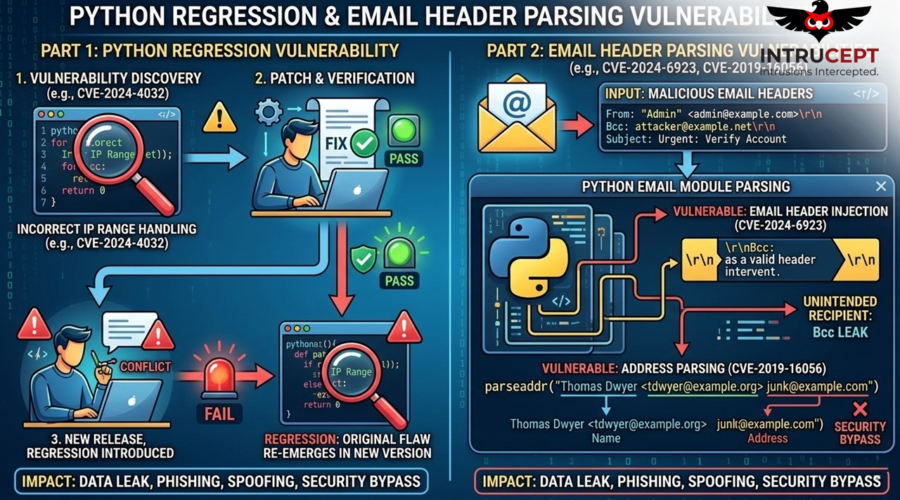
Summary: USN-8018-1 fixed vulnerabilities in python3. That update introduced regressions. The patches for CVE-2025-15366 and CVE-2025-15367 caused behavior regressions in IMAP and POP3 handling, which upstream chose to avoid by not backporting them.
| OEM | Python |
| Severity | Medium |
| CVSS Score | 6.5 |
| CVEs | CVE-2026-0865, CVE-2025-15366, CVE-2025-15367 |
| POC Available | No |
| Actively Exploited | No |
| Exploited in Wild | No |
| Advisory Version | 1.0 |
Overview
Python is a widely used high-level programming language that powers many enterprise applications, automation frameworks, DevOps pipelines, web platforms and email-processing services. Many Linux distributions – Ubuntu provide Python runtime packages as core system components.
Ubuntu released USN-8018-2 to address regressions introduced in the previous security update USN-8018-1. The earlier update attempted to fix vulnerabilities related to email header parsing and input validation but unintentionally introduced compatibility issues affecting IMAP, POP3, and WSGI header processing.
The new advisory prioritizes the fix for CVE-2026-0865, while also addressing issues related to CVE-2025-15366 and CVE-2025-15367.
| Vulnerability Name | CVE ID | Product Affected | Severity | CVSS Score | Fixed Version |
| WSGI Header Parsing Regression Vulnerability | CVE-2026-0865 | Python | Medium | 6.5 | Updated Python packages |
| Email Header Injection Vulnerability | CVE-2025-15366 | Python | Medium | 5.9 | Updated Python packages |
| Improper Email Header Parsing Vulnerability | CVE-2025-15367 | Python | Medium | 5.9 | Updated Python packages |
Technical Summary
These vulnerabilities affect multiple Python versions distributed within Ubuntu systems.
The original security update introduced patches intended to address email header parsing vulnerabilities. However, those fixes resulted in unintended behavioural regressions.
The CVE-2026-0865 patch incorrectly rejected horizontal tab characters in WSGI headers, potentially causing web applications relying on Python frameworks to malfunction.
Additionally, patches for CVE-2025-15366 and CVE-2025-15367 affected IMAP and POP3 email processing behavior, which allow upstream developers to avoid backporting those changes due to compatibility concerns.
Ubuntu released updated packages to resolve these regressions while maintaining protection against the underlying vulnerabilities.
| CVE ID | System Affected | Vulnerability Details | Impact |
| CVE-2026-0865 | Python (multiple Ubuntu packages) | Incorrect rejection of horizontal tabs in WSGI headers after patch | Web application compatibility issues |
| CVE-2025-15366 | Python email parsing library | Improper parsing allowing email header injection | Email spoofing or message manipulation |
| CVE-2025-15367 | Python email processing modules | Improper validation of message headers | Header manipulation in email processing |
Affected Packages
The following Python packages are affected –
python3.4 python3.5 python3.6 python3.7 python3.8
python3.10 python3.12 python3.13 python3.14
Remediation:
Apply the latest Ubuntu security updates immediately-
Fixed Package Versions
| Ubuntu Release | Fixed Package Version |
| Ubuntu 25.10 | python3.13 – 3.13.7-1ubuntu0.4 / python3.14 – 3.14.0-1ubuntu0.3 |
| Ubuntu 24.04 LTS | python3.12 – 3.12.3-1ubuntu0.12 |
| Ubuntu 22.04 LTS | python3.10 – 3.10.12-1 22.04.15 |
| Ubuntu 20.04 LTS | python3.8 – 3.8.10-0ubuntu1 20.04.18 |
| Ubuntu 18.04 LTS | Updated ESM packages |
| Ubuntu 16.04 LTS | Updated ESM packages |
| Ubuntu 14.04 LTS | Updated ESM packages |
If immediate patching is not possible, apply the following temporary mitigations-
You can follow the recommendations below as a best practice-
Conclusion:
The vulnerabilities addressed in USN-8018-2 highlight the risks associated with improper email header parsing and regression issues in widely used programming libraries such as Python. The primary concern, CVE-2026-0865, affects WSGI header handling and could disrupt web applications, while CVE-2025-15366 and CVE-2025-15367 relate to email header parsing weaknesses.
Organizations using Python-based applications or email processing services should prioritize updating affected Ubuntu packages to ensure both security and application stability.
References: