Cyberattack Campaign Targeted CISCO Products; Impacting Cisco AsyncOS Software; Security Updates Released
Cisco Patched Zero-Day RCE Exploited by China-Linked APT in Secure Email Gateways
Continue Reading

Cisco Patched Zero-Day RCE Exploited by China-Linked APT in Secure Email Gateways
Continue Reading
Recently the Scattered Spider Hacker group or cybercriminals are targeting the airline industry at large and keen interest on aviation sector.
The Scattered Spider group relies mostly on social engineering techniques that can impersonate employees or contractors to deceive IT help desks into granting access” and frequently involves methods to bypass multifactor authentication (MFA), as per observation by FBI.
Earlier the group breached at least two major US airlines in June, bypassed security protocols by exploiting remote access tools and manipulating support staff as reported by CNN .
There is a growing cyber risk on aviation sector and how the air traffic control is managed during attack which makes subsequent aviation systems vulnerable to cyberattacks due to outdated technology in many cases.
And cyber criminals are resorting to advanced techniques by which they can halt operations via cyberattacks that have the ability to take over or invade technology systems which in turn disrupt information flow from the aircraft to pilots to the airlines’ operations center resulting in chaos and delay in flight operations.
Every operation and service delivered by airlines is supported by technology and once that is not responding ,subsequent operations are halted i.e. flight management software, air traffic control communications, baggage handling systems and in-flight entertainment platforms will fail inevitability.
Recently the Scattered Spider group was behind a big data breach potentially exposing Social Security numbers, insurance claims and health information of tens of millions of customers.
Repercussions of Data Breaches Impacting Third parties
Cybercriminals often take advantage of fragile cyber security posture linked to smaller third parties that provide services to larger, well-established enterprises or industry. In-fact many vendors dont have cybersecurity protection and proper cybersecurity awareness in place to mitigate against attacks.
Cyber attacks have evolved to become increasingly complex, making vendor risk management critical. With rise in digital transformation, cloud services and AI technology has given cyber criminals greater potential to penetrate unsecured networks and systems more then ever.
Data breaches that originate from third-party vendors cause big fines and legal consequences are huge and affect primary organization. Along with these challenges, organizations often rely on third parties for critical services and cyber criminals take advantage of these vulnerability.
Organizations can still take steps to mitigate and defend against these attacks even as they onboard new vendors or service providers.
Let us see the emerging threats across third-party vendors:
Solutions that will improve Security Posture with Intru360 from Intruceptlabs
The new business environment demands IT support for a wider range of monitoring, security and compliance requirements. This creates significant burdens on network performance and network security as more appliances need access to incoming data.
Intrucept platform (Intru360) cover overall risk, detection, prevention, correlation, investigation, and response across endpoints, users, networks, and SaaS applications, offering end-to-end visibility.
Intru360 gives security analysts and SOC managers a clear view across the organization, helping them fully understand the extent and context of an attack. It also simplifies workflows by automatically handling alerts, allowing for faster detection of both known and unknown threats.
Identify latest threats without having to purchase, implement, and oversee several solutions or find, hire, and manage a team security analyst.
Sources: https://www.darkreading.com/cyberattacks-data-breaches/scattered-spider-hacking-spree-airline-sector

Summary
A newly-patched zero-day vulnerability in Google Chrome CVE-2025-2783 which was exploited in the wild by a threat actor TaxOff, leading to the deployment of Trinper which an advanced backdoor.
The CVE-2025-2783 exploited a sandbox escape vulnerability within Google Chrome’s Mojo IPC (Inter-Process Communication) framework, which allowed attackers to bypass the browser’s security sandbox and lead to RCE.
TaxOff Threat Actor
TaxOff is a highly sophisticated Advanced Persistent Threat (APT) group primarily targeting government organizations which is known for its use of advanced social engineering tactics, often involving phishing campaigns that exploit themed around financial reporting and regulatory compliance.
The CVE-2025-2783 vulnerability was first detected in March 2025 after Kaspersky reported real-world exploitation.
TaxOff used a phishing-based delivery method, which involved embedding a malicious link in emails masquerading as invitations to legitimate events like the Primakov Readings forum.
Once the link was clicked, the CVE-2025-2783 exploit was triggered, leading to the deployment of the Trinper backdoor. It was a one-click compromise that delivered a highly tailored payload with surgical precision.
Trinper Backdoor
This is a multi-threaded C++ backdoor that collected host data, logged keystrokes, exfiltrated targeted documents like document, excel or pdf files and maintained remote access.
But this wasn’t just a “plug-and-play” backdoor. Trinper’s loader employed five layers of encryption, utilizing ChaCha20, modified BLAKE2b hashes, and even machine-specific environmental checks. It was decrypted only on intended systems, using unique hardware identifiers like firmware UUIDs and PEB structures.
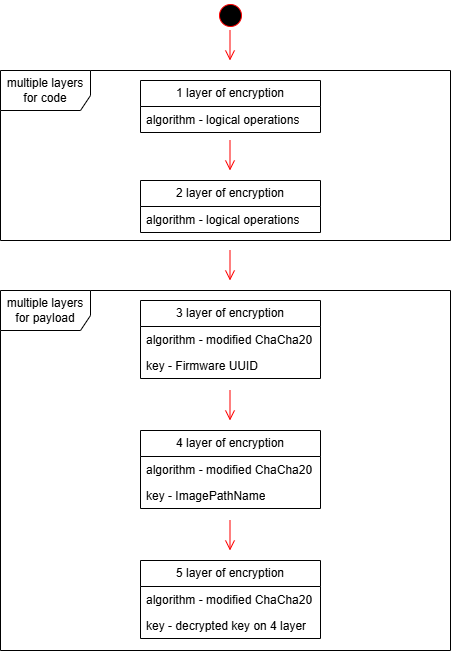
Source: global.ptsecurity.com
Interestingly, researchers found that Team46, a different APT group shares many similarities with TaxOff in terms of TTPs. This overlap raises the possibility that TaxOff and Team46 are the same group operating under different aliases.
Both groups have used PowerShell-based loaders and Cobalt Strike as their primary exploitation vectors.
This flaw allows threat actors to:
Recommendation
The rapid exploitation of CVE-2025-2783 highlights the critical importance of timely patch management. Google released a fix for this vulnerability in March 2025, and all users are strongly advised to update their Chrome browsers to the latest version immediately.
In addition to patching, organizations should implement the following defensive measures
References: