Italian digital forensics firm Forenser has uncovered a sophisticated zero-click attack campaign thatenables threat actors to covertly compromise WhatsApp accounts while legitimate users remain actively logged in and unaware of the intrusion.
The incidents primarily affected iPhone users running iOS 16, spanning devices from the iPhone 8 through the iPhone 14 series. Victims reported unauthorized WhatsApp messages requesting money transfers being sent from their accounts, despite no unfamiliar sessions or devices appearing within the app’s “Linked Devices” section.
What did researchers identified
Forensics ’ analysis identified unusual “resync” events in iOS unified logs, indicating that both the victim’s device and the attacker’s client were simultaneously competing to maintain control over the same WhatsApp session.
The attack chain combined two separate vulnerabilities to achieve a stealthy WhatsApp account takeover on vulnerable iPhones.
The first flaw, CVE-2025-43300, is an out-of-bounds write vulnerability within Apple’s ImageIO framework, a core iOS component responsible for processing image files.
By exploiting this ImageIO flaw, attackers could potentially execute malicious code on targeted iPhones without requiring any user interaction, making it a true zero-click exploit.
The second vulnerability, CVE-2025-55177, affected WhatsApp’s linked-device synchronization mechanism on iOS devices running versions earlier than iOS 16.7.12.
Attackers reportedly leveraged this WhatsApp synchronization weakness to secretly instantiate and maintain unauthorized WhatsApp sessions on compromised devices. The chained exploitation enabled threat actors to bypass normal WhatsApp security visibility, meaning compromised sessions did not appear under the app’s “Linked Devices” section.
Impact on Users
Attackers can gain full access to a victim’s WhatsApp account without the user clicking any link or opening any file.
Victims may not receive any warning, notification, or suspicious login alert during the compromise.
The hijacked session does not appear under WhatsApp’s “Linked Devices,” making detection extremely difficult.
Cybercriminals can impersonate victims and send fraudulent messages to contacts requesting money transfers or sensitive information.
Personal conversations, shared media, and confidential data may be exposed to attackers.
Users can experience ongoing session instability due to simultaneous access attempts between the legitimate device and the attacker.
Traditional phishing awareness offers limited protection because the exploit requires zero user interaction.
Individuals running outdated or unpatched iOS 16 versions face a significantly higher risk of compromise.
Financial fraud risks increase as attackers exploit trust between victims and their contacts.
Business users may face corporate data exposure, reputational damage, and unauthorized access to sensitive communications.
The attack demonstrates how mobile messaging platforms are increasingly becoming high-value targets for sophisticated cybercriminals. It highlights the critical importance of rapid OS updates, mobile threat monitoring, and secure communication practices.
Reminder for Organization on timely patching
This incident serves as a critical reminder for organizations that making timely patch management and proactive mobile security essential components of enterprise defense strategies.
The importance of adopting proactive threat intelligence, incident response readiness and Zero Trust security principles cannot be neglected.
When it is essential to defend against increasingly advanced attacks targeting communication platforms and sensitive business data in modern cyber warfare.
Key Highlights from Drupal Core SQL Injection Vulnerability: CVE-2026-9082
Severity: Highly Critical
CVSSv3: 6.5 : Medium
CVE-2026-9082 is a highly critical SQL injection vulnerability in Drupal core’s database abstraction API
Can be exploited by unauthenticated attackers on sites using PostgreSQL.
No exploitation has been observed in the wild, but a detection PoC was published on the same day as the advisory and the patch diff was shared publicly within hours.
Patches are available across six supported Drupal branches, including two exceptional releases for end-of-life versions.
As per Tenable, this vulnerability only affects Drupal sites using PostgreSQL as their database backend. Sites running MySQL, MariaDB, or SQLite are not affected. The vulnerable code resides in Drupal’s PostgreSQL EntityQuery condition handler, which is only invoked on PostgreSQL configurations. No in-exploitation in the wild reported.
This means older versions of Drupal — specifically Drupal 8.9 and 9.5 — are no longer officially supported and will not receive normal security update packages anymore because they have reached end-of-life (EOL).
Drupal has still released special emergency “hotfix” files for:
Drupal 9.5.11
Drupal 8.9.20
These hotfixes help protect vulnerable websites from the reported security issue. The update also includes security fixes from third-party components used inside Drupal, including:
Symfony
Twig
Even if organizations are not using PostgreSQL databases, Drupal still recommends updating because other security vulnerabilities are also fixed in these releases.
Affected Environments by CVE-2026-9082
The vulnerability only affects certain versions of Drupal when the website uses a PostgreSQL database.
In simple terms:
Vulnerable versions:
Drupal 8.9.0 to 11.3.9
Affected only if:
The site uses PostgreSQL as its database backend
The issue exists in the PostgreSQL-specific code used by Drupal to process database queries.
Websites using: MySQL, MariaDB and SQLite are not affected by this particular vulnerability because they use different database handling code.
Additionally: Drupal 7 is completely unaffected by this issue.
A list of Tenable plugins for this vulnerability can be found on the individual CVE page for CVE-2026-9082 as they’re released. This link will display all available plugins for this vulnerability, including upcoming plugins in our Plugins Pipeline.
Drupal estimates that under 5% of installations run on PostgreSQL. Across the hundreds of thousands of public Drupal sites, that still leaves thousands of internet-reachable targets, concentrated in the segments where Drupal adoption is strongest.
Drupal Patches:
Drupal released fixes across all six supported branches on May 20: 10.4.10, 10.5.10, 10.6.9, 11.1.10, 11.2.12, and 11.3.10. The security team also published exceptional patches for the end-of-life 8.9 and 9.5 branches, given the severity and the volume of legacy installations.
The advisory recommends upgrading to the patched release matching the current branch (11.3.x to 11.3.10, 11.2.x to 11.2.12, 11.1.x or 11.0.x to 11.1.10, 10.6.x to 10.6.9, 10.5.x to 10.5.10, 10.4.x or earlier to 10.4.10). Drupal 8 and 9 sites should treat the exceptional patches as a stopgap rather than a long-term position, because other unpatched issues remain in those branches.
Defenders should verify patch status directly with their hosting provider rather than assume any specific platform-level fix is in place.
Federal agencies and organizations are required to remediate the issue by May 27, 2026, under Binding Operational Directive (BOD) 22-01.
Conclusion: Because of improper input validation, attackers can insert harmful SQL commands into input fields such a application. If unchecked or not sanitized on time, user input before sending it to the database, attackers may manipulate backend database operations potentially bypassing authentication controls. This may lead to accessing sensitive database information and modify or delete data.
If patching is not applicable or not matching with application, organizations should consider temporarily turning off affected services until mitigation measures are in place. The active exploitation of CVE-2026-9082 underscores the ongoing risk posed by SQL injection vulnerabilities in widely used platforms such as Drupal.
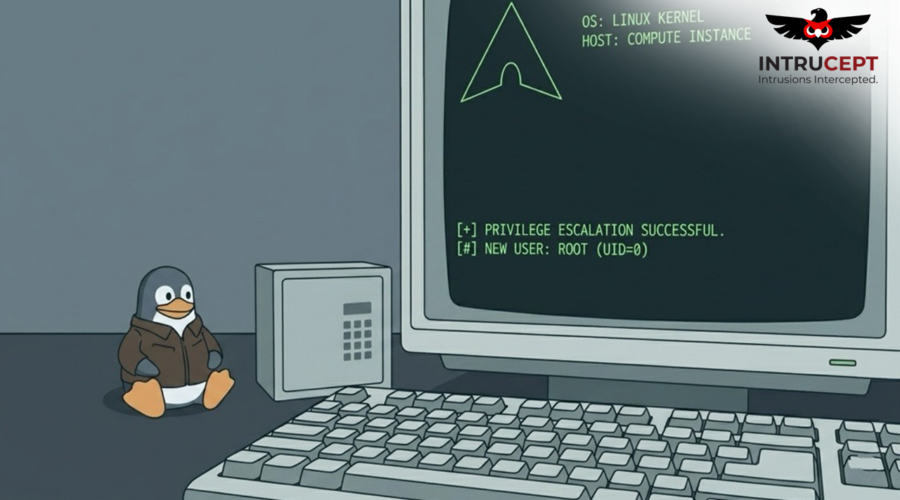
Overview: PinTheft vulnerability originates from improper memory reference handling inside the Linux kernel’s RDS zerocopy implementation
A newly disclosed Linux privilege escalation vulnerability named PinTheft allows local unprivileged users to gain full root access on vulnerable systems. Modern Linux systems use “zerocopy” operations to improve performance by avoiding unnecessary memory duplication during network transfers. In this case, failed RDS zerocopy operations improperly release memory references multiple times.
The flaw combines a long-standing issue in the Linux kernel’s RDS (Reliable Datagram Sockets) zerocopy functionality with io_uring to overwrite SUID-root binaries directly in memory and spawn a root shell.
Impact of PinTheft Vulnerability:
The issue primarily impacts systems where RDS modules are enabled and loadable, along with io_uring support. Researchers confirmed default exposure on Arch Linux, while several enterprise Linux distributions mitigate the risk by disabling or blocking RDS modules by default.
What makes PinTheft particularly dangerous is that the exploit modifies SUID-root binaries only in memory, leaving the original files on disk untouched.
PinTheft demonstrates how older kernel flaws can become highly exploitable when combined with newer Linux subsystems such as io_uring.
The vulnerability also highlights:
The increasing complexity of Linux kernel attack surfaces
Risks associated with performance-oriented kernel optimizations
The importance of minimizing unnecessary kernel modules in production environments
For enterprise security teams, systems allowing untrusted local workloads should be prioritized for immediate mitigation and monitoring.
The vulnerability impacts Linux kernels dating back to version 4.17, first released in 2018, highlighting how long-standing kernel flaws can remain dormant until newer features enable reliable exploitation techniques
Affected environments:
Researchers confirmed that:
Arch Linux systems were vulnerable by default
Some distributions ship RDS modules disabled or blacklisted
Certain enterprise Linux distributions are not affected because RDS is absent or io_uring is disabled by default
PoC Released
The release of a public proof-of-concept significantly increases operational risk for organizations running affected Linux environments.
Unlike remote vulnerabilities, PinTheft requires local access. However, once an attacker gains even limited user-level execution, the exploit provides a reliable path to full root compromise.
The vulnerability also highlights increasing complexity of Linux kernel attack surfaces and risks associated with performance-oriented kernel optimizations, importance of minimizing unnecessary kernel modules in production environments.
RakshaOne from Intrucept
RakshaOne can play a significant role in detecting and responding to the PinTheft Linux privilege escalation vulnerability. Since the exploit abuses kernel-level behavior and enables local users to gain root access while leaving minimal traces on disk, traditional security tools may struggle to identify the attack. RakshaOne helps security analysts and SOC teams gain centralized visibility across Linux servers, workloads, and enterprise infrastructure, allowing them to quickly understand the scope and context of suspicious activity.
By combining threat intelligence, behavioral analytics, and automated alert correlation, RakshaOne can detect abnormal privilege escalation attempts, suspicious SUID binary execution, unusual kernel activity, and unauthorized module loading associated with PinTheft exploitation.
The platform also simplifies incident response by automatically prioritizing high-risk alerts and correlating related events, helping organizations identify both known and unknown threats faster.
This becomes especially important for multi-tenant Linux environments, CI/CD runners, container hosts, and shared infrastructure where local privilege escalation vulnerabilities can rapidly lead to full system compromise.
New malware TencShell, a previously undocumented, Go-based implant derived from the open-source Rshell C2 framework targets manufacturing based enterprises. The malware’s activity appeared in traffic associated with a third-party user connected to the customer environment. The malware framework is based on screen control, browser artifact access and User Account Control (UAC) bypass that highlights how attackers are increasingly adapting open-source tools for real-world intrusions. Their attack pattern reveal careful design that can blend into normal enterprise traffic.
The tactics was revealed in April 2026, when Cato CTRL identified and blocked an attempted intrusion against a global manufacturing customer involving TencShell.
The malware has been previously undocumented, Go-based implant derived from the open-source Rshell C2 framework.
The activity appeared in traffic associated with a third-party user connected to the customer environment.
Malware attack chain
The attack chain used a first-stage dropper, Donut shellcode, a masqueraded .woff web-font resource, memory injection, and web-like C2 communication.
Activity noticed an suspected China-linked based on the apparent Rshell lineage, Tencent-themed API impersonation, and infrastructure patterns, While this pattern is relevant to our suspected China-linked assessment, it is not sufficient on its own for attribution.
If successful, TencShell could have given the attacker remote command execution, in-memory payload execution, proxying, pivoting, system profiling, and a path to deploy additional tooling. We blocked the attempt before the attacker could establish durable remote control.
Command & control framework
A C2 framework deployed through third-party access can turn a trusted business connection into an attacker-controlled bridge.
According to Cato CTRL, TencShell is a customized, Go-based implant derived from the open-source Rshell in C2 framework.
Security analysts suspect the malware has ties to Chinese threat actors, largely due to its infrastructure patterns and its clever impersonation of Tencent API services, which are designed to camouflage malicious communication.
If TencShell had installed successfully, the attacker could potentially execute commands, inspect files, steal credentials or session material, stage additional tools, proxy traffic through the endpoint, and move toward internal systems that are not directly exposed to the internet.
Business Riskfor manufacturers posed by the Malware
From the standpoint of manufacturers across the globe, the business risk extends beyond. If any endpoint connected is compromised to a regional site can further expose supplier relationships, production workflows, intellectual property, customer data, logistics processes and business continuity.
The C2 framework gives the attacker the control needed to decide what comes next.
What can attackers do from operational standpoint
To evade endpoint defenses, attackers can execute inline binaries, load dynamic link libraries and run .NET assemblies directly from memory.
The framework also enables operators to establish SOCKS5 proxies, allowing them to tunnel traffic and pivot deeper into segmented internal systems.
TencShell is derived from Rshell, an open-source Go-based C2 framework designed for cross-platform offensive security use. The original Rshell project includes remote command execution, file and process management, terminal access, in-memory payload execution, multiple C2 transports, and an MCP server. The version we observed was customized and repackaged for this operation, with communication and delivery changes that made it more suitable for the attacker’s campaign.
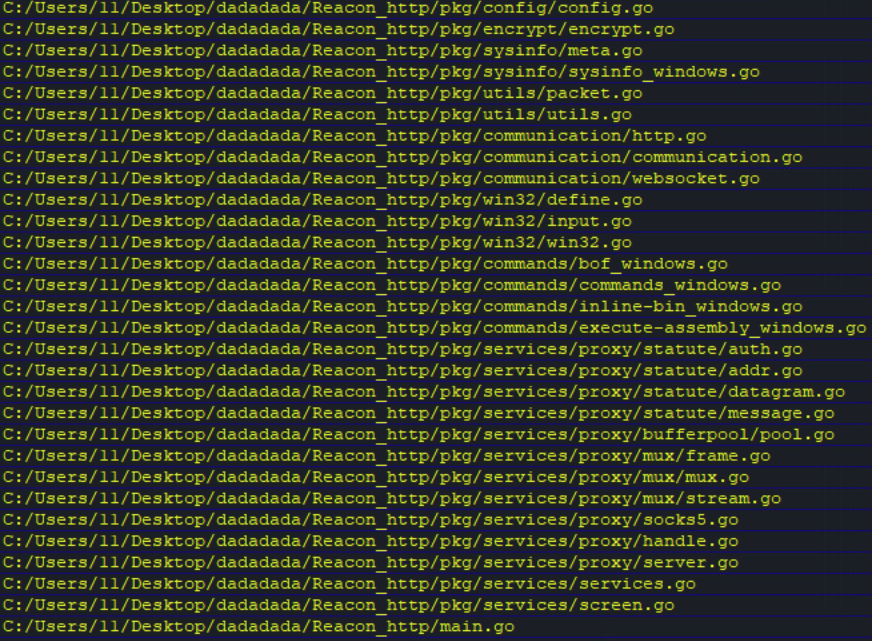
Embedded Go source paths in TencShell exposed the Reacon project structure and the threat actor user, as shown in Figure 1.
Figure 1. TencShell Go paths revealing the threat actor’s REACON project
Conclusion: The framework for Malware classification system (MCS) if adopted to analyze malware behavior dynamically using a concept of information theory and a machine learning technique will be useful for manufacturing organizations.
Any proposed framework will extracts behavioral patterns from execution reports of malware in terms of its features and generates a data repository. The specific aim of any proposed framework detects the family of unknown malware samples after training of a classifier from malware data repository.
Security researchers have the opinion, attackers no longer need custom malware development pipelines to conduct sophisticated intrusions. Adaptable open-source tooling is often enough for implementation and TencShell appears to have been customized from Rshell into a practical post-exploitation implant with web-like C2 communication. This assited the attacker to adapt available offensive tooling and attempted to blend the activity into normal enterprise traffic.
Google Threat Intelligence Group (GTIG) has tracked and found how attackers have models pose as security researchers or firmware experts to perform analyses on embedded systems and protocols. The zeroday exploit set to target popular open-source web administration tool, generated using AI. Observations revealed hackers are deploying agentic tools to partially automate research and exploit validation.
This shifts AI from a passive assistant to a system that independently executes parts of offensive workflows.
Theis report provide insights derived from Mandiant incident response engagements, Gemini and GTIG’s proactive research. The highlights aim at the threat environment where AI serves dual purpose. On one hand to disrupt advance cyber threats from hackers and other AI tools acting as high value agents for cyber attacks.
Here are key highlights of the threat research:
Vulnerability Discovery and Exploit Generation: For the first time, GTIG has identified a threat actor using a zero-day exploit that we believe was developed with AI. The criminal threat actor planned to use it in a mass exploitation event but our proactive counter discovery may have prevented its use.
AI-Augmented Development for Defense Evasion: AI-driven coding has accelerated the development of infrastructure suites and polymorphic malware by adversaries. These AI-enabled development cycles facilitate defense evasion by enabling the creation of obfuscation networks and the integration of AI-generated decoy logic in malware that google have linked to suspected Russia-nexus threat actors.
Autonomous Malware Operations: AI-enabled malware, such as PROMPTSPY, signal a shift toward autonomous attack orchestration, where models interpret system states to dynamically generate commands and manipulate victim environments. Analysis of this malware revealed previously unreported capabilities and use cases for its integration with AI.
AI-Augmented Research and IO: Adversaries continue to leverage AI as a high speed research assistant for attack lifecycle support, while shifting toward agentic workflows to operationalize autonomous attack frameworks.
Obfuscated LLM Access: Threat actors now pursue anonymized, premium tier access to models through professionalized middleware and automated registration pipelines to illicitly bypass usage limits. This infrastructure enables large scale misuse of services while subsidizing operations through trial abuse and programmatic account cycling.
Supply Chain Attacks: Adversaries like “TeamPCP” (aka UNC6780) have begun targeting AI environments and software dependencies as an initial access vector. These supply chain attacks result in multiple types of machine learning (ML)-focused risks outlined in the Secure AI Framework (SAIF) taxonomy, namely Insecure Integrated Component (IIC) and Rogue Actions (RA).
Hackers leveraging AI for vulnerability development and Zeroday exploitation
Cybercriminal groups are increasingly leveraging AI to support vulnerability discovery and exploit development.
Google Researchers observed threat actors planning large-scale exploitation campaigns using AI-assisted techniques.
A zero-day vulnerability was identified in a Python script capable of bypassing Two-Factor Authentication (2FA) in a popular open-source web administration tool. The exploit required valid user credentials but bypassed 2FA due to a hardcoded trust assumption within the application logic. Analysis suggests the vulnerability discovery and exploit development were likely assisted by an AI model due to:
Structured and highly “textbook” Python coding style
Excessive educational docstrings
Hallucinated CVSS scoring
LLM-like formatting patterns and helper classes
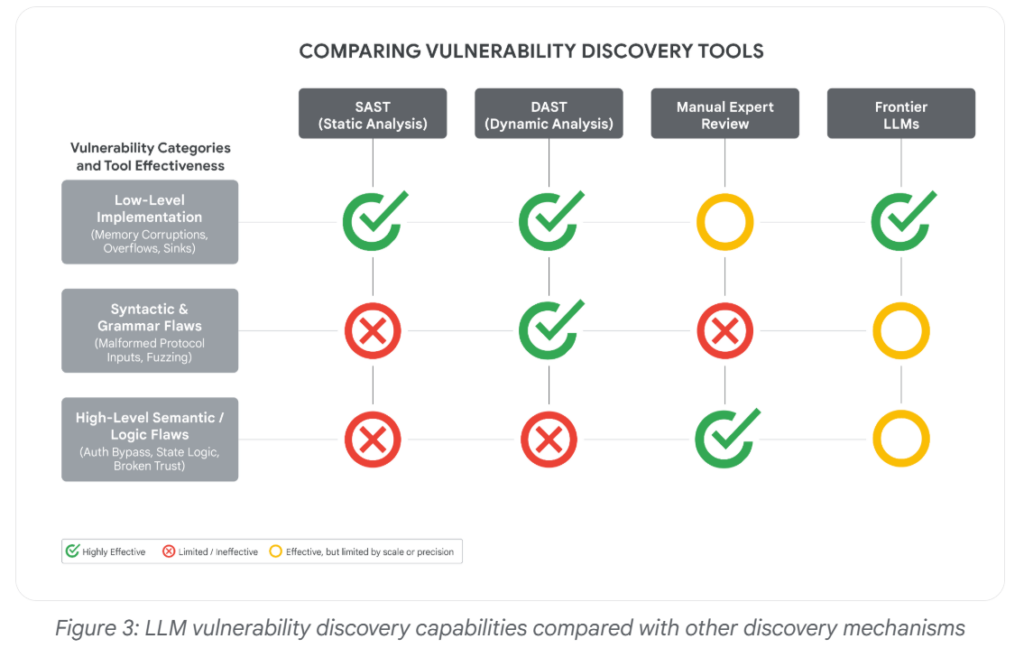
Unlike traditional vulnerabilities such as memory corruption or input validation flaws, this issue was a high-level semantic logic flaw difficult for conventional scanners to detect. Frontier AI models are becoming increasingly capable of:
Understanding developer intent
Identifying hardcoded security assumptions
Detecting hidden logic inconsistencies
Surfacing vulnerabilities missed by static analysis and fuzzing tools
The incident highlights the growing risk of AI-assisted zero-day discovery and exploitation by threat actors and as AI use datasets containing historical vulnerabilities to help models better reason about security flaws.
“For the first time, GTIG has identified a threat actor using a zero-day exploit that we believe was developed with AI,” GTIG researchers say.
What can be the consequences specifically at a time when new AI models unlike Anthropic’s Mythos, which were announced last month and appear to be good at finding such holes that Anthropic shared.
Rob Joyce, the former cybersecurity director of the National Security Agency, said that it can be difficult to know whether a human or machine wrote computer code, adding that, “A.I.-authored code does not announce itself.”
The Zeroday Defect
The report’s main findings involves a zero-day exploit that GTIG assessed was likely developed with AI assistance.
The vulnerability affected a popular open-source, web-based system administration tool and allowed two-factor authentication to be bypassed, although valid user credentials were still required.
The zero-day flaw was detected by the Google Threat Intelligence Group within the past few months and was exploited by “prominent cybercrime threat actors” in a script of the Python programming language.
Allow hackers to bypass two-factor authentication on “a popular open-source, web-based system administration tool,” though the hackers also would have needed access to valid credentials like user names and passwords to be successful, the company said.
Malware Evasion Techniques via AI
Hackers are also leveraging malware evasion techniques and sandbox evasions and other tricks to stay out of sight. As defenders increasingly rely on AI to accelerate and improve threat detection, a subtle but alarming new contest has emerged between attackers and defenders.
GTIG identified several malware families or tools with LLM-enabled obfuscation features, including PROMPTFLUX, HONESTCUE, CANFAIL, and LONGSTREAM.
Here is an example:
In June 2025, a malware sample was anonymously uploaded to VirusTotal from the Netherlands. At first glance, it looked incomplete. Some parts of the code weren’t fully functional, and it printed system information that would usually be exfiltrated to an external server.
The sample contained several sandbox evasion techniques and included an embedded TOR client, but otherwise resembled a test run, a specialized component or an early-stage experiment. What stood out, however, was a string embedded in the code that appeared to be written for an AI, not a human. It was crafted with the intention of influencing automated, AI-driven analysis, not to deceive a human looking at the code.
The malware includes a hardcoded C++ string, visible in the code snippet below:
In-memory prompt injection.
Hackers can leverage these emerging AI Evasion techniques to bypass AI-powered security systems by manipulating how Large Language Models (LLMs) interpret, analyze, and classify malicious content or activity.
How Attackers May Use AI Evasion Techniques
Prompt Injection Attacks Attackers craft malicious inputs that manipulate AI models into ignoring security rules, revealing sensitive information, or executing unintended actions.
Bypassing AI-Based Detection Threat actors can design malware, phishing emails, or malicious scripts in ways that appear legitimate to AI-powered detection systems.
Manipulating Context & Intent AI systems rely heavily on context and language interpretation. Attackers may exploit ambiguous wording, hidden instructions, or layered prompts to confuse AI defenses.
Generating Adaptive Malware AI-generated malware can dynamically modify behavior, code structure, or communication patterns to evade traditional and AI-driven security tools.
Automating Social Engineering AI can help create highly convincing phishing messages, fake identities, and impersonation attempts that are harder for AI-based defenses to detect.
Conclusion: AI is significantly strengthening cybersecurity defenses.
Security teams are leveraging AI for real-time threat detection, behavioral analytics, automated incident response, vulnerability management, and proactive risk assessment. While attackers currently benefit from AI-driven automation and exploitation capabilities, defenders are expected to gain a stronger long-term advantage as AI evolves into a core component of secure software development, proactive cyber defense, and intelligent security operations.