Malware

Malware Uses AWS Lambda to collect data; Govt Org’s Across S E Asia affected by HazyBeacon

Data Stolen from various government based organizations across South east-Asia via State-Backed HazyBeacon Malware that Uses AWS Lambda was discovered and tracked by researchers Palo Alto Networks Unit 42 under the moniker CL-STA-1020.

Here “CL” stands for “cluster” and “STA” refers to “state-backed motivation, data collected include information about recent tariffs and trade disputes. The initial access vector used to deliver the malware is currently not known, although evidence shows the use of DLL side-loading techniques to deploy it on compromised hosts. Specifically, it involves planting a malicious version of a DLL called “mscorsvc.dll” along with the legitimate Windows executable, “mscorsvw.exe.”

Campaign execution flow

As per researchers backdoor leverages AWS Lambda URLs as command and control (C2) infrastructure. AWS Lambda URLs are a feature of AWS Lambda that allows users to invoke serverless functions directly over HTTPS.

This technique uses legitimate cloud functionality to hide in plain sight, creating a reliable, scalable and difficult-to-detect communication channel.

Figure 1 shows the high-level execution flow of this attack.

(Source: Behind the Clouds: Attackers Targeting Governments in Southeast Asia Implement Novel Covert C2 Communication)

Key points:

The malware is using a newly discovered Windows backdoor dubbed HazyBeacon.

Secondly, it exploits a legitimate feature of the AWS Lambda serverless compute service called Lambda URLs, to hide its malicious activities

AWS Lambda URLs are a part of AWS Lambda that allow users to invoke serverless functions directly over HTTPS.

In this attack, the HazyBeacon backdoor uses the service to establish C2 communications, allowing the actor to engage in covert intelligence gathering.

Researchers at Trellix, revealed the attacker tactic of using Lambda to obscure C2 activity in late June, noting that such obscurity “makes network-based detection nearly impossible without decryption or deep behavioral analysis,” according to their report.

During backdoor deployment, attackers also establish persistence on the compromised Windows endpoint by creating a Windows service named msdnetsvc, which ensures that the HazyBeacon DLL would be loaded even after rebooting the system.

Unit 42 included a list of indicators of compromise (IoCs) in the post to help identify a potential attack. Defenders can set their machine-learning models and analysis techniques to be triggered by those IoCs, as well as use behavioral threat protection to detect and block the execution of processes with malicious behavior in their cloud environments.

How the malware reaches out to serverless AWS Lambda endpoints

  • These URLs are hosted on cloud infrastructure that’s globally trusted
  • Traffic looks like regular HTTPS communication
  • Detection becomes near-impossible for traditional firewalls or EDRs

This use of cloud-native tools for C2 is a growing trend in advanced persistent threats (APTs).

South east Asia a focal point of target

The reason why Southeast Asia has increasingly becoming a focal point for cyber espionage mainly due various sensitive trade negotiations being done by countries, defense enhancement taken up by countries as a part of modernization and power alignment between U.S.–China.

Why threat actors chose this area via targeting government agencies as the data stolen carried various intelligence inputs that were based on foreign policy direction, infrastructure planning and various regulatory shifts that further influence the behavior of global markets.

HazyBeacon reflects a broader aspect and trend in cyber security related to advanced persistent threats using trusted platforms as covert channels.

This cloud-based malware cluster, similar techniques have been observed in threats using Google Workspace, Microsoft Teams, or Dropbox APIs to evade detection and facilitate persistent access.

Once the malware is on the system, it doesn’t want to leave. HazyBeacon registers itself as a Windows service, making sure it gets relaunched after every reboot.

Organizations who detect and mitigate this emerging threats also understand how attackers exploit cloud services for malicious purposes.

The misuse of AWS Lambda occurs when the malicious DLL, mscorsvc.dll, establishes a C2 channel through an AWS Lambda URL. AWS Lambda runs code in response to events without requiring server provisioning or management; the URLs feature, introduced in 2022, extends this functionality by providing customers with a way to configure dedicated HTTPS endpoints for Lambda functions.

Source: 🔍 Deep Dive: How State‑Backed HazyBeacon Malware is Weaponizing AWS Lambda & Steganography | by Abhay Haswani | Jul, 2025 | Medium

SEO Poisoning Campaign Targets IT Admins with Weaponized PuTTY & WinSCP 

SEO poisoning & malvertising campaign Summary 

A sophisticated SEO poisoning and malvertising campaign has been active since early June 2025, targeting IT administrators with Trojanized installers of commonly used tools like PuTTY and WinSCP. 

Attackers are manipulating search engine results and sponsored ads to lead users to fake websites, which deliver backdoored versions of these tools. Arctic Wolf security researchers have uncovered thia malvertising campaign that has been targeting IT professionals since early June 2025.

The malicious campaign leverages search engine manipulation to promote fake download sites that closely mimic legitimate software repositories. 

Technical Summary 

A threat campaign has been leveraging SEO poisoning and malicious advertisements to trick IT professionals into downloading Trojanized versions of PuTTY and WinSCP from fake websites. Once installed, a malware known as Oyster (aka Broomstick) creates persistent access within the victim’s environment, posing a severe risk to enterprise infrastructure. 

This malware establishes persistence by creating a scheduled task that triggers every three minutes, invoking rundll32.exe to execute a malicious DLL named twain_96.dll using the DllRegisterServer export function, a technique commonly used to bypass traditional detection.  

The attackers specifically target IT administrators and system operators due to their elevated privileges, which allows rapid lateral movement, access to sensitive systems such as domain controllers and the potential deployment of additional payloads like ransomware.

The campaign’s effectiveness stems from its exploitation of everyday workflows, especially IT admins’ reliance on search engines to download tools making it both highly targeted and socially engineered for success. 

Element Detail 
Initial Access SEO poisoning and fake sponsored ads redirect users to malicious download sites. 
Malicious Tools Trojanized installers of PuTTY and WinSCP. 
Payload Backdoor malware is known as Oyster/Broomstick. 
Persistence Scheduled Task every 3 minutes executing twain_96.dll using rundll32.exe via DllRegisterServer. 
Target IT admins with elevated privileges (Domain Admins, Server Admins). 
Objective Network penetration, domain controller access, data exfiltration, possible ransomware deployment. 

Malicious Sponsored PuTTY Ad on Bing.       Source: Arcticwolf 

Observed Malicious Domains 

Organizations are urged to block the following domains immediately: 

  • updaterputty[.]com 
  • zephyrhype[.]com 
  • putty[.]run 
  • putty[.]bet 
  • puttyy[.]org 

These domains host fake versions of PuTTY and WinSCP and are actively used in the ongoing campaign. 

Remediation

1. Enforce Trusted Software Acquisition Policies 

  • Mandate the use of verified internal software repositories or direct access to official vendor websites. 
  • Where feasible, implement ad-blocking or web filtering to restrict access to software download categories known to be targeted by malvertising. 

2. Strengthen Network and Endpoint Security Controls 

  • Block known malicious domains at firewall and DNS levels. 
  • Continuously monitor endpoints for suspicious behavior, including: 
  • The creation of unauthorized or high frequency scheduled tasks. 
  • DLL execution via rundll32.exe, especially involving non-standard DLLs such as twain_96.dll. 
  • Deploy or enhance EDR/XDR solutions to detect backdoor persistence methods. 

3. User Awareness 

  • Educate IT staff on SEO poisoning and the risks of downloading tools via search results. 

Conclusion: 
By focusing on widely used administrative tools like PuTTY and WinSCP, threat actors are exploiting the trust and habits of IT professionals through convincing social engineering and poisoned search results.

This approach turns essential tools into delivery mechanisms for backdoors and persistent threats, compromising high-privilege users at the core of enterprise infrastructure.  

Organizations must respond decisively by reinforcing endpoint monitoring, tightening software acquisition policies and implementing robust network-level defenses to mitigate the risks posed by this rapidly evolving threat landscape. 

References

Cyber-Breach on Qantas Airliner re-echo’s Cyber Risk associated with Third Party

Third-party vendors are critical to and business or industry – but they confirm to significant amount of cyber risk. Qanatas airline confirmed of cyber attack where nearly  six million customers data may have been compromised. The airliner issued statement that said credit card details, financial information, and passport details were not part of the breach.

Qantas said in a statement: “We are continuing to investigate the proportion of the data that has been stolen, though we expect it will be significant. An initial review has confirmed the data includes some customers’ names, email addresses, phone numbers, birth dates and frequent flyer numbers.”

The alarming aspect of a third-party data breach is the sheer scale of impact. Hackers have the potential to attack thousands of organizations in one fell swoop.

KPMG, study showed how 73% of organizations have experienced at least one significant disruption from a third-party cyber incident within the last three years. 

Qantas Group chief executive Vanessa Hudson said the company was working closely with the National Cyber Security Coordinator and the Australian Cyber Security Centre.

We sincerely apologies to our customers and we recognize the uncertainty this will cause. Our customers trust us with their personal information, and we take that responsibility seriously,” she said.

In the breach that affected Qantas airliner which is one of the oldest, did not point to any hackers group. This data breach is one of Australia’s biggest breach in years which caused major setback and reputation damage to an airliner.

Last week, FBI said Scattered Spider group  was targeting airlines and that Hawaiian Airlines (HAII.UL) and Canada’s WestJet had already reported breaches. Read more on our blogs:

Key pointer of the Qantas Breach

The Cyber hacker broke into a database containing the personal information of millions of customer.

The breach was executed by hackers who targeted a call center and gained access to a third-party customer service platform containing six million names, email addresses, phone numbers, birth dates and frequent flyer numbers.

Third party risk management is complex but neglecting can be fatal for organizations whose data volume is huge such as airliners.

The airline is emailing affected customers and has set up a dedicated support line at 1800 971 541 (or +61 2 8028 0534 from overseas).

If we observe in recent past 2020, the solar Winds attack that happened where Solar winds confirmed that its network had been penetrated by a malicious actor and a complex malware program inserted into software updates of its technology platform – SolarWinds OrionⓇ.

Such is the magnitude of the attack that the malware program comprised a multistage process, scanning downstream customer networks to detect security tools it could avoid or disable, and stealthily connecting to the attacker’s command and control servers. The malware persisted for months before initial detection.

The solar winds attack cost to the company amounted to significant loss with Incident response and forensic services cost companies 11% of their annual revenue (an average of $12 million). 

How to make sure your vendor don’t create unnecessary risk that pose challenge for organization at large

First ensure your third party vendor’s meet the required robust security posture

Vendor risk assessment must be done holistically by streamlining due diligence

Upon discovery of any vulnerabilities, it is important that customizing and updating security requirements of the newly discovered threats and patch.

As a part of better threat mitigation strategy it is important that to automate vendors onboarding this will provide agility.

Managing Third party risk with Intru360

A research with KPMG found that found 61% of businesses underestimate third party risk management and often also struggle to have a healthy operation model and scale it same time.

KPMG research further found that Third-party/nth-party risk management that covers all third-party relationships over the entire life cycle; subjects vendors that support critical activities or are heavily relied upon to more comprehensive and rigorous oversight; and considers transition, contingency, recovery, and duplicity alternatives.

With most of the technology investments fail to provide visibility into third-party risk, we at Intercept help you to expand the scope and cover third parties related risk areas by identifying.

Intru360 gives security analysts and SOC managers a clear view across the organization, helping them fully understand the extent and context of an attack. It also simplifies workflows by automatically handling alerts, allowing for faster detection of both known and unknown threats.

In vendor security and management here are some of the features we offer to make sure cyber health of each and every supplier is checked and alerts are placed to get notification.

Prebuilt playbooks and automated response capabilities.

Over 400 third-party and cloud integrations.

More than 1,100 preconfigured correlation rules.

Ready-to-use threat analytics, threat intelligence service feeds, and prioritization based on risk.

Sources: https://www.techtarget.com/whatis/feature/SolarWinds-hack-explained-Everything-you-need-to-know

https://kpmg.com/us/en/articles/2022/ten-key-regulatory-challenges-2023-risk-governance.html
https://www.sbs.com.au/news/article/qantas-data-breach-everything-we-know-so-far-about-stolen-customer-details/49iggxre0

16 Billion Passwords Leaked in Largest Data Breach; Impact of Infostealer Malware

Data Breach with 30 exposed Datasets & contained approx 10 to 3.5 billion records making it one of the largest data breach.

According to a report security researchers from Cybernews found about a Data breach that leaked important data or passwords that was mostly generated by various cybercriminals using info stealing malware. They exposed data was made to look like a breach but these login credentials were gathered from social media, corporate platforms, VPNs etc via infostealer.

Now cybercriminals have unprecedented access to personal credentials and these credentials be used for account takeover, identity theft and targeted phishing activities.

The concern is the structure and recency of these datasets as they are not old breaches being recycled. This is fresh, weaponizable intelligence at scale”, added researchers.

The data sets contains a mix of details from stealer malware, credential stuffing sets and repackaged leaks. There is no way to compare these datasets, but likely to contain at least some duplicated information. This makes it hard to determine how many people were affected by the data breach.

What are Data sets & how deadly can be Infostealer as a malware?

Datasets are basically structure collection of data collected over the years or so and organized as case specific models

In 2024 datasets containing billions of passwords have previously found their way on the internet. Last year, researchers came across what they called the Mother of All Breaches, which contained more than 26 billion records.

The data breach that happened had data in sets, following a particular pattern, containing an URL followed by a username and password. To those unaware, this is exactly how infostealing malware collects information and sends it to threat actors.

The exposed data came from platforms widely used round the world starting from Google, Apple, Github, Telegram & Facebook. So data was first collected over a period of time, further made into data sets and grouped together.

Info stealers are malware programs that are designed to silently steal usernames and passwords Basically designed to swipe of credentials from people’s devices and send them to threat actors for further them for sale on dark web forums.

An infostealer is malware that attempts to steal credentials, cryptocurrency wallets, and other data from an infected device. Over the years, infostealers have become a massive problem, leading to breaches worldwide. No device is spare from infostealer’s impact including Windows and Macs, and when executed, will gather all the credentials it can find stored on a device and save them in what is called a “log.”

If a organization or individual is infected with an infostealer and have hundreds of credentials saved in their browser, the infostealer will steal them all and store them in the log. These logs are then uploaded to the threat actor, where the credentials can be used for further attacks or sold on cybercrime marketplaces.

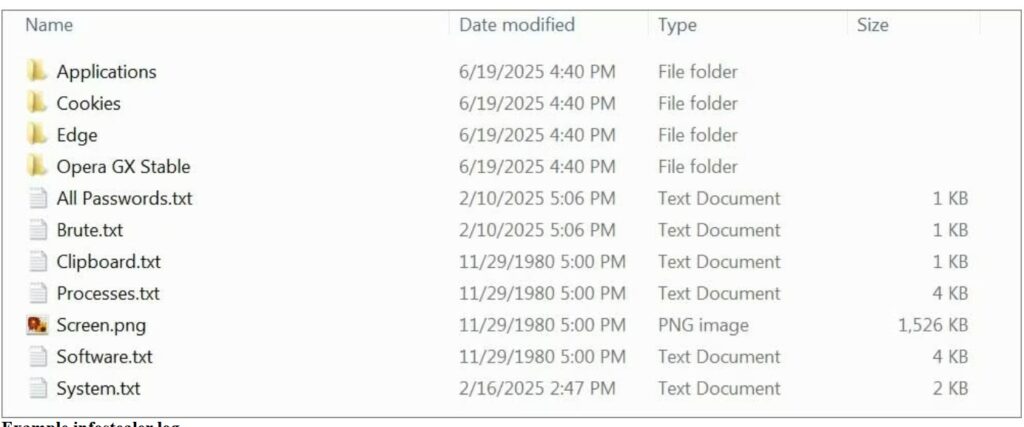
An infostealer log is generally an archive containing numerous text files and other stolen data.

Fig1:

(Image courtesy: Bleeping computers)

A devastating data breach is a nightmare for customers and affected organizations, but breaches can have a positive side also. Each incident is a learning opportunity. It’s easier to defend critical data when we understand the mistakes made by others and the tactics used by attackers.

How to be secure & keep your Data safe

If users are in midst of data breach or may find that their data is not safe as an infostealer might be there in your systems or devices then scan your device with an antivirus program. Once done then change password or your newly entered credentials could be stolen again. The system is clean so password hygiene can be maintained time to time.

At times even unique passwords won’t help you stay protected if you are hacked, fall for a phishing attack, or install malware. Its better not to change all credentials in one go instead having a cyber security hygiene in routine is better as an option.

Intru360

For organizations to stop and detect any intrusion by attackers prefer to have Intru360 in your list of cyber security go to products from Intruceptlabs.

Intru360 gives security analysts and SOC managers a clear view across the organization, helping them fully understand the extent and context of an attack. It also simplifies workflows by automatically handling alerts, allowing for faster detection of both known and unknown threats.

Globally every year cyberattacks are growing and mutating each month. Organizations have their Intelligent intrusion network detection systems in place analyze and detect anomalous traffic to face these threats.

Do visit our website for more information.

Source: https://www-bleepingcomputer-com.cdn.ampproject.org/c/s/www.bleepingcomputer.com/news/security/no-the-16-billion-credentials-leak-is-not-a-new-data-breach/amp/

RCE Risk in D-Link Routers due to Hardcoded Telnet Credentials

Summary A significant security flaw (CVE-2025-46176) has exposed thousands of D-Link routers to remote code execution attacks through hardcoded Telnet credentials embedded in firmware. This is affecting its DIR-605L and DIR-816L routers.

If successful exploitation happens this will enables attackers to modify router configurations, deploy malware, or pivot into internal networks.

OEMD-link
SeverityMedium
CVSS Score6.5
CVEsCVE-2025-46176
Actively ExploitedNo
Exploited in WildNo
Advisory Version1.0

Overview

The flaw exposes devices to remote command execution (RCE) through hardcoded Telnet credentials.

The vulnerability has been rated medium in severity (CVSS 6.5), with no official firmware patch available as of May 2025.

Vulnerability NameCVE IDProduct AffectedSeverityFixed Version
Hardcoded Telnet Credentials vulnerability  CVE-2025-46176D-Link Router  MediumNo official fix available

Technical Summary

The vulnerability arises from hardcoded Telnet credentials in the router firmware, which allows unauthenticated remote attackers to execute arbitrary commands.

Firmware analysis revealed embedded credentials in configuration files used during Telnet service initialization.

Security experts recommended retiring these EOL devices due to absence of security support and the impossibility of removing hardcoded credentials through configuration changes.

CVE IDSystem AffectedVulnerability DetailsImpact
    CVE-2025-46176D-Link DIR-605L v2.13B01, DIR-816L v2.06B01Telnet service (/usr/sbin/telnetd -l /bin/sh -u Alphanetworks:$image_sign) uses hardcoded credentials from image_sign file, exposing plaintext passwords.      RCE

Recommendations:

As of May 2025, no firmware updates are available to fix the vulnerability. Recommended temporary mitigations include :

  • Disable Telnet access via the router’s web interface.
  • Block Telnet port (23) using firewall rules:

“iptables -A INPUT -p tcp –dport 23 -j DROP”

  • Restrict WAN access to management interfaces.
  • Monitor D-Link’s official support page for firmware updates.

Conclusion:
Security researchers discovered the flaw through firmware analysis, revealing that both router models contain default Telnet credentials that cannot be changed by users. 

While exploitation likelihood is currently assessed as low, vulnerability enables unauthenticated attackers to gain control of the routers, affecting confidentiality, integrity and availability.

Immediate mitigation is advised, especially for publicly exposed devices and Security experts strongly recommend retiring these EOL devices due to the absence of security support and the impossibility of removing hardcoded credentials through configuration changes.

Threat from Legacy Devices:

The vulnerability in Telnet revealed security risks that legacy networking equipment carry with them and is embedded hardcoded credentials in IoT devices.

Inadequate security, harboring multiple unpatched vulnerabilities and relying on inadequate security controls that fail to address underlying risks. This poses a threat not only to device itself, but also to the network and connected critical assets.

References:

FBI Warns  End-of-Life Routers Exploited in Active Botnet and Proxy Campaigns 

Summary 

The FBI issued an alert warning of ongoing exploitation of 13 EOL Linksys/Cisco routers by cybercriminal groups operating the 5Socks and Anyproxy services.

The threat actors are using known vulnerabilities in outdated firmware to install malware, hijack routers, and leverage them as part of a botnet or proxy service used to mask malicious activities. 

The malware establishes persistent access via regular communication with a command & control (C2) server, and affected devices are being rented out to other criminals.

The FBI strongly recommends replacing EOL devices with with newer and actively supported model or at least disabling remote management features immediately. 

Technical Details 

Attack Overview 

  • Entry Point: Remote administration services exposed to the Internet. 
  • Authentication Bypass: Attackers bypass password protection to gain shell/root access. 
  • Malware Capabilities
  • Maintains persistent presence through C2 check-ins every 60 seconds to 5 minutes. 
  • Opens ports to act as proxy relays. 
  • Enables the sale of infected routers as “proxy-as-a-service” infrastructure. 

Confirmed Vulnerable Devices 

The FBI has identified the following end-of-life (EOL) routers from Cisco and Linksys as actively targeted in these campaigns: 

  • E1200 
  • E2500 
  • E1000 
  • E4200 
  • E1500 
  • E300 
  • E3200 
  • WRT320N 
  • E1550 
  • WRT610N 
  • E100 
  • M10 
  • WRT310N 

Indicators of Compromise (IOCs) 

Since the malware is router-based, it is difficult for an end user to know if their device is compromised due to the inability of antivirus tools to scan these devices.

Below is a list of files associated with the malware’s router exploitation campaign: 

Name Hash 
0_forumdisplay-php_sh_gn-37-sh 661880986a026eb74397c334596a2762 
1_banana.gif_to_elf_t 62204e3d5de02e40e9f2c51eb991f4e8 
2_multiquote_off.gif_to_elf_gn-p_forward- 
hw-data-to-exploit-server 
9f0f0632b8c37746e739fe61f373f795 
3_collapse_tcat_gif_sh_s3-sh 22f1f4c46ac53366582e8c023dab4771 
4_message_gif_to_elf_k cffe06b0adcc58e730e74ddf7d0b4bb8 
5_viewpost_gif_to_elf_s 084802b4b893c482c94d20b55bfea47d 
6_vk_gif_to_elf_b e9eba0b62506645ebfd64becdd4f16fc 
7_slack_gif_DATA 41e8ece38086156959804becaaee8985 
8_share_gif_DATA 1f7b16992651632750e7e04edd00a45e 
banana.gif-upx 2667a50869c816fa61d432781c731ed2 
message.gif-upx 0bc534365fa55ac055365d3c31843de7 

Recommended Mitigations

  • Replace Vulnerable Devices: Immediately replace EOL routers with models still supported by vendors and receiving firmware/security updates. 
  • Disable Remote Administration: Turn off any form of remote management via web, SSH, or Telnet. 
  • Reboot Compromised Devices: This can temporarily disrupt malware persistence, though not permanently remove it. 
  • Network Segmentation: Isolate critical devices from consumer routers or IoT networks. 
  • Implement Monitoring Tools: Use firewalls or network sensors that detect unusual traffic or device behavior. 

“End of life routers were breached by cyber actors using variants of TheMoon malware botnet,” reads the FBI bulletin.

“Recently, some routers at end of life, with remote administration turned on, were identified as compromised by a new variant of TheMoon malware. This malware allows cyber actors to install proxies on unsuspecting victim routers and conduct cyber crimes anonymously.”

References


Intruder Alert! Security Breach Leading to Data Breach

Recently 2.9 billion records of data stolen in cyber breach from National Public Data that includes Social Security numbers. Cyber experts assume that sensitive information including Social Security numbers for millions of people could be in the hands of a hacking group.

Reports suggest that after the breach occurred the data may have been released on an online marketplace or dark web.

What does this mean and how does organizations fight to save their clients and brand value?

It is a big question and something that can give restlessness to CISO’s and security teams. The results of breach remains for months and the impact too. This can result in financial losses and if hackers can have unauthorized access to online accounts or financial documents, the result is far reaching.

What it can do is first damage the brand value and result in expenses incurred from investigations.

This include legal fees for lawyers and if suit is bought by any customer or client and goes up to customer notification including compensation, fines.

Loosing brand value due to breach affects regaining the confidence of customers or partners and clients. This is long term as chance of possible loss of business opportunities and lasting reputational damage exist.

Gaining unauthorized access to a device or system leads to security breach and that leads to data breach or other malicious activity and as we know the devastating consequences for organizations at large. Now this can be defined as being over powering and surpassing all security measures that protect data or network systems of the organization including physical hardware assets.

Mostly we are accustomed with few names as

Malware: The attacker infects a system with malware that’s designed to steal sensitive data, hijack system resources.

Phishing: This technique involves a seemingly legitimate email or text or fake websites that come in surface as a scam

Physical asset: Sometimes  attackers gets involved in stealing or meddling with a piece of organizations assets if he can hold on the equipment, tool to get access in enterprise system and steal data.

Breach details of national Public Data:

The hacking group USDoD claimed it had allegedly stolen personal records of 2.9 billion people from National Public Data, according to a class-action lawsuit filed in U.S. District Court in Fort Lauderdale, Florida, reported by Bloomberg Law. The breach was believed to have happened in or around April, according to the lawsuit.

One major aspect of the breach is the data also included information about the individuals’ relatives. One of the unique aspects of the data was the longevity — the addresses spanned decades of residence, and some relatives have been deceased for as long as two decades.

In addition to neglecting to inform the victims, National Public Data has not released a public statement regarding the breach. The Los Angeles Times reported that the company responded to email inquiries with “We are aware of certain third-party claims about consumer data and are investigating these issues.” The lawsuit mentions the lack of notification as a top concern of the Plaintiff.

(Source: www.usatoday.com)

In recent years, plenty of high-profile examples of security breaches have captured public attention . One security breach that actually captured attention was the Nvidia breach in 2022.

Nvidia, a major chip manufacturer, experienced a cyberattack where up to 1TB of data was stolen, including employee credentials and proprietary information.

The impact was that Hackers demanded Nvidia remove limitations on its GPUs, and internal source code was leaked. The company had to take several security measures to mitigate further damage.

This incident proved that hackers and cybercriminals are in equal terms powerful in their methods and tactics as cyber security teams . Each hacker pushed the boundaries of what was thought possible in the cyber world and their actions have had far-reaching consequences.

They targeted financial institutions and government agencies to exposing vulnerabilities in national defense systems. These incidents have served as wake-up calls, highlighting the critical need for robust cybersecurity measures and a better understanding of digital ethics and law

Preventing security breach:

Enterprise and security teams at times may take more time to rectify or better to prevent a security breach than to resolve one after it occurs. Though not all security breaches are avoidable, applying a few tried-and-tested best practices is always on the cards.

Tips for Best practices for preventing data breaches

Data breach prevention requires a comprehensive, proactive approach and a enterprise level if ots followed its better for security measure to remain strong that are being implemented.

  • A secure coding principles in best practice strategy: Writing secure code involves following best practices such as avoiding hardcoded credentials, implementing input validation, and ensuring proper data encryption. This way organization can reduce vulnerabilities that attackers might exploit.
  • Conducting Regular security audits: Conducting penetration testing and threat modeling helps identify weaknesses in your security framework and routine security assessments to mitigate potential threats.
  • Implementing practices with DevSecOps: Embedding security into the SDLC ensures security considerations are addressed at every stage of development. By integrating application security testing and practices like shift left testing into software development workflows, organizations can identify and fix vulnerabilities early in the process.
  • Creating incident response plans: Having a clear incident response plan allows organizations to detect, contain, and mitigate security breaches more efficiently. Security teams get enough time and  can respond quickly to security incidents, minimizing damage and reducing downtime.
  • Security training for Teams : Educating development teams on cybersecurity best practices helps them recognize threats and implement secure coding practices. Security teams should stay updated on emerging threats and modern security measures.

Protect yourself with GaarudNode from Intruceptlabs

GaarudNode is an all-in-one  solution designed to empower development teams with the tools they need to secure their applications throughout the development lifecycle. By combining the power of SAST, DAST, SCA, API security, and CSPM, GaarudNode provides a comprehensive security framework that ensures your applications are built, tested, and deployed with confidence.

  • Our Platform:
    • Identifies security flaws early in the development process by scanning source code, helping developers detect issues like insecure coding practices or logic errors.
    • Tests running applications in real-time to identify vulnerabilities such as SQL injection, Cross-Site Scripting (XSS), and other runtime threats.
    • Detects vulnerabilities in third-party libraries and open-source components, ensuring that your dependencies don’t introduce risks.
    • Continuously tests and monitors your APIs for vulnerabilities such as authentication flaws, data exposure, and insecure endpoints.

Do connect or DM for queries

(Sources:https://www.ibm.com/think/news/national-public-data-breach-publishes-private-data-billions-us-citizens)

Android Malware Crocodilus; Threat for cryptocurrency wallet Users

Crocodilus is a new banking malware that evades detection from Google’s play protect.

The Android malware has been specifically targeting to steal sensitive cryptocurrency wallet credentials through social engineering. Its convincing overlay screen warns users to back up their wallet key within 12 hours or risk losing access says security researchers.

Why threat researchers call this trojan ?

Crocodilus includes all the necessary features of modern banking malware: overlay attacks, keylogging, remote access, and “hidden” remote control capabilities. Also the malware is distributed via a proprietary dropper that bypasses Android 13 (and later) security protections as per researchers of Threat fabric.

Unlike any banking trojan which takes over devices, Crocodilus is similar in pattern and uses tactics to load a fake overlay on top of the real app to intercept the victim’s account credentials. These are targeted mostly for banking or cryptocurrency app users.

Another data theft feature of Crocodilus is a keylogger and the malware monitors all Accessibility events and captures all the elements displayed on the screen, i.e. it is an accessibility Logger.

Intricacies of Crocodilus Malware

The modus operandi of the malware makes it easier to preform task to gains access to accessibility service, to unlock access to screen content, perform navigation gestures, monitor for app launches.

The malware also offers remote access Trojan (RAT) functionality, which enables its operators to tap on the screen, navigate the user interface, perform swipe actions.

The malware is fitted with dedicated RAT command to take a screenshot of the Google Authenticator application and capture one-time password codes used for two-factor authentication account protection.

Android users are advised to avoid downloading APKs from outside Google Play and to ensure that Play Protect is always active on their devices.

Researchers discovered source code of malware revealing debug messages left by the developer(s), reveal Turkish speaking.

The Expanding Threat landscape with evolving Modern Malware’s

The Crocodilus malware designed to go after high valued assets that targets cryptocurrency wallets and Banks. These malware can make the defense line up of banking system weak and researchers advise to adopt a layered security approach that includes thorough device and behavior-based risk analysis on their customers’ devices.

Modern malware has the capability to break the security defenses of organization even if they are protected by cutting edge solutions to defend. As the threat landscape expand so are sophisticated attacks rising.

Modern malware can bypass most security solutions, including email filtering, anti-virus applications, sandboxing, and even IPS/IDS and sometime few file-less malware leaves no footprint on your computer and is executed exclusively in run-time memory.

In this sophisticated war against threat criminals enterprise security requires is taking services for active threat hunting and be diligent in scanning files meant for downloads.

To improve enterprise security the important aspects needs to be covered increase usage of multi-layer defenses. Protecting against modern malware is an ongoing effort, and rarely it is “set and forget.” Utilize multiple layers of security, including anti-virus software, network layer protection, secure web gateways, and other tools for best results.

Keep improving your security posture against modern malware is an ongoing effort and includes multiple layers of security. With anti-virus software, advanced network layer protection, secure web gateways, and other tools the security posture at enterprise level increases.

Remember your best defenses can be in trouble, so continue monitoring, adapt and train employees, while using comprehensive multi-layer approach to security.

Source: https://www.threatfabric.com/blogs/exposing-crocodilus-new-device-takeover-malware-targeting-android-devices

Security software to represent 60% of worldwide security market; IDC

Worldwide Security Spending to Increase by 12.2% in 2025 as Global Cyberthreats Rise, Says IDC

As we witness complex and more frequent more frequent and complex cyber attacks, a rising concern for global security the spending from worldwide data projects a steady growth. The amount is staggering $377 billion by 2028 says the IDC report. This is an yr on increase of 12.2% year-on-year increase in security spending in 2025.

“Growing digital transformation and hiking emerging technology adoption across the Middle East & Africa (MEA) region — especially countries in the Gulf Cooperation Council (GCC) — have pushed the demand significantly for security solutions to face the evolving threat landscapes,” said Eman Elshewy, senior research manager with IDC Data and Analytics.

The security software market growth will be driven especially by cloud native application protection platform (CNAPP).

This also includes Identity and access management software

security analytics software growth, reflecting the special focus that companies will put on integrated cyberthreats detection and response around their whole organizational perimeter.

Key points on security software market growth

  • Security services will be the second fastest growing technology group in 2025,
  • This is driven by the continuous expansion of managed security services and growths of organizations of all size are included in it. Security hardware will rank third, achieving single-digit but steady growth in 2025.
  • This also include the Banking, federal/central government, telecommunications, capital markets, and healthcare provider will be the industries spending the most at the global level on security in 2025.

 While the fastest-growing will be capital markets, media and entertainment, and life sciences with an expected year-on-year growth rate of 19.4%, 17.1%, and 16.9%, respectively in 2025.

Organisations developing software’s will develop their strategies based on  national and international regulations that still play an important role in guiding organizations’ security strategies — especially in regulated industries .

Cause of rise in the market demand .

The rising malware including virus and Trojan horses are increasing the capacity of cyber criminal and their sophistication in attacks. Cybercriminals deploy attack and employ malware that can take control of devices. With BOYD things are more complicated.

We cannot deny how AI is giving companies a competitive edge and help to fuel more sustainable growth. Forrester predicted that IT services and software will account for nearly two-thirds of global tech spending and, in Europe and North America, this share will be even higher. 

A greater drive for, and increased investment in, cybersecurity will underpin the rise in software spend, says Forrester.

In particular, this includes the updating and modernization of legacy and outdated enterprise systems to better protect organisations in the rapidly evolving threat landscape. 

While large and very large businesses account for the majority of security spending across all regions, small and medium-sized businesses will continue to increase their investments in security throughout the forecast period to address security gaps and protect their assets and processes as their digital transformation accelerates.

Fig 1 Represent the state of security spending 2025

Organizations still lack the internal expertise, to properly assess or address the security implications of this shift. Cyber criminals are making these threats more sophisticated, which is adding to the urgency. IDC says this steady climb in spending will continue through 2028, hitting $377 billion by then.

Now with IDC research finding  reveal investments in security throughout the forecast period to address security gaps and protect organizational assets and processes as their digital transformation accelerates.

Organisations are moving from being secure to being cyber resilient

Right now, business of every models are almost uniformly reliant on digital technology and any disruption here seriously impacts operations and revenue. Cyber criminals are on look out for every scope to launch stealthies attack.

Almost all security strategies often focus on proactively identifying and mitigating threats. Now at this hour as we stand in 2025 we need greater focus on cyber resilience.

Adopting a holistic approach in cyber security is walking the path of cyber resilience and we at Intruceptlabs working in tandem to weave the fabric of security in every workflow that supports this agility.

Recently IntruceptLabs won the Elevate 2024 Program, founded with the mission of “Making applications & digital space safer for businesses,” is encouraging for us as an organization for a cyber resilient future.

Sources: https://www.idc.com/getdoc.jsp?containerId=prEUR253264525

Scroll to top