Intru360

AI Surge in CyberSecurity Redefining Threat & Defense; Reshaping Software Development & Security

Currently enterprise Cyber Security strategy with AI has become a game changer, reshaping is critical for both threat and defense. Embracing Gen AI for a robust defensive system empowers organizations to analyze vast amount of data is key requirement for enterprise security where software development is key to enterprise security , embracing ‘security by design’.

In 2024-2025, we have witnessed how mainstream enterprise deployment of AI has changed the strategic cyber security requirement. Thereby creating a strong defense mechanism around enterprise security, redefining the threat landscape and shaping software development.

AI is changing the way we look at products being a risk multiplier. How organization balancing innovation with protection?

AI can track and break commonly used passwords within minutes. So this is scary as more powers are in the hands of hackers, on the other side AI can improve password security again a boon. The Dark Web is already selling Fraud GPT and Worm GPT.

For Organizational cyber security strategy AI is being used now to tackle threats and cyber defense. Again AI has the capability to accelerate the speed of cyber attacks.

So what are leaders deciding when chasing AI based products. The way leaders are looking at products is products that give practical and actionable outlook and being embedded in delivery workflows.

Strategically, this means evolving away from rigid, checkbox-based compliance toward dynamic, adaptive security models that reflect how modern teams really build software—especially in AI-accelerated environments.

As per statistics 2025 witnessed the following AI based cyber attacks.16% of all breaches in 2025 involved attackers using AI. (IBM),and other AI attacks included 37% used phishing attacks and 35% used deepfake attacks. (IBM). 63% of breached organizations had no AI governance policy or were still developing one, highlighting the governance gap around AI adoption (IBM).

OpenText has released their survey and the report entails, AI is rapidly changing the threat landscape for organizations . Organizations are navigating a high-stake balancing act to enable innovation while managing risk.

Here are the key findings

Top AI-related concerns among respondents include data leakage (29%), AI-enabled attacks (27%), and deepfakes (16%).

95% of respondents are confident in their ability to recover from a ransomware attack, but only 15% of those attacked fully recovered their data.

88% allow employees to use GenAI tools, yet less than half (48%) have a formal AI use policy.

Enterprises lead AI governance (52%) compared to SMBs (43%) by having a formal AI policy in place.

52% report increased phishing or ransomware due to AI; 44% have seen deepfake-style impersonation attempts.

Surge in AI Threats via sophisticated attacks

One of the reasons cited by threat researchers is organizations are embracing GenAI, allowing employees to use generative AI tools and few less then 50% have a formal AI-use or data privacy policy in place, the report noted.

This is added with hackers innovative way in tricking using AI, bypassing any defense mechanism which is traditional. 

AI tools are now being used to create such convincing phishing emails, fake websites and even deepfake videos to injecting malicious code giving leverage to cyber criminals

In the last few months we witnessed how Ransomware attacks round the world surged and quite complex in nature as third-party service providers or software supply chains were prime targets. The Qantas airline breach and M&S data beach that hit UK’s top retail brand.

While Qantas did not to Information Age whether AI voice deepfakes were used in the breach, the cybercrime group experts believe may be linked to the hack — dubbed ‘Scattered Spider’ — has a track record of using voice-based phishing (or ‘vishing’) in its attacks. This is clear AI being used and surge is quite high in AI based cyber attacks.

AI for Cyber Defense for Organizational Cyber Security Strategy

It is not hackers who are benefiting but for Organizations it is a game changer as AI being used to detect attack at faster pace meaning mean time.

Findings of this survey reinforces that protecting against ransomware now depends not just on internal defenses, but also on how effectively organizations’, partners, and technology providers collaborate to close security gaps before they are exploited.

Key pointer for building pragmatic and strategic choices and this approach starts with embracing security by design approach in developmental life cycle.

  • Continuously Embedding security in developer workflows keeping automating, scanning, policy enforcement and anomaly detection in tools used by developers.
  • Cybersecurity AI tools are better at identifying patterns and anomalies in large datasets including vulnerabilities. teams have to highly prioritize and contextualize them in term of developing products.
  • Supposedly there is an attack and the security tools not able to detect. So continuous testing is mandatory.
  • Developers can favor simple solutions that favors pragmatic security patterns and transparency in architecture. In this way trust is developed with clients.

Few important developers keep in focus is to sponsor bug bounties, publish advisories using standards like the Common Security Advisory Framework (CSAF) and provide context on severity and exploitability.

Threat researcher suggest organizations who are building in products accept all vulnerability reports, investigate them, and fix the issues. Any critically important advisory to be used for root cause analysis to improve tools, training and various threat models. Developers are suggested to give feedback for external tools if they help them evolve. Understanding no software can ever be perfect.

Offerings from IntruceptLabs are exactly what you need to develop organizational cyber defense capabilities

Intru360

Intru360 gives security analysts and SOC managers a clear view across the organization, helping them fully understand the extent and context of an attack. It also simplifies workflows by automatically handling alerts, allowing for faster detection of both known and unknown threats.

Identify latest threats without having to purchase, implement, and oversee several solutions or find, hire, and manage a team security analyst. Unify latest threat intelligence and security technologies to prioritize the threats that pose the greatest risk to your company.

Here are some features we offer:

  • Over 400 third-party and cloud integrations.
  • More than 1,100 preconfigured correlation rules.
  • Ready-to-use threat analytics, threat intelligence service feeds, and prioritization based on risk.
  • Prebuilt playbooks and automated response capabilities.

(Sources: https://www.mckinsey.com/about-us/new-at-mckinsey-blog/ai-is-the-greatest-threat-and-defense-in-cybersecurity-today)

Sources: https://investors.opentext.com/press-releases/press-releases-details/2025/OpenText-Cybersecurity-2025-Global-Ransomware-Survey-Rising-Confidence-Meets-a-Growing-AI-Threat/default.aspx)

Deep Dive into AI Ransomware ‘PromptLock’ Malware

AI Ransomware ‘PromptLock’ uses OpenAI gpt-oss-20b Model for Encryption has been identified by ESET research team, is believed to be the first-ever ransomware strain that leverages a local AI model to generate its malicious components. As we Deep dive into AI Ransomware we discover the intricacies and challenges organizations face dure to AI ransomware.

The malware uses OpenAI’s gpt-oss:20b model via the Ollama API to create custom, cross-platform Lua scripts for its attack.

PromptLock is written in Golang and has been identified in both Windows and Linux variants on the VirusTotal repository and uses the gpt-oss:20b model from OpenAI locally via the Ollama API to generate malicious Lua scripts in real-time.

ESET researchers have discovered the first known AI-powered ransomware. The malware, which ESET has named PromptLock, has the ability to exfiltrate, encrypt and possibly even destroy data, though this last functionality appears not to have been implemented in the malware yet.

PromptLock was not spotted in actual attacks and is instead thought to be a proof-of-concept (PoC) or a work in progress, ESET’s discovery shows how malicious use of publicly-available AI tools could supercharge ransomware and other pervasive cyberthreats.

“The PromptLock malware uses the gpt-oss-20b model from OpenAI locally via the Ollama API to generate malicious Lua scripts on the fly, which it then executes. PromptLock leverages Lua scripts generated from hard-coded prompts to enumerate the local filesystem, inspect target files, exfiltrate selected data, and perform encryption,” said ESET researchers.

New Era of AI Generated Ransomware

A tool can be used to automate various stages of ransomware attacks and the same can be said as AI-powered malware are able to adapt to the environment and change its tactics on the fly and warns of a new frontier in cyberattacks.

Its core functionality is different then traditional ransomware, which typically contains pre-compiled malicious logic. Instead, PromptLock carries hard-coded prompts that it feeds to a locally running gpt-oss:20b model.

As per researchers for its encryption payload, PromptLock utilizes the SPECK 128-bit block cipher, a lightweight algorithm suitable for this flexible attack model.

ESET researchers emphasize that multiple indicators suggest PromptLock is still in a developmental stage. For instance, a function intended for data destruction appears to be defined but not yet implemented.

Indicators of Compromise (IoCs)

Malware Family: Filecoder.PromptLock.A

SHA1 Hashes:

  • 24BF7B72F54AA5B93C6681B4F69E579A47D7C102
  • AD223FE2BB4563446AEE5227357BBFDC8ADA3797
  • BB8FB75285BCD151132A3287F2786D4D91DA58B8
  • F3F4C40C344695388E10CBF29DDB18EF3B61F7EF
  • 639DBC9B365096D6347142FCAE64725BD9F73270
  • 161CDCDB46FB8A348AEC609A86FF5823752065D2

Given LLMs’ success, many companies and academic groups are currently creating all kinds of models and constantly developing variants and improvements to LLM. In the context of LLMs, a “prompt” is an input text given to the model to generate a response. 

The success rate is high so threat actors are leveraging these models for illicit purposes, making it easier to create sophisticated attacks like ransomware and evade traditional defenses. sale of models Now

By automating the creation of phishing emails, ransomware scripts, and malware payloads, LLMs allow less skilled attackers to conduct sophisticated campaigns.

For AI-powered ransomware

AI-powered ransomware is a challenging threat to organizations far and above older attack tactics adopted by cyber criminals. If organization’s basic defensive methods such as ensuring critical vulnerabilities are patched as soon as possible, network traffic is monitored and implementing offline backups applied on time.

How Intrucept helps Defend Against AI-Powered Ransomware

Analyzing threat by behavior allows for early detection and response to malware threats and alert generation,. This reduces the risk of data exfiltration.

Intru360

Intru360 gives security analysts and SOC managers a clear view across the organization, helping them fully understand the extent and context of an attack. It also simplifies workflows by automatically handling alerts, allowing for faster detection of both known and unknown threats.

Identify latest threats without having to purchase, implement, and oversee several solutions or find, hire, and manage a team security analyst.

Unify latest threat intelligence and security technologies to prioritize the threats that pose the greatest risk to your company.

Here are some features we offer:

  • Over 400 third-party and cloud integrations.
  • More than 1,100 preconfigured correlation rules.
  • Ready-to-use threat analytics, threat intelligence service feeds, and prioritization based on risk.
  • Prebuilt playbooks and automated response capabilities.

Source of above graphics : Courtesy: First AI Ransomware ‘PromptLock’ Uses OpenAI gpt-oss-20b Model for Encryption

Surge in Ransomware attack reveal sophistication of Threat actors that strategically focuses on industries to incentivizes Ransom payment

  • The United States remains the primary target for Ransomware attacks
  • UK is preparing to ban any Ransomware payments  for critical infrastructure companies
  • Manufacturing, Technology and Healthcare top targeted sectors, with the Oil & Gas industry experiencing a remarkable 935% increase in attacks as per Zscaler report
  • RaaS market growth drivers

There has been improvement in cyber resilience but it has been observed when too many entities pay ransom, each payment provides gateway for next attack as the payment incentivise.

Ransomware attack target pattern reveals how threat actors are strategically focusing on industries where operational disruption, data sensitivity, and regulatory concerns create maximum leverage.

In the beginning of July 2025, Federal authorities, including the FBI and the U.S. Cybersecurity and Infrastructure Security Agency (CISA), have issued a high-priority advisory warning about the escalating threat posed by the Medusa ransomware group.

Medusa ransomware group ramped up its attacks, increasingly targeting users of major email service providers like Gmail and Outlook. Medusa’s reach extends across multiple industries, with healthcare, education, legal services, insurance, technology, and manufacturing among the hardest hit.

Now UK is preparing to ban any Ransomware payments  for critical infrastructure companies, local governments, schools and publicly funded entities like the NHS. The new ransomware payment proposal is just one part of a package of new regulations slated to soon go into effect in the UK, mostly centered on the Cyber Resilience Bill.

The new UK rules would additionally require all business types that are not impacted to notify the government when they intend to make a ransomware payment and may be required to seek guidance on the possibility of the payment violating sanctions on cybercriminal groups.

Surge in ransomware attacks

Zscaler  released its annual ThreatLabz 2025 Ransomware Report, revealing a dramatic 146% surge in ransomware attacks blocked by their cloud platform

The report highlights a significant shift in attack strategies, with threat actors increasingly focusing on data extortion over encryption.

Key findings show that ransomware groups stole 238 TB of data, representing a 92% increase year-over-year.

The report identifies Manufacturing, Technology, and Healthcare as the most targeted sectors, with the Oil & Gas industry experiencing a remarkable 935% increase in attacks.

The United States remains the primary target, accounting for 50% of all attacks with 3,671 incidents. RansomHub emerged as the most active group with 833 publicly named victims, followed by Akira (520) and Clop (488).

Ransomware and Crypto market

Well ransomware technique might have changed its pattern but not tactics, with crytpcurrencies it marked a major change and turning point in the world of cyber security.

How can we forget WannaCry (2017), it was perhaps the most infamous ransomware attack in history, caused global disruption by exploiting a Windows vulnerability.

The demand was Bitcoin, but its scale and method were more advanced but not the first.

BlackSuit ransomware extortion sites seized in Operation Checkmate

Law enforcement has seized the dark web extortion sites of the BlackSuit ransomware operation, which has targeted and breached the networks of hundreds of organizations worldwide over the past several years.

Yesterday 28 july,  the websites on the BlackSuit .onion domains were replaced with seizure banners announcing that the ransomware gang’s sites were taken down by the U.S. Homeland Security Investigations federal law enforcement agency as part of a joint international action codenamed Operation Checkmate.

Key trends Key driving the Ransomware Protection Market


The demand for ransomware protection solutions is further fuelled by the growing number of cyber-attacks targeting businesses, particularly in the BFSI sector, which remains the largest revenue generator in the market.

The demand for RaaS based products growing due to corporate digitization, and the advent of crypto currency like Bitcoin are the key market drivers enhancing the market demand and growth.

This  include technological advancements and increasing cyber threats.

  • Market size in 2024: USD 32.24 billion; projected to reach USD 93.35 billion by 2032.
  • End-point security segment accounted for 35% of market revenue.
  • BFSI sector generated the most income, with significant ransomware attacks reported.
  • Managed services segment dominated the market, catering to SMEs for enhanced cyber security.

Of all the reasons, cyber attacks now focus on any vulnerability as many businesses are switching to cloud services. In response to the ransom, distributed denial-of-service (DDoS) attacks are launched, which continue until the ransom is paid or the data risks being permanently lost.

Cybercriminals may breach into sites for trading cryptocurrencies and steal money. Crypto currency is currently the most widely used payment method in the event of a ransomware attack

Email remained the primary entry point in 96% of the reviewed breaches, accounting for 93%.

Social attacks are roughly three times more likely to cause breaches in businesses than physical vulnerabilities, highlighting the importance of regular staff cybersecurity training.

It has caused business to start researching ransomware defenses and has significantly increased demand for these defenses in the market under investigation.

Around the world, there are more data leaks and other security breaches. Phishing attacks have been used against numerous businesses from various industries at some point.

APEC market for Ransomware expected to grow

The Asia-Pacific Ransomware Protection Market is expected to grow at the fastest CAGR from 2023 to 2032.

This is due to the growing economies of China, India, and Australia spending extensively on cyber security solutions; Asia Pacific is also predicted to have growth potential in the ransomware prevention market.

Moreover, China’s Ransomware Protection market held the largest market share, and The Asia-Pacific region’s fastest-growing market for ransomware protection was India.

The market for Ransomware Protection industry has recently provided some of the most important benefits. Major players in the Ransomware Protection market, are attempting to increase market demand by investing in research and development operations.

Ransomware Protection Industry Developments

Intrucept has launched Intru360 gives security analysts and SOC managers a clear view across the organization, helping them fully understand the extent and context of an attack. It also simplifies workflows by automatically handling alerts, allowing for faster detection of both known and unknown threats.

Identify latest threats without having to purchase, implement, and oversee several solutions or find, hire, and manage a team security analyst.

Unify latest threat intelligence and security technologies to prioritize the threats that pose the greatest risk to your company.

Here are some features we offer:

  • Over 400 third-party and cloud integrations.
  • More than 1,100 preconfigured correlation rules.
  • Ready-to-use threat analytics, threat intelligence service feeds, and prioritization based on risk.
  • Prebuilt playbooks and automated response capabilities.

Source:

 BlackSuit ransomware extortion sites seized in Operation Checkmate

Ransomware attacks surge despite international enforcement effort | Cybersecurity Dive

Ransomware Protection Market Size, Growth Analysis – 2032

Iran & Israel war shaping cyber warfare; Hacktivism a tool used widely for Proxy Warfare

Iran & Israel war shaping cyber warfare; Hacktivism a tool used widely for Proxy Warfare

The latest in geo -politics is Israeli air strikes on Iran that triggered Hacktivist to attack and they chose social media platform to announce their activities ‘The Telegram platform’. Now cyber war fare is taking a different path and has no borders and enemy is not visible. One shot of attack is enough to bring down and cripple and entire system starting from banking systems to power grids.

Hacktivist group often uses Telegram as first approach to share about their cyber-attacks and victims list. The hacktivist group DieNet claimed that they will attack Israeli radio stations and   announced it in Telegram.

Israeli cyber officials expect more spear-phishing, malware and similar patterns of attack attempts in the days ahead. Iran is currently engaged in a cyber-conflict with Israel and uses major two hacktivist groups that helps conduct destructive cyber-attacks, linked to Iran’s Ministry of Intelligence and Security (MOIS).

According to NSFOCUS Fuying Lab, hacker groups targeting Israel and Iran have been active since 2025. Up to now, there are about 170 hacker groups attacking Israel, with about 1,345 cyber attacks on Israel, including about 447 cyber attacks launched against Israel after the conflict broke out. (The Hacktivist Cyber Attacks in the Iran-Israel Conflict – Security Boulevard)

In the past Russia has used “hacktivism” as a tool for proxy warfare for various forms of cyber activities to create fear and uncertainty on their opponent.

The Iranian Cyber Units or forces are mostly linked to MOIS and IRGC the hackers group who use fake identities or front groups to hide their state connections.

Surge in Disruptive Cyber Operations

According to Radware, a global cybersecurity provider, Israel has faced an average of 30 DDoS attacks per day since the conflict’s onset. These attacks primarily target government and public institutions (27%), manufacturing (20%), telecommunications (12%), and media platforms (9%).

DDoS operations overload online services, rendering them inaccessible and often accompany website defacements and data leaks to maximise disruption during crises.

The pro-Iranian hacker group’s attacks on Israel peaked on June 16, the day after the Israeli military’s “massive strike” against multiple Iranian weapons production sites, including surface-to-surface missile production sites, detection radar bases and surface-to-air missile launchers in Tehran.

The targets of attack were mainly concentrated on Israeli government and public sector, national defense, aerospace, education and other industries.

The War in disguise-fought with malicious coding

Now along with tanks and war machineries, another kind of war is being simultaneous wagged i.e. cyber warfare. Here it is unconventional warfare no border no clear enemy. Everything is in disguise to create more sensation and install fear. This is being conducted by either by various state sponsored espionage or individual groups who are posing challenge for nation security.

And sometimes this kind of cyber-attack is fatal as malicious code on any application software can damage the system. Imagine doctors not able to open the required files in their system to check patient history on time, due to swarm of malicious code being pushed in their system and is life threatening for the patient as there is a delay to start treatment.

Again malicious code threats are hidden in software and mask their presence to evade detection by traditional security technologies.

Once any encrypted coding being pushed by threat actors inside organizations network, they can enter network and mail, overload with email messages, steal data like passwords and even reformat hard drives.

Hacktivist are now more empowered and Cyber warfare is now fought in disguise to exert influence and destabilize adversaries. Many methods used by Iran in destructive cyber attacks mirror those used by large ransomware groups, such as abusing vulnerabilities in VPN applications to gain entrance. 

Emergence of New Axis in Cyber warfare

Those countries who lack in having a resilient cyber security infrastructure or organizations particularly fragile are soft targets becomes unintended battlegrounds in the global cyber war.

They make the easy victims either via hacking; data theft, cyber extortion and sometimes major cyber-attack that can sabotage their government systems.

If your capability suffers and able to provide effective defense then remaining vulnerable is an option slowly loosing creditability.

Either as a organization or country this growing disparity in cyber defense capacity has emerged as a new axis of global inequality and thriving grounds for threat actors.

The wave of cyber activity in this present state of Iran and Israel war, highlights how modern conflicts extend beyond physical battlegrounds. Attacks on infrastructure highlights the strategic importance of digital resilience.

Iranian state-sponsored hackers, particularly the APT35 group (also known as Charming Kitten), reportedly used AI to enhance their cyberattacks.

According to Check Point, these operations targeted Israeli cybersecurity experts, computer scientists, and tech executives with sophisticated phishing attempts. The attackers used fake messages and emails designed to trick people into sharing sensitive information, along with realistic decoys and fake login pages mimicking Google’s. 

Here are recommendations to secure your networks against cyber-attacks, happening in disguise. How to improve organizational resilience.

  • First have clear visibility across your network as traffic flows, without visibility it is not possible to stop attack. You can’t defend if your enemy is not visible. Once you have visibility, you can see across the threat landscape in your network and gather intelligence.
  • Now with insights one gathers it’s time to turn insights into action and understand the tactics employed by threat actors. These insights are keys to set up proactive defense.
  • Bring Intrucept as a part of your Security team. We are here to assist you as you need a deeper understanding of evolving threats and ways to mitigate them. Our next gen SIEM is a comprehensive solution for Security Information. It gathers information and then interprets, centralizing all security data for organizations.

For visibility Intru360 gives security analysts and SOC managers a clear view across the organization, helping them fully understand the extent and context of an attack.

  • Simply your workflows with Intru360, which automatically handles alerts, allow faster detection of both known and unknown threats.
  • When it is question of cyber security and threats most organizations face, one need’s to have confidence in the threat intelligence one uses
  • Once you are able to identify latest threats and you will not have to purchase, implement and oversee several solutions and even manage a team security analyst, it is easier. You get to save time and reduce complexity while researching for threats.

At the end we can say its not only responsibility for Government to respond or remain alert to cyber attacks and hackers foul play.

The present decade will witness more cyber war that is parallel along side when two nations go at war with each other deploying different AI-driven tools in their attacks. It is high time to stay alert and practice safe cyber security measures at individual level and enterprise level.

Sources: Reflections of the Israel-Iran Conflict on the Cyber World – SOCRadar® Cyber Intelligence Inc.

https://8am.media/eng/the-role-of-cyber-warfare-in-shaping-global-power-dynamics/#

Oxford City Council Latest Prey of Cyber criminal; Personal Data on legacy system exposed

The Oxford City Council informed it suffered a data breach where attackers accessed personally identifiable information from legacy systems. The incident which took place over the weekend of 7 and 8 June, witnessed how attackers accessed historic data stored over a decade held on legacy systems.

The leaked personal information are of individuals who worked on elections administered by the council between 2001 and 2022, including poll station workers and ballot counters. Most of these people, said the council, will be current or former council officers.

‘”No evidence to suggest that any of the accessed information has been shared with third parties,” said the council in a statement.

The automated systems were able to detect the breach and resulted in disruption to some of their services last week. But the have been working hard to minimize impact on residents.

The council’s email systems and wider digital services remain secure and safe to use, it said, and the council has reported the incident to the relevant government authorities and law enforcement agencies.

According to the Information Commissioner’s Office (ICO), cyber attacks on local authority systems rose by a quarter between 2022 and 2023, while personal data breaches rocketed by 58%.

Major cyber attacks on institutions based in UK

The Oxford attack is the latest of many to affect UK councils. In 2025 alone, Gateshead and West Lothian councils have reported material attacks on their systems, with ransomware groups claiming responsibility for both.

Nottingham City Council also suffered a freak service outage earlier this year, which turned off the lights at the authority’s office building, although that was caused by a datacenter electrical fault rather than intruders.

Legacy Systems Vulnerable to cyber attacks:

A study by Accenture found that 85% of IT leaders in government agencies believe not updating legacy systems threatens their future.

When legacy systems were developed, these applications may have been on top of then-current cybersecurity practices. But with the passage of even a short time, the threat landscape evolves while many legacy systems get left behind.

Legacy systems are the workhorses of many businesses and dependable as these aging software and hardware applications keep core operations running. Legacy dependencies can stall a strategic move to the cloud and digital transformation. 

These outdated software applications, databases, and codebases were once reliable. Presently the software’s struggle to keep pace with digital trends.

Few examples of Legacy system

  • Old Enterprise Resource Planning (ERP) systems: These were often built with a monolithic architecture, making them inflexible and difficult to integrate with newer technologies.
  • Outdated databases: Hierarchical and older relational database systems may lack the features and security needed for modern applications.
  • Custom code: Businesses may still rely on proprietary software written in languages like COBOL, posing challenges for maintenance and updates.

Protect your Network & Digital environment with Intru360

If you are storing sensitive information like passwords, API keys, certificates, and other secrets, it’s critical to ensure they are kept secure.

Many developers often overlook this crucial step, either hardcoding secrets directly into their code or storing them in an insecure manner.

Sometimes lack of attention can have disastrous consequences as we have witnessed many high-profile breaches over the years.

  • For seamless business continuity even in the face of cyber threats while maintaining productivity and profitability Intru360 have been introduced to proactive cybersecurity measures and protect your valuable information.
  • Stay safe, stay informed and protect your digital environment as Intru360 gives security analysts and SOC managers a clear view across the organization, helping them fully understand the extent and context of an attack.
  • Intru360 simplifies workflows by automatically handling alerts, allowing for faster detection of both known and unknown threats.
  • Identify latest threats without having to purchase, implement, and oversee several solutions or find, hire, and manage a team security analyst.
  • Unify latest threat intelligence and security technologies to prioritize the threats that pose the greatest risk to your company.


(Sources: https://www.theregister.com/2025/06/20/oxford_city_council_breach/)

https://www.secopsolution.com/blog/common-vulnerabilities-in-legacy-systems-and-how-to-mitigate-them

16 Billion Passwords Leaked in Largest Data Breach; Impact of Infostealer Malware

Data Breach with 30 exposed Datasets & contained approx 10 to 3.5 billion records making it one of the largest data breach.

According to a report security researchers from Cybernews found about a Data breach that leaked important data or passwords that was mostly generated by various cybercriminals using info stealing malware. They exposed data was made to look like a breach but these login credentials were gathered from social media, corporate platforms, VPNs etc via infostealer.

Now cybercriminals have unprecedented access to personal credentials and these credentials be used for account takeover, identity theft and targeted phishing activities.

The concern is the structure and recency of these datasets as they are not old breaches being recycled. This is fresh, weaponizable intelligence at scale”, added researchers.

The data sets contains a mix of details from stealer malware, credential stuffing sets and repackaged leaks. There is no way to compare these datasets, but likely to contain at least some duplicated information. This makes it hard to determine how many people were affected by the data breach.

What are Data sets & how deadly can be Infostealer as a malware?

Datasets are basically structure collection of data collected over the years or so and organized as case specific models

In 2024 datasets containing billions of passwords have previously found their way on the internet. Last year, researchers came across what they called the Mother of All Breaches, which contained more than 26 billion records.

The data breach that happened had data in sets, following a particular pattern, containing an URL followed by a username and password. To those unaware, this is exactly how infostealing malware collects information and sends it to threat actors.

The exposed data came from platforms widely used round the world starting from Google, Apple, Github, Telegram & Facebook. So data was first collected over a period of time, further made into data sets and grouped together.

Info stealers are malware programs that are designed to silently steal usernames and passwords Basically designed to swipe of credentials from people’s devices and send them to threat actors for further them for sale on dark web forums.

An infostealer is malware that attempts to steal credentials, cryptocurrency wallets, and other data from an infected device. Over the years, infostealers have become a massive problem, leading to breaches worldwide. No device is spare from infostealer’s impact including Windows and Macs, and when executed, will gather all the credentials it can find stored on a device and save them in what is called a “log.”

If a organization or individual is infected with an infostealer and have hundreds of credentials saved in their browser, the infostealer will steal them all and store them in the log. These logs are then uploaded to the threat actor, where the credentials can be used for further attacks or sold on cybercrime marketplaces.

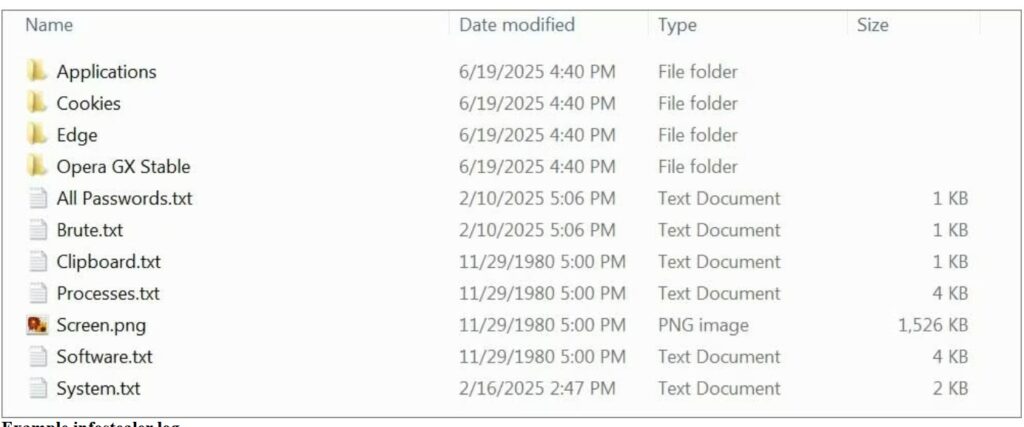
An infostealer log is generally an archive containing numerous text files and other stolen data.

Fig1:

(Image courtesy: Bleeping computers)

A devastating data breach is a nightmare for customers and affected organizations, but breaches can have a positive side also. Each incident is a learning opportunity. It’s easier to defend critical data when we understand the mistakes made by others and the tactics used by attackers.

How to be secure & keep your Data safe

If users are in midst of data breach or may find that their data is not safe as an infostealer might be there in your systems or devices then scan your device with an antivirus program. Once done then change password or your newly entered credentials could be stolen again. The system is clean so password hygiene can be maintained time to time.

At times even unique passwords won’t help you stay protected if you are hacked, fall for a phishing attack, or install malware. Its better not to change all credentials in one go instead having a cyber security hygiene in routine is better as an option.

Intru360

For organizations to stop and detect any intrusion by attackers prefer to have Intru360 in your list of cyber security go to products from Intruceptlabs.

Intru360 gives security analysts and SOC managers a clear view across the organization, helping them fully understand the extent and context of an attack. It also simplifies workflows by automatically handling alerts, allowing for faster detection of both known and unknown threats.

Globally every year cyberattacks are growing and mutating each month. Organizations have their Intelligent intrusion network detection systems in place analyze and detect anomalous traffic to face these threats.

Do visit our website for more information.

Source: https://www-bleepingcomputer-com.cdn.ampproject.org/c/s/www.bleepingcomputer.com/news/security/no-the-16-billion-credentials-leak-is-not-a-new-data-breach/amp/

Scroll to top